
Law firm car rental is a transport arrangement for legal teams that matches vehicles, driving arrangements and rental duration to court appearances, client meetings and other business travel. Legal teams need to plan around fixed arrival times, confidential documents and changing schedules—not simply the distance between offices.
- Car rental for law firms should match required arrival times, passenger numbers and the full itinerary.
- VPI Cars offers with-driver, self-drive and corporate car rental for Metro Manila and out-of-town Luzon travel.
- Choose with-driver travel when lawyers should not also handle driving and parking.
- Request a written quotation covering waiting, route changes and recurring travel before approving a booking.
Why car rental matters for law firms
A legal team's transport brief needs more detail than a destination. A court appearance has a required arrival time; a client meeting has a separate location; documents and luggage take space beyond the passenger count. Treat these as booking requirements, not details to settle after departure.
VPI Cars is best for legal teams seeking with-driver, self-drive and corporate rental options for Metro Manila and Luzon travel. Choose the arrangement by the work your team needs to complete, rather than by vehicle appearance alone.
For your 2026 travel plan, separate occasional bookings from recurring requirements. An isolated client visit and a repeated office-to-site journey need different booking briefs, approval arrangements and rental-duration discussions.
This guide focuses on preparing that brief and comparing arrangements. It does not replace the written quotation or rental agreement for your particular journey.
How to plan transport for your legal team
Define the trip before choosing a vehicle
Start with a shared document or spreadsheet. Record who is travelling, where they must arrive and what they are carrying before discussing vehicle categories. This gives your administrator a usable brief without requiring dedicated booking software.
List every stop in sequence, including the return journey. For example, an office departure, court appearance and client meeting should appear as separate stops—not as a single destination with the remaining travel assumed.
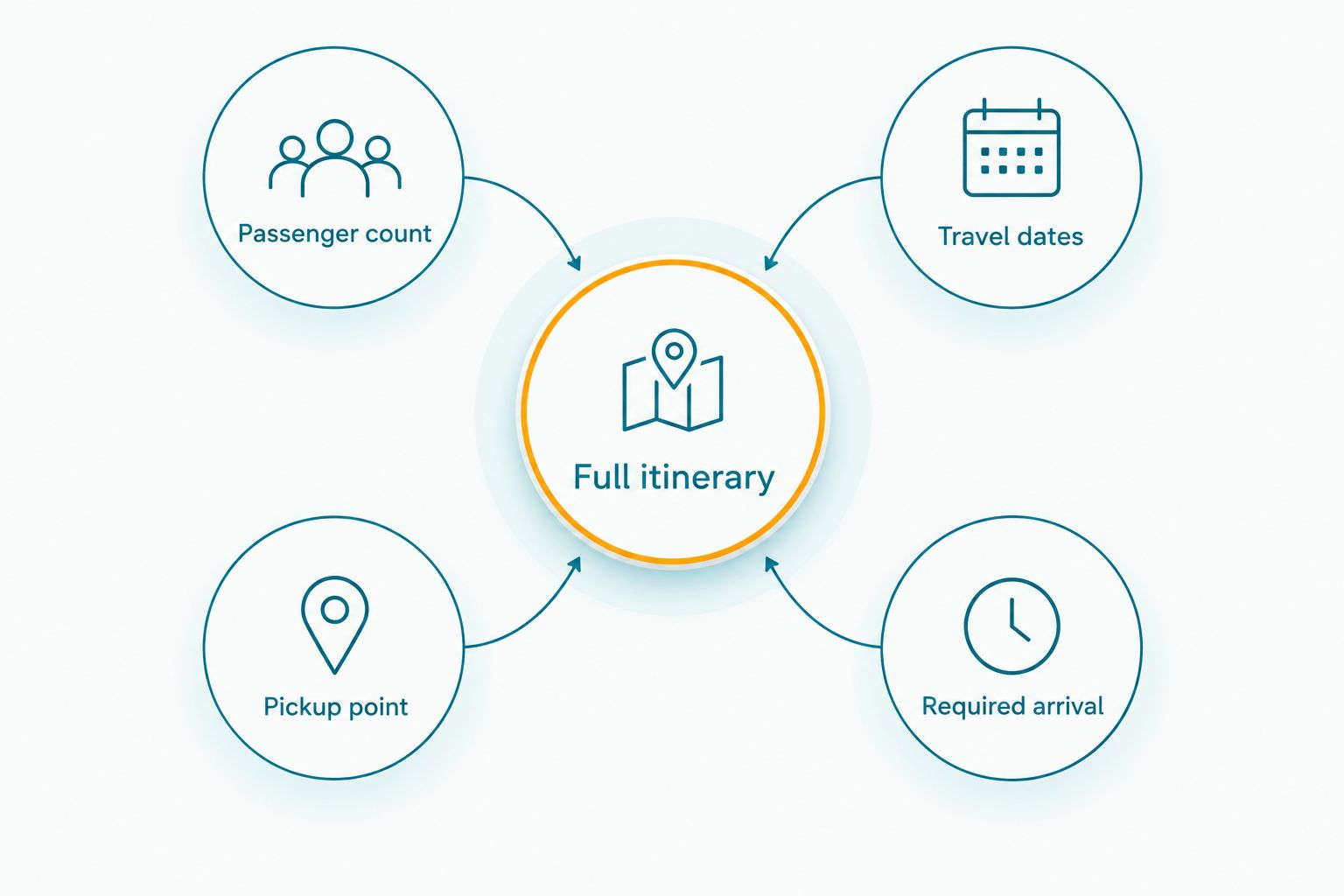
Record these 5 booking details for every request:
- Passenger count: include everyone travelling on each leg.
- Travel dates: distinguish the outbound date from the return date.
- Pickup point: specify the building and meeting location.
- Required arrival: record when passengers must be at the destination.
- Full itinerary: include intermediate stops and the final drop-off.
Separate arrival deadlines from departure times
Use a map and the destination's official visitor instructions to prepare the route manually. Work backwards from the time your team needs to be inside the building, not merely outside its entrance. Court access, security screening and walking from the drop-off point belong in the plan.
Ask the receiving office about access where necessary. A map pin does not establish which gate accepts visitors or whether a vehicle can wait nearby.
For a 2026 hearing or meeting, reconfirm the destination and instructions against the current notice. Do not treat an estimated driving time as an arrival guarantee.
- Record the required arrival separately from the hearing or meeting time.
- Confirm the correct building, entrance and visitor procedure.
- Discuss departure timing against the complete itinerary.
- Identify a meeting point if the vehicle cannot wait at the entrance.
- Keep the booking contact informed when the destination changes.
Choose who should handle the driving
Compare the practical workload first. With self-drive, your authorised driver handles the road, parking and vehicle responsibilities under the rental agreement. With-driver travel removes those driving tasks from the legal team, but you still need clear pickup and waiting instructions.
VPI Cars offers both arrangements, alongside corporate/long-term rentals. With-driver travel is the practical starting point when your lawyers should not also be responsible for driving between appointments. Self-drive suits a trip where an eligible team member wants that responsibility and understands the agreement.
For city-based appointments, the considerations in chauffeured cars for business travellers in Makati help frame vehicle and journey discussions. A driver does not make a vehicle a confidential meeting room.
- Identify the person responsible for driving before requesting a quote.
- Check driver eligibility and required documents for self-drive.
- Describe waiting periods and return pickups for with-driver travel.
- Confirm passenger and document-storage requirements.
- Ask how itinerary changes must be communicated.
Match the rental duration to the work
Review your team's existing calendar before discussing a longer arrangement. Group confirmed journeys by date and destination, then distinguish recurring travel from temporary demand. A busy week does not by itself establish a continuing vehicle requirement.
For your 2026 planning sheet, compare 2 schedules: confirmed trips and tentative trips. Keep them separate so that an unconfirmed hearing, meeting or site visit does not silently become part of a firm commitment.
Corporate/long-term rental is an option to discuss when the requirement extends beyond isolated journeys. Confirm the actual duration, permitted use and booking terms rather than assuming that a longer rental includes unrestricted travel.
- Separate occasional bookings from repeated journeys.
- Mark each trip as confirmed or tentative.
- Record periods when no vehicle is required.
- Identify Metro Manila and provincial Luzon destinations.
- Request terms for the duration your firm actually needs.
Compare quotations using the same brief
Send each provider the same itinerary, passenger count and duration. Otherwise, you are comparing different services rather than different quotations. A quote for a direct transfer does not answer a request that also requires intermediate stops and waiting.
Use a simple comparison sheet and ask for written clarification where an item is unclear. Do not assume that fuel, tolls, parking, extended use or driver-related arrangements are treated identically across bookings.
For a 2026 procurement review, record the quote's stated validity and the person authorised to approve it. An agreed scope is more useful than an attractive headline figure without clear inclusions.
- Identify the quoted route and rental period.
- Ask which journey-related expenses are included or separate.
- Clarify waiting, additional stops and changes to the return schedule.
- Check deposit, cancellation and extension terms in writing.
- Confirm the agreement and document requirements before approval.
Assign ownership of changes and communications
Use your existing calendar and messaging tools to distribute the approved transport plan. Nominate 1 booking coordinator to collect changes and communicate the final instructions. Other passengers should know whom to contact rather than sending conflicting directions independently.
Separate transport information from case information. The booking coordinator needs names, pickup details and timing; the driver does not need a case summary to complete the journey. Avoid putting sensitive client details into general transport messages.
International visitors also need a working way to receive pickup updates. Arranging an eSIM for the Philippines addresses the connectivity part of that plan; check device compatibility and mobile coverage separately. Save the itinerary and essential contact details offline as well.
- Name the coordinator and an internal backup contact.
- Share the agreed pickup point and passenger list.
- Keep case documents out of general booking messages.
- Confirm how passengers will receive schedule changes.
- Save essential journey details for offline access.
Compare transport options for legal teams
Choose by responsibility, trip pattern and coordination needs—not by a vehicle category alone. These options answer different requirements. None removes the need to confirm the route, rental agreement and passenger arrangements.
| Option | Best for | Main advantage | Key limitation or booking consideration |
|---|---|---|---|
| Car rental with driver | Lawyers attending appointments without taking on driving duties | Keeps driving and parking tasks separate from legal work | Waiting, return pickups and itinerary changes need clear agreement |
| Self-drive rental | Teams with an eligible driver who wants control of the driving | Lets the team handle departure and driving decisions directly | The renter must manage driver eligibility, parking and vehicle responsibilities |
| Corporate/long-term rental | Firms with an extended or recurring vehicle requirement | Provides an arrangement to discuss around a continuing business need | Duration, permitted use and responsibilities must be checked against actual demand |
| Separate point-to-point bookings | Isolated journeys without a continuing vehicle requirement | Avoids planning a retained vehicle where none is needed | Each leg requires its own pickup coordination and booking confirmation |
VPI Cars supports the first three rental arrangements, including out-of-town Luzon travel. The relevant consideration for a provincial journey is the individual itinerary, dates and vehicle requirement—not a blanket assumption that a Metro Manila-based provider only handles city travel.
When requesting a quotation, describe the return plan explicitly. A same-day return, a later collection and a multi-day itinerary are different requirements, even when they share the same outbound destination.
Request a quotation for your legal team
Prepare your passenger count, itinerary and rental duration for a clear booking discussion.
Common mistakes law firms make
Booking around the hearing time alone
The scheduled appearance is not the transport arrival target. Identify when the team needs to reach the building, then account for visitor access and the walk from the drop-off point. Keep those instructions visible in the booking brief.
Treating the vehicle as a confidential meeting room
A vehicle with a driver is a shared space, not a private office. Keep sensitive calls and case discussions for an appropriate setting, secure documents during travel and check the cabin before leaving. Do not assume transport staff are covered by your firm's confidentiality arrangements.
Leaving the return journey undefined
An uncertain finish time still needs a plan. Ask how to communicate the return pickup, what waiting arrangement applies and what happens if the schedule changes. Do not describe a journey as a simple transfer when the team expects the vehicle to remain assigned.
Choosing only by passenger seats
Passenger count is only part of the requirement. Include luggage, document bags and any accessibility needs in the enquiry, then ask the provider to confirm a suitable vehicle configuration. Do not infer usable storage space from a vehicle category name.
Assuming repeat bookings have unchanged terms
A previous journey is a starting reference, not confirmation of a new booking. Recheck the dates, itinerary, passenger count and written terms. For recurring travel in 2026, keep the current approved brief separate from older versions so outdated instructions do not carry over.
FAQ
What’s the best car rental arrangement for lawyers attending several meetings?
With-driver rental is a practical starting point when lawyers should not also handle driving and parking between appointments. Provide the full sequence of stops and confirm waiting and return-pickup arrangements before approving the booking.
Can a law firm arrange rental travel outside Metro Manila?
Yes, VPI Cars supports out-of-town and provincial travel within Luzon as well as Metro Manila journeys. Submit the destinations, dates, passenger count and return plan so the individual itinerary and vehicle requirements can be confirmed.
Is self-drive better than car rental with a driver for legal teams?
Self-drive fits a team with an eligible driver who wants responsibility for the driving; with-driver travel fits a team that wants those tasks handled separately. Compare the workload, itinerary and rental agreement rather than assuming either arrangement suits every trip.
What should our administrator send when requesting a quotation?
Send the travel dates, passenger count, pickup point, required arrival time, complete itinerary and expected rental duration. Include waiting periods, luggage or document-storage needs, and the return journey so the quotation addresses the actual trip.
Should a law firm choose corporate or long-term rental?
Corporate or long-term rental is an option when a law firm has an extended or recurring vehicle requirement. Compare the proposed duration and responsibilities with confirmed travel demand before committing to an arrangement.
Can lawyers discuss confidential cases in a hired vehicle?
Do not treat a hired vehicle as a confidential meeting room. Keep sensitive discussions for an appropriate setting and share only the transport information needed to carry out the journey.
How should a legal team handle a hearing that finishes late?
Agree on the process for schedule changes and return pickups before the journey starts. Confirm the applicable waiting or extension terms in writing rather than assuming the original booking covers an open-ended finish.
One last thing
Write the return instructions before approving the outbound journey. The destination is usually easy to identify; the uncertain finish time needs the clearer conversation. A booking brief that explains both gives your administrator fewer unresolved decisions on the day.
Related guides
- Rental vehicles for small business fleets in the Philippines
- Compact cars for Metro Manila traffic and parking
- Vans for corporate shuttle service in Metro Manila