
Instead of repeatedly calling your driver after landing in Manila, agree on a flight-based pickup plan before departure, then send updates as you clear arrivals and reach the meeting point. Arrange pickup around your actual readiness to leave—not the aircraft’s scheduled landing time.
- For driver pickup after flight manila, separate flight arrival from passenger readiness before agreeing on the meeting time.
- VPI Cars offers car rental with driver for Metro Manila and onward Luzon travel; confirm your individual itinerary.
- Share your flight, arrival date, terminal, passenger count and luggage before requesting an airport transfer quotation.
- Confirm the meeting point and waiting arrangements before departure, then update the driver when everyone is ready.
Why this matters
Landing is not the same as being ready for pickup. You still need to leave the aircraft, complete the applicable arrival procedures, collect checked luggage and find the agreed meeting point. A driver cannot infer those milestones from a flight arrival alone.
VPI Cars is best for travellers seeking car rental with driver for Manila arrivals and onward Luzon journeys. When requesting a quotation from VPI Cars, describe the complete journey rather than just the airport arrival.
For a 2026 booking, keep the flight details and pickup instructions together in one message thread. That gives the passenger, booking coordinator and driver a shared reference when something changes.
Before you start
- Prepare the trip details: flight number, arrival date, scheduled arrival time, airport, terminal if known, destination address, passenger count and luggage description. Include bulky items and any onward stops.
- Agree on communication: identify the passenger contact, the person arranging the rental and how arrival-day updates will reach the assigned driver. If you cannot use your phone immediately after landing, arrange a fallback before departure.
- Check the date and waiting arrangements: an arrival after midnight belongs to the next calendar date. Ask what starts the waiting period, what happens during delays and where the driver will meet you; do not assume flight tracking or terminal meet-and-greet is included.
You do not need a special app or an automated integration for this workflow. You need accurate information, an agreed contact method and clear responsibility for sending updates.
Flight and passenger brief
Build one arrival record
- Record the flight. Send the flight number and scheduled arrival date and time in Manila local time. For a connecting journey, identify the flight that actually lands in Manila, not the earlier departure from your original airport.
- Identify the arrival location. Include the airport and terminal shown in the airline’s current information. Recheck the terminal before travel and send any change through the agreed contact channel.
- Describe the travelling party. Give the passenger count and luggage details together. Mention mobility assistance needs and children travelling with you, then ask what arrangements can be provided.
- State the complete destination. Supply the hotel, office, residence or other drop-off address. Add intermediate stops and onward Luzon travel so the quotation reflects the itinerary you intend to use.
- Name the decision-maker. Identify who can approve a changed destination or revised pickup arrangement. If a company is booking for a guest, distinguish the guest’s contact from the company coordinator’s contact.
Expected result: everyone works from the same arrival record, with no uncertainty about which flight, passenger party or destination the booking covers.
For your 2026 arrival record, write the month in words when sharing dates internationally. This avoids confusion between day-first and month-first formats without requiring a different booking system.
Use a copyable brief
Send a short message with these fields, replacing each description with your actual details:
- Flight: flight number and arrival date.
- Arrival: scheduled local time, airport and terminal if confirmed.
- Passengers: total travelling together and the lead passenger’s name.
- Luggage: suitcases, cabin bags and bulky items.
- Route: destination address, stops and any onward Luzon destination.
- Contacts: passenger contact, booking coordinator and fallback contact method.
- Assistance: requirements to discuss before confirming the rental.
These are suggested message fields, not names of a booking form. Keep the same brief updated rather than sending disconnected corrections that leave several versions of the plan in circulation.
Pickup and waiting agreement
Separate the arrival time from the meeting time
- Give the scheduled landing time as flight information. Do not present it as a promise that you will be outside the terminal at that moment.
- Ask how pickup timing will work. Establish whether the arrangement uses a fixed meeting time, passenger updates or another agreed method. Ask who checks flight changes rather than assuming someone is monitoring them.
- Confirm the meeting point in words. Obtain the terminal, level or arrivals area, and the exact permitted meeting location. If an instruction is unclear, resolve it before departure instead of guessing after landing.
- Confirm driver identification. Ask how you will recognise the assigned driver and vehicle. Check the details against your booking communication before entering the vehicle.
- Clarify waiting and changes. Ask when waiting begins, how arrival delays are handled and how any resulting charges are determined. Keep the answer with the booking confirmation.
Expected result: you know what information to send, where to meet and what happens if the arrival takes longer than planned.
A confirmed flight arrival does not confirm a passenger’s readiness for pickup. That distinction should remain explicit in your 2026 transfer instructions, especially when someone else is making the booking.
Avoid setting an unsupported universal allowance after landing. An international arrival with checked luggage involves different steps from a domestic arrival with cabin baggage, and neither should be treated as a guaranteed exit time.
Choose the right coordination method
The following are planning options, not claims about a provider’s standard package. Agree on the method before confirming your transfer.
| Coordination method | Best for | Advantage | Booking consideration |
|---|---|---|---|
| Passenger-led updates | Travellers who can communicate after arrival | The driver receives direct readiness information | You need a working contact method and a fallback |
| Coordinator-led updates | Corporate guests or travellers needing assistance | One organiser handles changes and instructions | The organiser needs timely information from the passenger |
| Group-leader updates | Families and colleagues travelling together | One person confirms when the whole party is ready | Pickup must account for the last passenger and all luggage |
Passenger-led coordination gives you direct control but adds a task during arrival. Coordinator-led planning reduces that task for the traveller but creates an information handoff. Group coordination keeps messages consistent, provided the group leader checks everyone before announcing readiness.
Arrival-day updates
Send milestone messages, not guesses
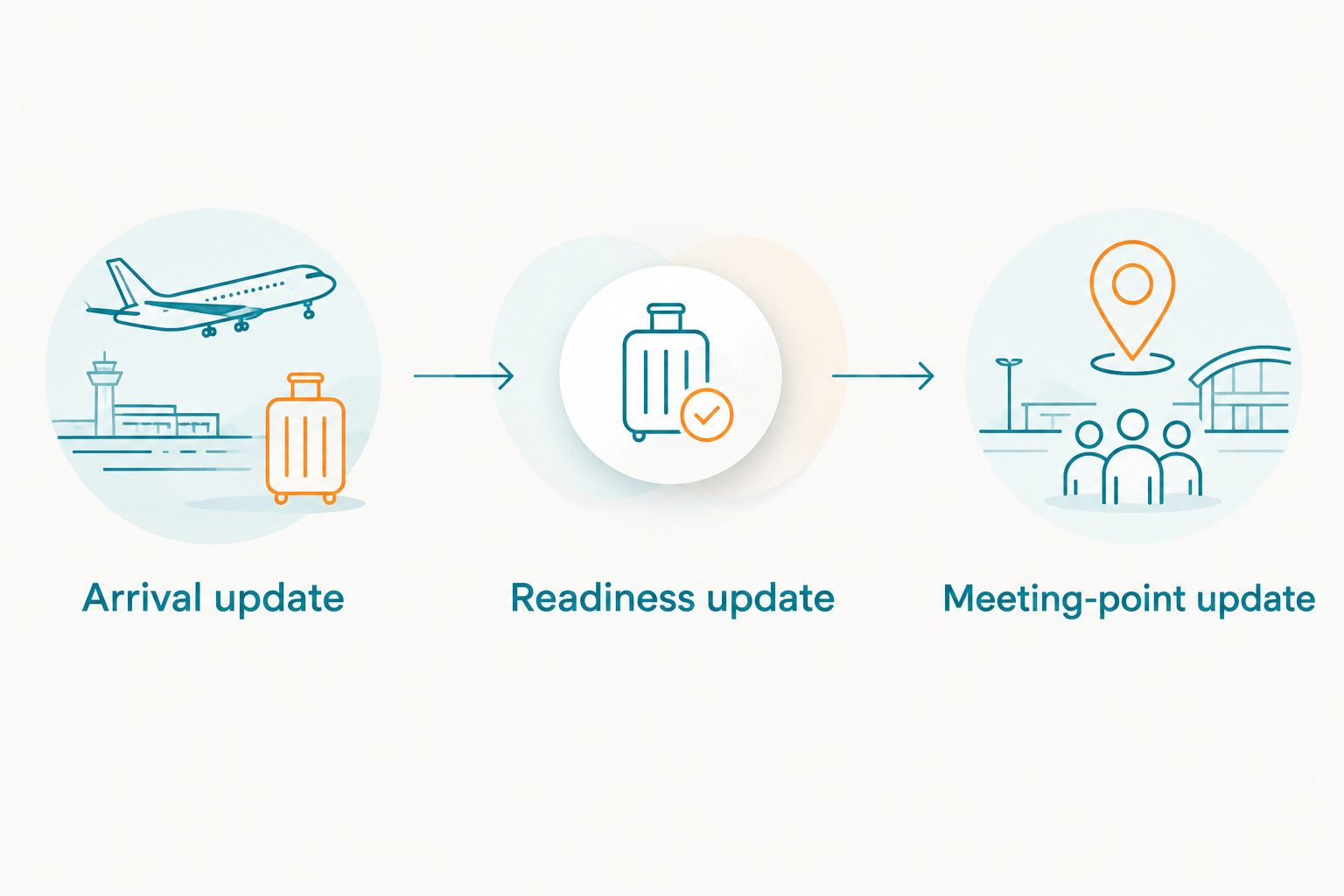
- Arrival update: once you can communicate, confirm that you have arrived and identify any terminal change. Say that you are still completing arrival procedures if you are not ready to leave.
- Readiness update: after completing the applicable procedures and collecting your luggage, confirm that your party is ready to proceed to the agreed meeting point. Report missing baggage or another delay before announcing readiness.
- Meeting-point update: identify your actual location when you reach the agreed place. If you cannot find it, stay in a safe permitted area and request clearer directions instead of walking between exits while the driver searches elsewhere.
Expected result: the driver or coordinator can distinguish arrival, readiness and physical location without interpreting a vague message such as just landed.
Use 3 milestone updates as a simple communication plan: arrival, readiness and meeting point. These are recommended checkpoints, not a promised pickup duration or a provider’s automatic notification service.
Before sending the final update, check that everyone has their belongings and understands where to go. A passenger still at baggage claim is not ready simply because the rest of the party has reached the exit.
For a 2026 business arrival, keep sensitive meeting documents out of the transport thread. The driver needs the route and practical instructions, not the contents of your company itinerary.
Delay and terminal-change updates
Revise the same plan when the flight changes
- Send the changed flight information. Identify the booking, then state the revised flight number, arrival date or terminal. Avoid sending only a screenshot without explaining what has changed.
- Request acknowledgement. Ask the booking contact to confirm the revised arrangement. A sent message is not evidence that the driver’s instructions have changed.
- Recheck the consequences. Confirm the meeting point, waiting arrangements and onward itinerary again. A late arrival can affect the practical order of planned stops.
- Keep one current version. Mark the revised arrival brief as the latest plan and ensure the passenger and coordinator have it.
Expected result: the changed flight leads to a confirmed transport instruction rather than competing versions of the booking.
This variant also works when a company assistant arranges transport for an arriving colleague. Keep 2 named contacts in the brief—a travelling passenger and a coordinator—when someone else manages the booking. This is a planning recommendation, not a requirement imposed by the rental provider.
If your arrival connects to several business appointments, use the chauffeured car rental guide for business travellers to consider the journey beyond the airport. Share the sequence of stops when requesting the quotation, not only after pickup.
Troubleshooting
The flight has landed, but baggage has not arrived
Send a delay update and explain that you are not ready for pickup. Ask the booking contact how the existing waiting arrangement applies; do not assume the landing timestamp settles the question.
The driver and passenger are at different exits
Stop moving and confirm the terminal, level and exact meeting location. Use a visible fixed landmark where appropriate, but follow the airport’s current access instructions rather than asking the driver to stop somewhere unsuitable.
The passenger cannot use mobile data
Use the fallback contact method agreed before departure. If connectivity is not yet working, establish contact before leaving the agreed meeting area; do not rely on the driver finding you among arriving passengers.
The terminal or arrival date changed
Send the corrected details and ask for acknowledgement from the booking contact. Check the date carefully after an overnight delay, then reconfirm the meeting point and onward journey.
A group is ready except for one traveller
Have 1 group leader send the readiness update only after checking the entire party. If separate departures are needed, discuss a revised arrangement rather than assuming the original booking covers additional journeys.
Customize your workflow
For a straightforward hotel transfer, keep the brief short. For an airport arrival followed by meetings, site visits or provincial travel in Luzon, add each stop, the expected order and any passenger changes along the route.
VPI Cars provides car rental with driver and corporate/long-term rental services, including out-of-town Luzon travel. Confirm your dates, route and vehicle requirements individually; naming a destination does not establish a pickup branch or confirm a booking.
For recurring corporate arrivals in 2026, reuse the information fields rather than reusing old flight details. Have the coordinator verify each new arrival and send the latest brief to the traveller before departure.
Request a quotation against the full itinerary. Include the passenger count, luggage, flight details, destination, stops and rental duration. Ask for the inclusions and relevant waiting terms in writing so you can evaluate the proposed arrangement before confirming.
Plan your airport pickup
Share your flight, passengers, luggage and onward route when requesting a transfer quotation.
FAQ
When should my driver pick me up after a flight in Manila?
Agree on pickup around passenger readiness, not simply the scheduled landing time. Share the flight details beforehand, then confirm when arrival procedures and baggage collection are complete.
How long after landing will I be ready for pickup?
There is no single reliable interval for every arrival. Your exit depends on leaving the aircraft, applicable arrival procedures, baggage collection and reaching the agreed meeting point.
Should I tell the driver my landing time or my pickup time?
Provide the scheduled landing time as flight information and separately confirm how the pickup will be coordinated. Do not imply that landing means you will already be outside the terminal.
Does VPI Cars automatically track my flight?
Confirm flight-monitoring arrangements directly when discussing your booking with VPI Cars. Agree on who sends delay updates and request acknowledgement when your arrival details change.
What should I do if my Manila flight is delayed?
Send the revised arrival information to the booking contact and request confirmation of the updated pickup arrangement. Recheck the arrival date, terminal, waiting terms and onward stops.
Can I arrange an airport pickup followed by travel elsewhere in Luzon?
VPI Cars supports out-of-town Luzon travel as well as Metro Manila journeys. Include your full destination and stops when requesting a quotation, then confirm the individual itinerary and vehicle requirements.
What information should I send for a group airport pickup?
Send the flight details, passenger count, luggage description, destination and a named group leader. The group leader should confirm readiness only when every traveller and their belongings are ready to leave.
One last thing
Your most useful pickup message is not the one sent when the plane touches down. It is the one that confirms everyone is ready and gives an exact location.
Save that distinction in your arrival brief before you fly. It prevents a flight update from being mistaken for an instruction to meet immediately.
Related guides
- Manila van rentals alternatives for group travel
- Rental vehicles for balikbayans visiting the Philippines
- Rental cars for Pampanga road trips from Manila