
Best overall: a midsize sedan for individual business travel. Best for a small team: an MPV. Best for a solo traveller packing light: a compact sedan. For chauffeured business travel in Makati in 2026, VPI Cars is best for travellers seeking a car-with-driver service rather than a self-drive rental; choose the vehicle around your passengers, luggage and meeting schedule.
- The best chauffeured car for business travelers Makati depends on passenger numbers, luggage and the itinerary.
- Choose a midsize sedan for individual business travel; consider an MPV for colleagues travelling together.
- Consider an SUV for bulky luggage and a passenger van for a business delegation.
- Ask VPI Cars for a written car-with-driver quotation covering your route, schedule and vehicle requirements.
Why your vehicle choice matters
A business transfer is not just a ride between addresses. Your booking needs to account for bags, building entrances, pickup instructions and what happens between meetings. Choosing by appearance alone leaves those practical questions unanswered.
For a Makati business trip in 2026, start with the itinerary rather than a preferred badge. A solo airport arrival and a delegation visiting several offices have different requirements, even when both bookings use a driver. Choose the smallest suitable vehicle that accommodates everyone and their luggage without compromising seating.
The rankings below compare vehicle categories, not particular models. Confirm the exact vehicle and its configuration before accepting a quotation.
What makes the best chauffeured car for business travel?
Use these criteria to assess a proposed vehicle before you book:
- Passenger fit: Count everyone travelling, excluding the driver. Check usable passenger seating rather than relying on a vehicle category alone.
- Luggage fit: Describe suitcases, laptop bags, presentation materials and unusual items. Passenger capacity does not establish luggage capacity.
- Itinerary fit: Specify airport transfers, meetings, waiting periods and the final drop-off. A point-to-point journey differs from a day with several stops.
- Pickup practicality: Give the hotel entrance, office building or agreed meeting point. Include any instructions supplied by the property.
- Booking clarity: Request the vehicle description, service scope, inclusions, exclusions and arrangements for schedule changes in writing.
A polished vehicle is not a substitute for a clear booking. In 2026, the right chauffeured-car choice is still the one that fits the actual journey—not the one with the most impressive category name.
Chauffeured vehicle options at a glance
| Rank and vehicle category | Best for | Standout benefit | Key limitation |
|---|---|---|---|
| 1. Midsize sedan | Individual business travel | Conventional passenger cabin with a separate boot | Luggage must fit without occupying passenger seats |
| 2. MPV | A small team travelling together | Passenger-focused cabin with flexible seating arrangements | Using additional seats can reduce luggage space |
| 3. SUV | Travellers carrying bulky luggage | Rear cargo area worth assessing for awkward items | Category name does not establish cargo capacity |
| 4. Passenger van | Business delegations | Group-oriented passenger layout | Seats and luggage space must be assessed together |
| 5. Compact sedan | A solo traveller packing light | Straightforward fit for a simple passenger-and-bag brief | Less flexibility when passengers or bags are added |
These are booking categories, not assurances about a particular fleet. Your decision should follow the confirmed vehicle description and seating layout.
1. Midsize sedan: best for individual business travel
A midsize sedan is the default starting point for an individual attending meetings in Makati. It separates the passenger cabin from the boot, so your luggage can remain out of the seating area when it fits properly. Request the proposed model before deciding whether the cabin and boot meet your needs.
For example, a brief covering 1 passenger and 1 suitcase gives the rental company a clearer starting point than simply asking for an executive car. Add the suitcase size and any hand luggage. Those details matter more than a broad label.
Midsize sedan pros:
- Suits a straightforward individual-travel brief.
- Keeps luggage separate from passengers when the boot accommodates it.
- Provides a clear starting point for comparing vehicle proposals.
Midsize sedan cons:
- A separate boot limits how awkwardly shaped items can be loaded.
- Adding colleagues or large bags can change the suitability of the booking.
Best for: An individual traveller with ordinary luggage and a defined meeting itinerary.
Verdict: Buy—book a midsize sedan when the confirmed cabin and boot meet your requirements.
2. MPV: best for a small team travelling together
An MPV is worth considering when colleagues need to share a vehicle between meetings. Its passenger-focused layout gives you a different seating arrangement from a sedan, but the exact configuration determines how much room remains for bags.
Do not treat every seat as usable without considering luggage. Ask the provider to assess the passenger list and bags together, particularly if the same booking includes an airport pickup. An MPV that suits an office-to-office journey needs a separate check for a luggage-heavy arrival.
MPV pros:
- Offers a passenger-oriented layout for colleagues travelling together.
- Allows the team to follow one agreed pickup and drop-off schedule.
- Provides an alternative when a sedan does not fit the passenger brief.
MPV cons:
- Occupied rear seats can leave less space for luggage.
- Entry access and seating arrangements vary by vehicle.
Best for: A small team with shared destinations and a confirmed passenger-and-luggage fit.
Verdict: Buy—book an MPV for a shared itinerary after checking the occupied-seat layout.
3. SUV: best for travellers carrying bulky luggage
An SUV deserves consideration when your luggage includes bulky or awkward items. Assess the proposed vehicle’s rear cargo area rather than assuming that an SUV automatically offers more useful space than every sedan or MPV.
Describe equipment cases, display materials or oversized bags before requesting a quotation. Ask whether those items fit with every required passenger seat in use. Folding a seat is not a solution if a colleague needs to occupy it.
SUV pros:
- Provides a rear cargo area to assess for bulky items.
- Offers another configuration when a sedan’s boot is unsuitable.
- Lets you evaluate passengers and unusual luggage in one vehicle proposal.
SUV cons:
- Useful cargo space varies substantially between vehicles.
- Higher entry height deserves attention for passengers with mobility needs.
Best for: Travellers whose bulky luggage makes the cargo layout a deciding factor.
Verdict: Hold—choose the SUV only after confirming that its cargo area solves your specific packing problem.
4. Passenger van: best for business delegations
A passenger van is the category to assess when a delegation needs to travel together. It makes the group’s seating layout the central booking question. Confirm the proposed arrangement instead of treating the word van as a complete specification.
For group planning, separate people from bags on your request. A delegation with hand luggage presents a different brief from the same delegation arriving with checked suitcases. Also establish whether everyone shares the same destination and departure time.
Passenger van pros:
- Offers a group-oriented passenger layout.
- Keeps a delegation on one shared transport schedule.
- Provides a starting point for assessing group seating needs.
Passenger van cons:
- Passenger seats do not establish space for everyone’s suitcases.
- A shared vehicle is less useful when delegates need different routes.
Best for: A business delegation with a common itinerary and a verified seating-and-luggage arrangement.
Verdict: Buy—book a passenger van for a shared group itinerary, not merely because it has more seats.
5. Compact sedan: best for a solo traveller packing light
A compact sedan is a practical category to assess for a solo traveller with limited luggage and straightforward transfers. It keeps the vehicle brief focused on what the journey actually requires. It is not automatically the right choice just because only one person is travelling.
Check the luggage fit and passenger comfort before confirming. If your plans include collecting a colleague, carrying equipment or adding an airport transfer, include those requirements from the start. A smaller initial brief should not conceal a larger eventual itinerary.
Compact sedan pros:
- Matches a simple solo-travel brief.
- Avoids selecting a larger category without a clear requirement.
- Provides a useful comparison against a midsize sedan proposal.
Compact sedan cons:
- Extra bags or passengers can change the booking requirements.
- Cabin and boot suitability still depend on the exact vehicle.
Best for: A solo traveller with light luggage and no planned additions to the passenger list.
Verdict: Buy—book a compact sedan when the confirmed fit is sufficient; otherwise choose a midsize sedan.
How these vehicle categories are ranked
The ranking prioritises passenger fit, luggage fit and itinerary fit. A midsize sedan comes first because it is the starting recommendation for individual business travel; each subsequent category addresses a different requirement rather than representing a lower-quality choice.
No category wins every trip. The best vehicle is the one whose confirmed configuration matches your booking brief. Compare written proposals against the same requirements, not against category names alone.
How to request the right chauffeured-car quotation
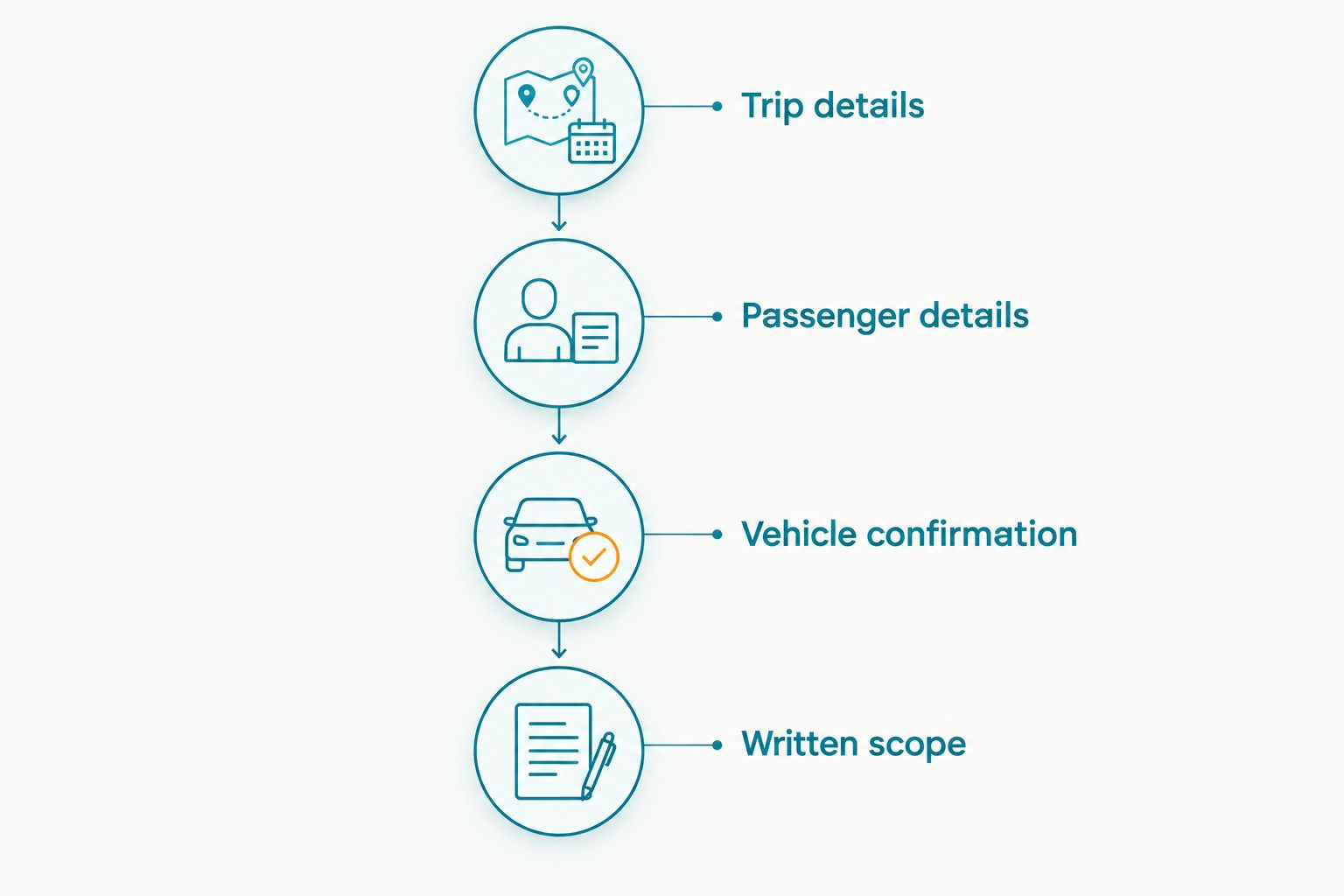
Before requesting a 2026 booking, prepare the information below. VPI Cars offers car rental with driver, self-drive and corporate/long-term rentals; specifying that you need a chauffeured service keeps the inquiry aligned with this trip.
Trip details
List the travel date, pickup time, starting address, stops and final destination. For an airport pickup, include your flight details and identify which parts of the onward itinerary are already fixed.
A day with 3 meeting stops should be described as such, not as a single transfer to Makati. State whether you need the vehicle between appointments or only for separate journeys. Ask how the proposed service handles that distinction.
Passenger details
Give the passenger total, luggage list and any access requirements. For example, 2 passengers with 2 suitcases is a useful planning brief, not a claim that every sedan accommodates those bags. Include dimensions for unusual items.
Vehicle confirmation
Ask for the proposed vehicle description and seating configuration. Request confirmation that the luggage fits with the required seats occupied. If a particular feature matters to your trip, ask about it explicitly rather than assuming it comes with the category.
Written scope
Request an itemised quotation and check what the service covers. Ask how waiting time, additional stops, route changes, parking and tolls are handled, without assuming any item is included or excluded.
For the questions to ask when assessing a proposal, read how much a car rental with driver costs in Manila. Compare the stated scope as carefully as the vehicle.
For recurring business travel, tell VPI Cars that the inquiry concerns repeated journeys rather than a one-off transfer. That gives the company the context to discuss its corporate/long-term rental service with you.
Request your business travel quotation
Share your Makati itinerary, passenger count and luggage requirements for a car-with-driver inquiry.
Which chauffeured car should you choose?
Choose a midsize sedan as the default for individual business travel in Makati in 2026. Move to an MPV for a shared team itinerary, assess an SUV for bulky luggage, or consider a passenger van for a delegation. Choose a compact sedan when a solo, light-luggage brief makes it sufficient.
For VPI Cars chauffeured car rental, send the itinerary before requesting a particular vehicle category. A complete brief makes the conversation about suitability, service scope and your actual transport needs.
FAQ
What’s the best chauffeured car for business travelers in Makati?
A midsize sedan is the default recommendation for individual business travel in Makati. Choose a different category when the passenger count, luggage or itinerary requires it, and confirm the exact vehicle before booking.
Is an MPV better than a sedan for business meetings?
An MPV is the better category to assess when colleagues need to travel together and a sedan does not fit the passenger brief. Confirm luggage space with the required seats occupied, especially for airport journeys.
Should I book an SUV for an airport transfer to Makati?
Consider an SUV when bulky luggage makes its cargo layout useful. The SUV label alone does not establish capacity, so ask whether your specific bags fit alongside every passenger.
What’s the best chauffeured vehicle for a business delegation?
A passenger van is the category to assess for a delegation sharing one itinerary. Confirm both the seating arrangement and luggage space, and check that delegates need the same route and schedule.
How do I compare chauffeured-car quotations?
Compare quotations against the same itinerary, passenger list and luggage requirements. Check the proposed vehicle, service scope and treatment of waiting time, additional stops, parking and tolls in writing.
What should I send when requesting a car with driver?
Send your travel date, pickup time, addresses, planned stops, passenger count and luggage details. Add flight information for airport pickups and identify any access requirements or expected schedule changes.
Does VPI Cars offer transport for recurring business travel?
VPI Cars offers corporate/long-term car rental services alongside car rental with driver and self-drive rentals. Describe your recurring routes and scheduling needs when requesting a quotation.
One last thing
Write the luggage list before choosing the vehicle. Passenger seating is only half the booking: a vehicle that accommodates everyone must also carry the bags without taking away seats you need. Confirm both together before accepting the quotation.
Related guides
- Best vans ranked by seating capacity for Manila group trips
- Best SUVs for Philippine road trips
- Best vans for family road trips around the Philippines