
Best overall for paved Philippine road trips: Honda CR-V. Best for routes with uneven surfaces: Toyota Fortuner; best for families needing a third row: Ford Everest; best for smaller groups that do not need a third row: Toyota RAV4. This 2026 guide helps you choose an SUV by road conditions, passenger needs and luggage—not by badge alone.
- For the best SUV for road trip Philippines shortlist, choose Honda CR-V for paved-route comfort.
- Toyota Fortuner suits uneven-road itineraries; confirm that the rental agreement permits your planned route.
- Ford Everest suits families needing a third row, but luggage space needs a separate check.
- Toyota RAV4 suits smaller groups that do not need third-row seating.
- VPI Cars offers self-drive and chauffeured car rental services; request a quotation matched to your itinerary.
Why this matters
An SUV that fits your passengers does not automatically fit their luggage. A vehicle suited to an expressway journey is also not automatically the right choice for an itinerary involving narrow access roads or damaged pavement.
VPI Cars is best for travelers comparing self-drive and chauffeured car rental for a Philippine road trip. Start with VPI Cars and request a quotation that identifies the vehicle, rental arrangement and permitted itinerary. Treat the models below as a shortlist, not as confirmation of a particular rental fleet.
For your 2026 trip, choose the vehicle around the hardest part of the journey: the most demanding road, the fullest passenger load or the longest stretch behind the wheel. That gives you a useful decision rule before you compare quotations.
What makes the best SUV for a Philippine road trip?
Use these criteria before choosing a model:
- Road suitability: Match the vehicle to paved highways, uneven provincial roads and the actual access road at your destination. An SUV badge does not establish off-road capability.
- Passenger comfort: Check entry and exit, seating position, rear-seat space and cooling where your passengers will sit.
- Luggage fit: Assess the boot with every occupied seat in its intended position. Folding a seat is not a solution if someone needs it.
- Driving workload: Consider vehicle size, visibility, parking and whether you want to drive or travel with a driver.
- Exact variant: Confirm the transmission, drivetrain and equipment on the quoted vehicle. Features differ across variants and model years.
- Rental terms: Check route permissions, authorized drivers, insurance conditions, return arrangements and assistance procedures before signing.
For example, plan a 3-day trip with 4 adults and 4 overnight bags around that actual load. Those are planning inputs, not a capacity claim for any model. Ask whether the quoted vehicle accommodates the complete group without using a passenger seat for luggage.
Best road-trip SUVs at a glance
This 2026 shortlist ranks vehicles by distinct uses rather than claiming that one SUV wins every journey. Honda CR-V and Toyota RAV4 use unibody construction; Toyota Fortuner and Ford Everest use body-on-frame construction. That distinction helps explain their different layouts and driving characteristics, but the exact vehicle still needs checking.
| SUV | Best for | Standout characteristic | Key limitation |
|---|---|---|---|
| Honda CR-V | Mainly paved, comfort-focused trips | Unibody crossover layout | Seating layout depends on the variant; do not assume a third row |
| Toyota Fortuner | Itineraries with uneven road surfaces | Body-on-frame SUV construction | An SUV configuration does not establish four-wheel drive or permission for off-road use |
| Ford Everest | Families needing third-row seating | Three-row SUV layout | Occupied rear seats reduce the space available for luggage |
| Toyota RAV4 | Smaller groups without a third-row requirement | Two-row crossover layout | Not the choice when your group needs a third row |
The default recommendation is Honda CR-V for an itinerary dominated by paved roads. Change that recommendation when passenger count, road conditions or luggage make another layout more suitable.
1. Honda CR-V: best SUV for paved-route comfort
Honda CR-V is a unibody crossover suited to trips where paved roads define the journey. Put Honda CR-V first on your shortlist when passenger comfort matters more than having a truck-based SUV layout.
For a 2026 itinerary built around expressways, city stops and paved provincial roads, assess the quoted Honda CR-V's seating configuration and luggage space first. Do not choose it simply because another CR-V you have seen had the equipment you wanted.
Honda CR-V pros:
- Unibody construction makes it a relevant alternative to body-on-frame SUVs for paved-road travel.
- Its crossover format fits a comfort-focused shortlist without requiring an off-road use case.
- Different configurations give you reasons to compare the exact vehicle rather than the model name alone.
Honda CR-V cons:
- Seating layouts vary; a third row cannot be assumed from the badge.
- Drivetrain, safety equipment and other features depend on the variant.
- A paved-road recommendation is not permission to use damaged tracks or prohibited routes.
Best for: Travelers whose itinerary is mainly paved and whose passengers and bags fit the confirmed seating layout.
Before committing, ask for the exact variant and a luggage-area photo with the seats positioned for your trip. If you need every passenger seat, judge the remaining boot space—not a photograph taken with the rear seats folded.
Verdict: Hold until the quoted Honda CR-V's seating and luggage layout are confirmed; then choose it as the paved-route default.
2. Toyota Fortuner: best SUV for uneven-road itineraries
Toyota Fortuner is a body-on-frame SUV with a three-row layout. It belongs on the shortlist when your route includes uneven surfaces and you want to assess a truck-based SUV rather than a crossover.
The important distinction is between an uneven public road and an off-road excursion. Toyota Fortuner does not remove the need to check road conditions, drivetrain or the rental agreement's route restrictions.
Toyota Fortuner pros:
- Body-on-frame construction gives you a different vehicle type to compare with Honda CR-V and Toyota RAV4.
- Third-row seating supports trips where an additional passenger row is necessary.
- Folding unused rear seating creates another luggage arrangement when the group does not need that row.
Toyota Fortuner cons:
- Not every Fortuner configuration has four-wheel drive.
- Occupying the third row leaves less luggage space than folding it.
- Body-on-frame construction does not guarantee the ride quality your passengers prefer; assess that separately.
Best for: Travelers with an uneven-road itinerary who have checked that the specific vehicle and rental terms suit the route.
Tell the rental provider about the final access road, not just the destination town. Describe whether it is paved, steep, narrow or unsealed. A route discussion is more useful than asking whether an SUV can go anywhere.
Verdict: Hold until route permission and the exact Toyota Fortuner configuration are confirmed; choose it for the uneven-road use case.
3. Ford Everest: best SUV for families needing a third row
Ford Everest is a body-on-frame SUV with three-row seating. Its role in this shortlist is a family trip where the third row is part of the passenger plan, rather than an occasional extra.
Start by checking who will sit in the rear row and how they will enter and exit. Then inspect luggage space with that row occupied; passenger capacity and luggage capacity must work together.
Ford Everest pros:
- Three-row seating supports a family layout that a two-row SUV cannot provide.
- Unused rear seats can be folded when luggage takes priority over additional seating.
- Its body-on-frame format offers another option for travelers comparing truck-based SUVs.
Ford Everest cons:
- Third-row use reduces the luggage area available behind the passengers.
- Driver-assistance and convenience equipment vary by variant.
- A larger vehicle requires attention to parking spaces and access roads at overnight stops.
Best for: Families who need a third row and have verified that their luggage fits with the required seats occupied.
Ask about child-seat arrangements if your group needs them. Confirm compatibility and who supplies the seat rather than assuming the rental includes one. A vehicle photograph also cannot establish whether a particular child restraint fits correctly.
Verdict: Hold until rear-row access and luggage fit are checked; choose Ford Everest when the third row is genuinely necessary.
4. Toyota RAV4: best SUV for smaller travel groups
Toyota RAV4 is a two-row unibody crossover. It is the clearest shortlist option here when your group does not need a third row and wants to assess a crossover rather than a truck-based SUV.
Keep Toyota RAV4 separate from the family-third-row decision. Its value in this guide is the simpler two-row layout, not an unsupported claim that it has the lowest rental cost or fuel use.
Toyota RAV4 pros:
- A two-row layout removes the need to trade third-row seating against luggage space.
- Unibody construction makes it a relevant paved-road alternative to Toyota Fortuner and Ford Everest.
- The layout suits groups whose passenger plan fits within two rows.
Toyota RAV4 cons:
- It does not provide a third row for a larger group.
- Large bags still require a fit check; two rows do not mean unlimited boot space.
- Powertrain and equipment depend on the specific vehicle offered.
Best for: Couples and smaller groups whose passenger and luggage needs fit a two-row crossover.
If luggage is your main concern, describe the bags rather than just the number of travelers. A suitcase, stroller and sports equipment place different demands on the boot, even when the passenger count stays unchanged.
Verdict: Hold until luggage fit is confirmed; choose Toyota RAV4 when a third row is unnecessary.
How the ranking works
The ranking uses road suitability, seating layout, luggage fit, driving workload and variant checks. It is a use-case guide, not a road-test score or a claim about rental inventory.
Honda CR-V takes the paved-route default position. Toyota Fortuner addresses uneven-road itineraries, Ford Everest addresses the third-row family requirement, and Toyota RAV4 addresses smaller groups. For a 2026 booking, the exact vehicle and agreement take priority over this model-level ranking.
Turn the shortlist into a rental decision
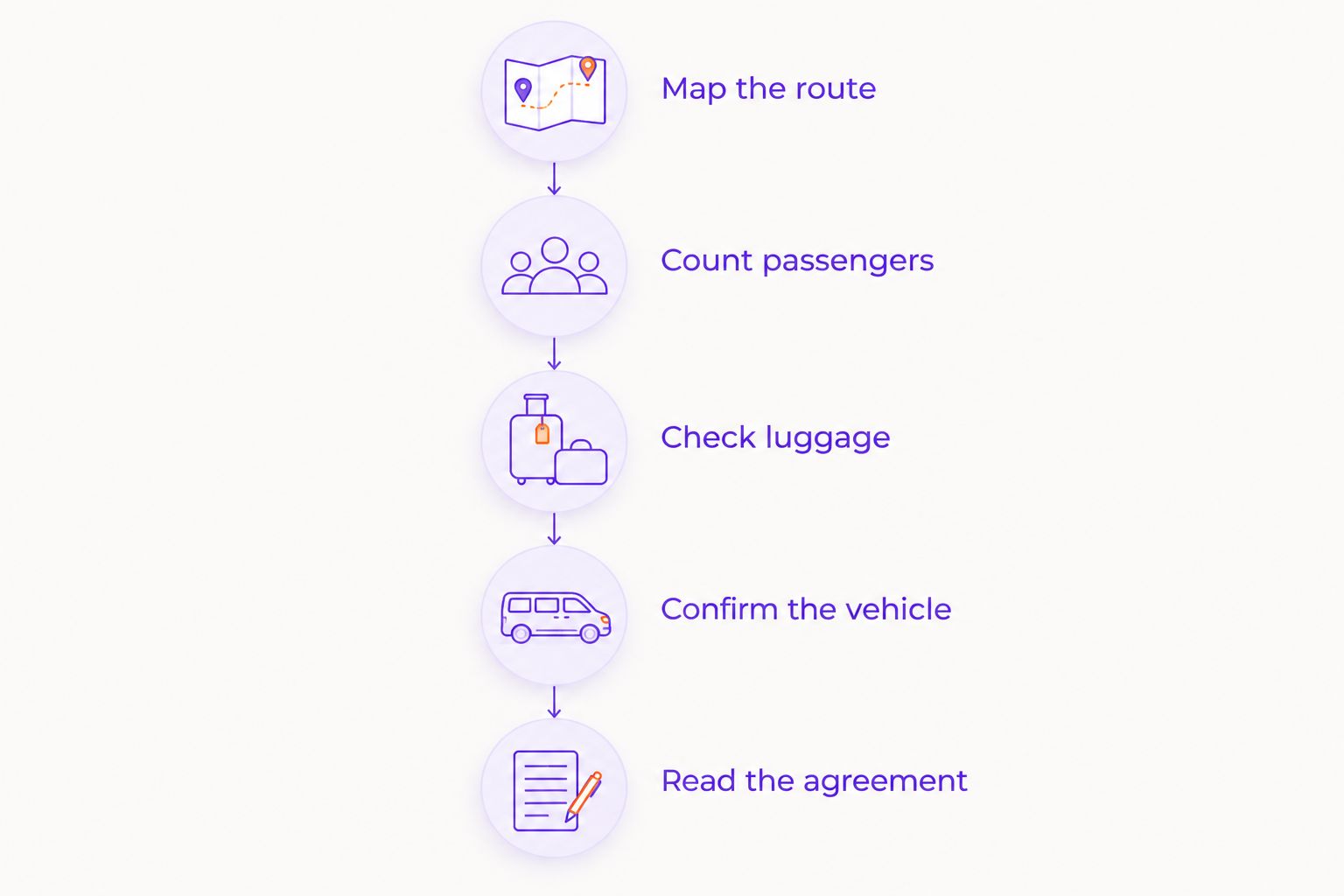
Follow this sequence before requesting a final quotation:
- Map the route. Include overnight stops and the final approach to each destination. Identify any unsealed or difficult sections.
- Count passengers. Include the driver when planning a self-drive trip, and clarify the seating arrangement for a chauffeured trip.
- Check luggage. List suitcases, backpacks, child equipment and bulky items. Ask about fit with every required seat occupied.
- Confirm the vehicle. Request the model, variant, transmission and relevant equipment for the vehicle being quoted.
- Read the agreement. Check permitted routes, authorized drivers, insurance conditions, assistance procedures and return requirements.
Complete these checks before treating a quotation as a match. A model name alone does not answer whether the vehicle fits your group or whether the agreement permits your itinerary.
Decide between self-drive and chauffeured travel
Choose self-drive when you want to handle the driving and accept the responsibilities stated in the agreement. Choose chauffeured travel when you want a driver to handle that part of the journey; confirm how the itinerary, waiting periods and overnight arrangements are covered.
For a 2026 chauffeured trip, use the guide to car rental with driver costs in Manila to frame your quotation questions. Ask for the applicable inclusions and exclusions rather than assuming every quotation covers the same services.
VPI Cars offers both self-drive and chauffeured car rental services. Send the passenger count, luggage description, dates and route together so the quotation request describes the actual trip.
Request a quotation for your trip
Share your route, passenger count, luggage needs and preferred driving arrangement.
Which SUV should you choose?
Choose Honda CR-V as the default for a mainly paved Philippine road trip. Choose Toyota Fortuner when uneven surfaces drive the decision, Ford Everest when your family needs a third row, and Toyota RAV4 when your smaller group does not.
Reject any option that fails the luggage check or the route-permission check. The best SUV for your 2026 trip is the specific vehicle that fits your passengers, carries their bags and is permitted on your itinerary—not simply the highest-ranked badge.
FAQ
What’s the best SUV for a road trip in the Philippines?
Honda CR-V is this guide’s default choice for a mainly paved Philippine road trip. Toyota Fortuner, Ford Everest and Toyota RAV4 address different road, seating and group requirements; confirm the exact rental vehicle before deciding.
Is Toyota Fortuner better than Honda CR-V for a road trip?
Toyota Fortuner is the shortlist choice for an uneven-road itinerary, while Honda CR-V is the paved-route default. Confirm the Fortuner’s drivetrain and route permissions rather than assuming every variant is suitable for off-road use.
Which SUV should I choose if my family needs a third row?
Ford Everest is this guide’s family-third-row recommendation. Check access, seating comfort and luggage space with the third row occupied before accepting the vehicle.
Is Toyota RAV4 suitable for a Philippine road trip?
Toyota RAV4 suits a smaller group that does not need third-row seating. Confirm that the quoted vehicle accommodates your passengers and bags; a two-row layout does not establish luggage capacity for every trip.
Do I need four-wheel drive for a Philippine road trip?
A Philippine road trip does not automatically require four-wheel drive; the route determines that requirement. Confirm difficult sections with the rental provider, and remember that drivetrain capability does not override rental restrictions.
Should I rent an SUV with a driver or drive it myself?
Choose self-drive if you want to handle driving responsibilities, or chauffeured travel if you want a driver to handle the journey. Confirm authorized-driver rules for self-drive and itinerary inclusions for chauffeured travel.
What should I send when requesting an SUV rental quotation?
Send your travel dates, route, passenger count, luggage description and preferred driving arrangement. Ask VPI Cars to identify the vehicle being quoted and clarify the applicable rental terms.
One last thing
Ask for a boot photo with the required passenger seats upright. A spacious-looking luggage area photographed with seats folded can answer the wrong question.
Send that photo request alongside your bag list. It is a practical way to catch a seating-versus-luggage mismatch before the trip.