
Technology company car rental is planned transport for technical teams, client-facing staff and visiting colleagues, with the aim of keeping site visits coordinated and project work on schedule. For Metro Manila and out-of-town Luzon trips, plan around site access, equipment, passenger numbers and the return journey—not just the destination.
- For corporate car rental for technology companies Manila teams need, define the itinerary before choosing a vehicle.
- VPI Cars offers with-driver, self-drive and corporate/long-term rentals for Metro Manila and Luzon travel.
- Choose with-driver transport when employees need to focus on meetings rather than driving and parking.
- Compare quotations against the same passenger count, equipment load, itinerary and rental duration.
Why this matters for technology companies
A technology site visit is not always a simple office transfer. Your team might need to bring demonstration equipment, meet a facilities contact, pass a security check and finish an installation before travelling to another location.
Plan transport around the work your team must complete, not just the addresses. A vehicle booking does not confirm building access, loading arrangements or permission to enter a restricted site. Those details need their own checks.
For your 2026 travel plan, separate occasional client visits from recurring deployment or support schedules. The right arrangement depends on how often your team travels and whether employees should drive. Review the available car rental services after defining those needs, rather than starting with a preferred vehicle.
Plan site-visit transport in seven steps
1. Define the purpose of each visit
Start with a shared spreadsheet or calendar. Record what your team needs to accomplish at each stop, who must attend and which appointments have fixed start times. You do not need a separate transport system to create a useful brief.
Distinguish a short client presentation from an installation with an uncertain finish. Both involve travelling to a site, but they create different requirements for waiting, equipment handling and the return journey.
For an illustrative brief, a team of 4 passengers visiting 2 sites in 1 day should identify whether everyone travels together throughout. If a specialist stays behind at the first site, the return plan needs to account for that person separately.
Record these details before requesting transport:
- Visit purpose: presentation, inspection, deployment or support work.
- Required attendees and the person coordinating each appointment.
- Fixed appointments versus flexible arrival windows.
- Expected completion time and the final drop-off point.
- Any staff movements that split from the main itinerary.
2. Confirm site access before setting pickup times
Contact the client or facility representative directly. A map pin identifies a location; it does not identify the correct entrance, visitor registration point or unloading area. Ask the host to confirm those details before you finalise the itinerary.
For a Metro Manila office visit, check whether the meeting address and vehicle entrance are different. For a provincial Luzon site, confirm the approach road and where passengers should meet their host. Describe access conditions to the rental provider instead of assuming a vehicle type will suit them.
Build your 2026 itinerary from confirmed appointment details, then assess travel time using current route information. Treat a route estimate as a planning input, not a promised arrival time.
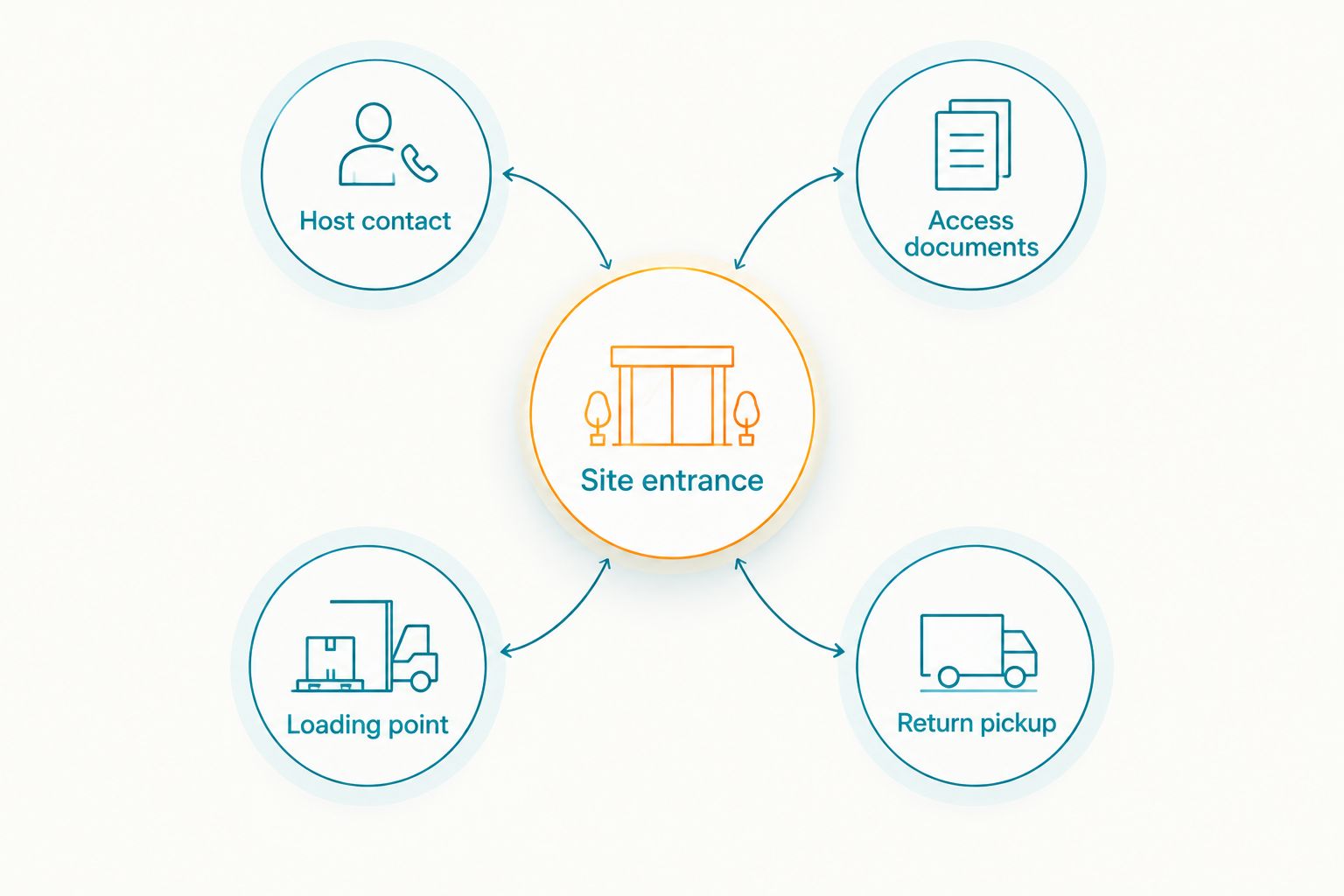
Check these items with each host:
- Site entrance: the gate or driveway the vehicle should use.
- Host contact: the person who can resolve arrival questions.
- Access documents: visitor and equipment requirements to confirm.
- Loading point: where the team can safely unload equipment.
- Return pickup: the meeting place after the visit.
3. Choose who will handle the driving
First, decide whether a staff member should drive at all. Self-drive puts driving, parking and vehicle handover responsibilities within your team. With-driver transport separates those tasks from the employees attending the visit.
VPI Cars is best for technology teams seeking with-driver or corporate car rental for Metro Manila and Luzon site visits. Its services also include self-drive rental, so your enquiry can start with the work schedule rather than a predetermined driving arrangement.
VPI Cars corporate car rental supports business transport planning, but a service category alone does not settle your booking details. Confirm the particular itinerary, dates, vehicle requirements and applicable terms in the quotation.
Use these decision points:
- Choose with-driver transport when staff need to concentrate on appointments.
- Consider self-drive when your company has a designated driver and accepts the driving responsibilities.
- Discuss corporate/long-term rental when site visits form a recurring requirement.
- Confirm how waiting and changes to the itinerary will be handled.
- Keep confidential calls and sensitive work off the travel agenda unless privacy is assured.
4. Match the vehicle request to people and equipment
Write down the actual load before selecting a vehicle category. Count passengers separately from the person driving, and include visiting colleagues who join partway through the day. Then list the equipment that must travel with them.
Laptop bags, demonstration cases and installation tools need space as well as seats. If you carry sensitive hardware, describe its handling needs and packaging to the provider. Do not assume ordinary passenger transport includes specialist equipment handling or cargo protection.
Send equipment dimensions when they affect fit. The aim is to confirm a suitable arrangement before departure, not discover at pickup that cases occupy passenger space.
Include these details in your request:
- Passenger count for every leg of the journey.
- Number and dimensions of bulky equipment cases.
- Separate personal luggage, especially for airport-linked visits.
- Any mobility or boarding requirements passengers have identified.
- Equipment loading needs to discuss with the provider.
5. Build a workable itinerary and return plan
Use a shared calendar to arrange stops in a practical sequence. Check appointment times against the route, then ask each host whether the proposed arrival works. Keep the itinerary readable enough for someone outside your project team to follow.
A Makati office meeting followed by a Laguna site visit is a supported type of Metro Manila-to-Luzon travel enquiry, not proof of a confirmed booking. Give the provider the actual addresses, dates and expected return arrangements for assessment.
For recurring 2026 deployments, distinguish the standard schedule from exceptions. A regular meeting pattern and an occasional late completion should not be presented as if they require identical transport arrangements.
Make the itinerary explicit:
- Starting pickup address and the employee coordinating departure.
- Ordered stops with appointment times and host contacts.
- Expected waiting periods at each location.
- Final drop-off address, including any separate staff returns.
- A named person authorised to request itinerary changes.
6. Compare quotations on the same scope
Create a single brief and use it for every quotation request. Comparing different passenger counts, durations or routes does not reveal which arrangement meets your needs. It leaves your team comparing unlike services.
Ask for the quotation to distinguish the agreed service from items requiring separate confirmation. Discuss fuel, tolls, parking, waiting, additional time and provincial travel arrangements where relevant; do not assume how any provider treats them.
For a 2026 procurement review, keep the latest itinerary beside the quotation. If a client adds another stop, have the revised scope confirmed before approving the booking.
Check these points before approval:
- Travel dates, service duration and complete route.
- Vehicle requirements and the agreed driving arrangement.
- What the quotation includes and excludes.
- How additional time or route changes are handled.
- Deposit, cancellation and other agreement terms to review.
- Documents your company needs and whether they can be provided.
7. Assign a coordinator and confirm the handover
Choose a person who owns the transport brief from request to return. That person should keep the approved itinerary, supplier correspondence and host contacts together. A shared document is enough if everyone knows which version is current.
Send your confirmed brief to VPI Cars when you are ready to request a quotation. Specify whether you need car rental with driver, self-drive or a recurring corporate arrangement, and include Metro Manila and provincial Luzon stops in the same request.
Before departure, make the final handover clear:
- Share the confirmed pickup instructions with all passengers.
- Identify the contact for transport questions on the travel day.
- Give the site host the team's expected arrival details.
- Confirm who can approve changes during the trip.
- Record unfinished work that requires another visit rather than assuming an extension.
Compare transport options for technology site visits
Choose the option that fits the assignment, not the one that looks simplest to book. With-driver and self-drive describe who handles driving; corporate/long-term rental describes an ongoing arrangement whose driving setup still needs confirmation.
The table compares service approaches, not specific vehicle models or contractual promises. Use it to narrow your enquiry before reviewing a quotation.
| Option | Best for | Main advantage | Key consideration |
|---|---|---|---|
| With-driver rental | Technical teams attending scheduled client visits | Employees can focus on the visit instead of driving and parking | Confirm waiting arrangements, service duration and the return itinerary |
| Self-drive rental | Teams with a designated driver and flexible movements | Your nominated driver handles the journey directly | Your team takes on driving, parking and handover responsibilities |
| Corporate/long-term rental | Recurring deployments, meetings and support visits | An ongoing rental arrangement can be discussed against recurring needs | Confirm the driving setup, duration, terms and change process |
| Separate bookings per journey | Independent visits with separately defined travel needs | Each journey can be arranged around its own brief | Someone must coordinate every leg and confirm the return journey |
A recurring assignment does not automatically require long-term rental. Equally, booking every journey separately is not automatically the right fit for a repeated schedule. Compare both approaches against your actual travel calendar.
Common mistakes technology companies make
Treating an installation finish time as certain
An expected completion time is not the same as a fixed meeting end. Tell the provider when work depends on testing, client acceptance or another contractor, then confirm how changes should be requested.
Counting seats but overlooking equipment
A passenger count does not describe the full load. List cases, tools and personal bags separately, and confirm fit before approving the vehicle arrangement.
Assuming the office address is the pickup point
A building's mailing address does not settle where a vehicle should wait. Ask the host about the correct entrance and departure meeting point, particularly when passengers will leave through a different gate.
Leaving the return journey unassigned
The outward trip is only part of the booking. State who returns, where they go and who handles arrangements if the team splits after the visit.
Approving a recurring booking from an old itinerary
Project locations and attendance can change. Before renewing a 2026 travel schedule, check the next set of visits rather than copying an earlier brief without review.
FAQ
What’s the best car rental arrangement for a technology team visiting client sites?
With-driver rental is best when the team needs to focus on site work rather than driving and parking. Self-drive suits teams with a designated driver, while corporate/long-term rental is an option for recurring requirements.
Can VPI Cars handle technology site visits outside Metro Manila?
VPI Cars supports out-of-town and provincial travel within Luzon as well as Metro Manila trips. Submit the individual itinerary, dates, passenger count and vehicle requirements for confirmation.
What should our company send when requesting a site-visit quotation?
Send the travel dates, passenger count, equipment details, pickup address, ordered stops and final drop-off point. State whether you want with-driver, self-drive or a recurring corporate arrangement.
Can our engineers bring equipment in a rental vehicle?
Describe the equipment and confirm a suitable vehicle arrangement before booking. Provide case dimensions and handling requirements, and do not assume passenger transport includes specialist cargo services.
Is corporate rental better than booking each site visit separately?
Corporate rental is an option to assess when site visits recur, while separate bookings let you scope each visit individually. Compare both against the same schedule, driving requirements and agreement terms.
What happens if the installation takes longer than expected?
Follow the change process agreed with the rental provider. Before booking, confirm who can request additional time and how any revised arrangements will be documented.
Does booking transport also arrange access to a client’s site?
Booking transport does not establish permission to enter a client’s premises. Your team should confirm visitor registration, equipment documentation, the entrance and the host contact directly with the site.
One last thing
Name the person who can authorise leaving a site. A driver or transport coordinator should not have to interpret whether an installation is complete, whether equipment can be left behind or whether another engineer still needs a ride.
Add that decision-maker to the travel brief. It turns an uncertain departure into a clear instruction without asking the transport provider to make a project decision.
Related guides
- Connecting a recurring meeting schedule to monthly chauffeur bookings
- Is corporate car rental cheaper than individual bookings?
- Planning a Luzon road trip: from itinerary to self-drive booking