
Best overall for routine city meetings: a compact sedan. Best for business travellers who need to work between appointments: a chauffeured car. Best for shared staff transport: a passenger van. This guide compares vehicle categories for small business fleets in Metro Manila and Luzon, with VPI Cars offering self-drive, with-driver and corporate/long-term rental services.
- For best rental vehicle small business fleet philippines searches, start with your Metro Manila passenger numbers and itinerary.
- Choose a compact sedan for small-team city appointments; choose a passenger van for shared staff transport.
- VPI Cars corporate car rental suits businesses evaluating self-drive, with-driver and long-term arrangements in Metro Manila and Luzon.
- Compare written rental terms, luggage space and driver requirements before choosing a vehicle category.
Why this matters
The best fleet vehicle is the one that fits the work you actually schedule. A vehicle chosen for an occasional group outing can be awkward for everyday appointments; a city car chosen for everyday appointments can be unsuitable when several employees travel with equipment.
For your 2026 fleet plan, separate routine journeys from exceptions. Identify who travels together, where they go and whether an employee should drive. That gives you a useful shortlist before you discuss a particular vehicle.
Start with the recurring journey, not the largest vehicle you might occasionally need. Add requirements for unusual trips separately instead of making every booking carry the same assumptions.
What makes the best rental vehicle for a small business fleet?
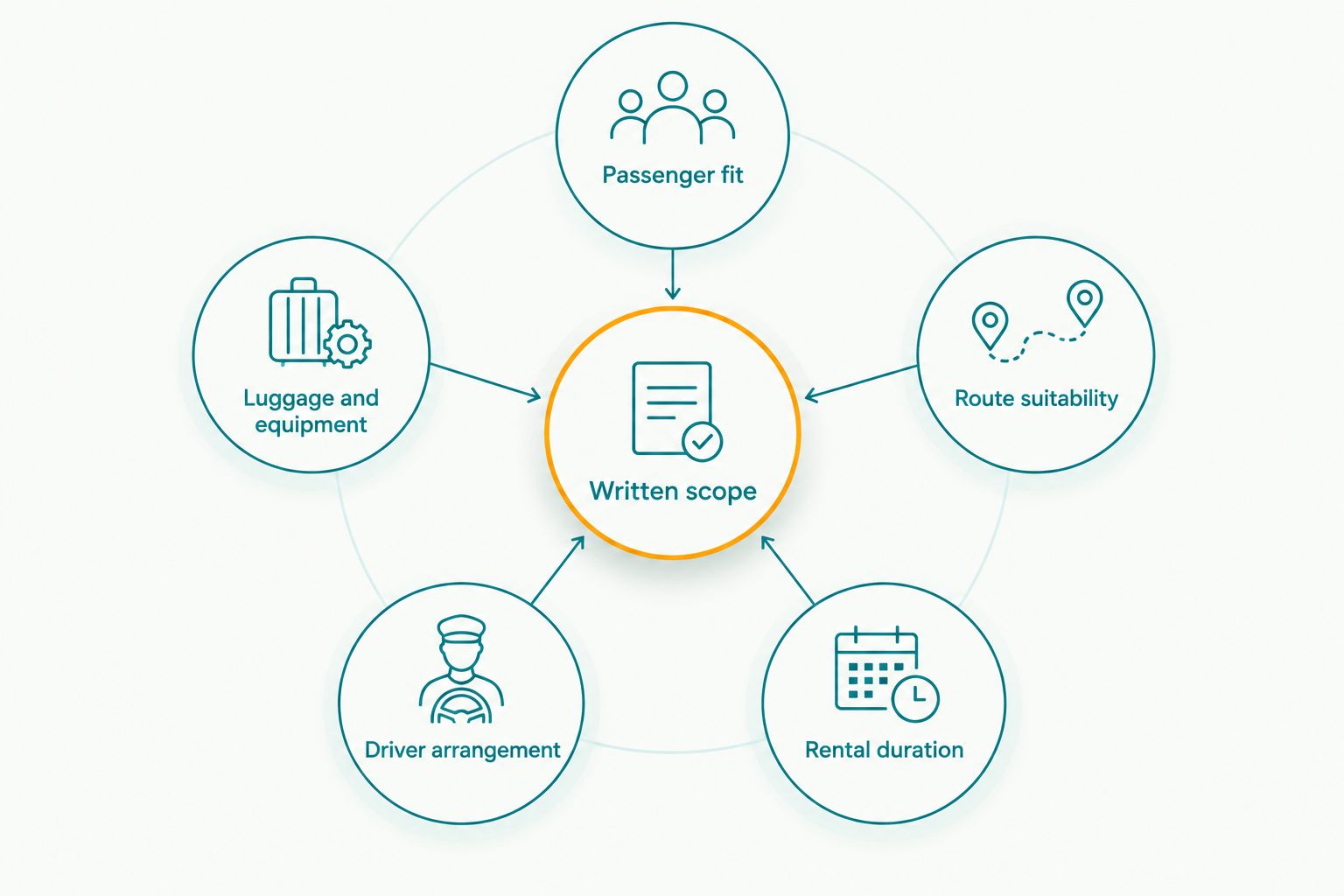
Use these criteria before comparing vehicle categories:
- Passenger fit: Count everyone travelling, including the driver. Check the exact vehicle's approved seating rather than relying on a category name.
- Luggage and equipment: List suitcases, samples, presentation materials and tools separately. Passenger capacity does not establish usable storage space.
- Route suitability: Match the vehicle to your actual Metro Manila streets, building access, parking and planned Luzon destinations.
- Driver arrangement: Decide whether an employee will drive or whether your booking needs a driver. Treat employee time as part of the decision.
- Rental duration: Distinguish occasional bookings from recurring or long-term needs. Ask for terms that match the required dates and schedule.
- Written scope: Request clear inclusions, exclusions, responsibilities and change conditions. Compare equivalent arrangements, not different headline offers.
A useful shortlist connects three decisions: who travels, what the journey requires and who drives. Keep those decisions separate; a passenger van can solve a seating requirement without answering your driver requirement.
Small business fleet options at a glance
These are category recommendations, not claims about specific models or current fleet inventory. Confirm the exact vehicle and booking terms before approving a rental.
| Rank and option | Best for | Standout benefit | Key limitation |
|---|---|---|---|
| 1. Compact cars for Metro Manila traffic and parking | Routine small-team city appointments | Smaller vehicle footprint for everyday city use | Limited space for larger teams or bulky equipment |
| 2. Chauffeured car | Visiting professionals and appointment-heavy workdays | An employee does not need to drive | Requires a clear itinerary and agreed driver scope |
| 3. Vans for corporate shuttle service in Metro Manila | Employees travelling together on a shared route | Keeps a group in the same vehicle | Larger vehicle needs suitable access and parking |
| 4. SUV | Site visits with documented route and equipment needs | Alternative cabin and cargo layouts to assess | Category alone does not prove road capability |
| 5. Mixed-category rental plan | Businesses with distinct recurring trip types | Assigns different vehicles to different tasks | Requires more booking coordination |
1. Compact sedan: best fleet vehicle for routine city appointments
A compact sedan is the default starting point when a small team travels between offices, client meetings and other city appointments. Its smaller footprint is useful when vehicle size matters at parking entrances or destination buildings.
Check luggage space with the actual equipment your team carries. A comfortable passenger layout does not guarantee room for presentation materials or multiple suitcases.
Compact sedan pros:
- Fits a straightforward small-team travel requirement.
- Keeps your initial shortlist focused on everyday city journeys.
- Gives you a useful baseline for comparing larger categories.
Compact sedan cons:
- Does not fit every group transport requirement.
- Storage needs can rule it out even when seating is sufficient.
- Self-drive use still assigns driving responsibility to an employee.
Best for: Recurring appointments where a small team and modest luggage travel together.
For a hypothetical journey with 2 employees carrying laptop bags, assess a compact sedan before moving to a larger category. That is a planning example, not a statement about any particular model's capacity.
Verdict: Buy this rental category for routine small-team city travel once the exact vehicle fits your passengers and bags.
2. Chauffeured car: best for meeting-heavy business travel
A chauffeured car changes who handles the driving; it is a service arrangement rather than a vehicle size. It fits workdays when a visitor or employee needs transport between appointments without taking responsibility for driving.
VPI Cars offers car rental with driver alongside self-drive and corporate/long-term rentals. For a 2026 business itinerary, specify pickup, every planned stop, the final destination and the required service period before requesting a quotation.
Chauffeured car pros:
- Removes the need to assign an employee as the driver.
- Supports a single transport plan across several appointments.
- Lets passengers use travel time without handling the vehicle.
Chauffeured car cons:
- Unplanned stops need to be addressed in the booking scope.
- Driver arrangements do not remove traffic or journey-time uncertainty.
- The car must still fit passengers and luggage.
Best for: Visiting executives, international business travellers and employees attending several meetings.
If a hypothetical workday includes 3 meeting destinations, list all three rather than describing the booking as a general city trip. Include waiting requirements and ask how itinerary changes are handled.
Verdict: Buy a with-driver arrangement when the business needs passengers focused on appointments rather than driving.
3. Passenger van: best for shared staff transport
A passenger van belongs on the shortlist when employees travel together between shared pickup and destination points. It is particularly relevant to group site visits, team movements and recurring staff transport requirements.
Assess the precise seating layout and luggage space together. A van's category name does not establish how comfortably a particular group and its belongings will fit.
Passenger van pros:
- Keeps a travelling group in one vehicle when capacity fits.
- Supports a common arrival and departure plan.
- Provides a category to assess when a sedan cannot meet the passenger requirement.
Passenger van cons:
- Building entrances and parking need closer checking.
- One shared route does not suit employees with unrelated destinations.
- Empty seats indicate a mismatch when the regular group is much smaller.
Best for: Staff groups travelling on the same schedule and route.
For a hypothetical shuttle operating 5 workdays each week, document the pickup sequence and return journey. A shared vehicle works best when the transport requirement is genuinely shared, not simply because several employees need rides.
Verdict: Buy a passenger-van rental for coordinated group travel; skip it as the default for separate small-team appointments.
4. SUV: best for site visits with specific route requirements
An SUV is a category to evaluate when your site visits have requirements a compact sedan does not meet. Those requirements should be specific: access conditions, passenger needs, equipment shape or luggage layout.
Do not use the SUV label as proof of suitability for rough roads, steep approaches or flooded streets. Confirm the exact vehicle's characteristics and the permitted use with the provider.
SUV pros:
- Adds another cabin and cargo layout to your shortlist.
- Gives you an option to evaluate for equipment-heavy journeys.
- Supports a route-led comparison rather than a city-only assumption.
SUV cons:
- A larger footprint can complicate destination parking.
- The category does not establish off-road capability.
- Additional size is unnecessary when a compact vehicle already fits the task.
Best for: Luzon site visits where documented access or equipment requirements justify assessing an SUV.
For your 2026 site-visit brief, describe the destination entrance and the items travelling with the team. Ask about suitability rather than requesting an SUV and assuming the route question is settled.
Verdict: Hold until the exact vehicle and permitted route match the documented site-visit requirements.
5. Mixed-category rental plan: best for varied business schedules
A mixed-category rental plan assigns different vehicle types to different journeys. It is a planning approach, not a named package or a promise that every category is available.
Separate recurring city appointments, shared staff journeys and occasional site visits. Then request the appropriate category and driver arrangement for each task.
Mixed-category plan pros:
- Avoids forcing unrelated journeys into one vehicle category.
- Keeps occasional group needs separate from everyday travel.
- Makes each booking's passenger and itinerary requirements clearer.
Mixed-category plan cons:
- Needs a coordinator to manage separate requirements.
- Creates more booking details to check.
- Every vehicle assignment remains subject to confirmation.
Best for: Small businesses whose travel needs change substantially between routine meetings, staff transport and site visits.
Do not create several categories simply to make the fleet look versatile. Use a mixed plan only when the journeys differ enough to justify separate arrangements.
Verdict: Buy a mixed-category approach when recurring tasks need genuinely different vehicles; skip unnecessary complexity otherwise.
How these recommendations are ranked
The ranking prioritises passenger fit, luggage, route suitability, driver arrangement, rental duration and written scope. Compact sedans come first because they are a practical starting point for the small-team city appointment use case—not because every business should choose one.
These recommendations compare transport requirements, not tested models or competing suppliers. A chauffeured car, passenger van or SUV moves to the top of your shortlist when its distinct use case matches your actual work.
Which fleet rental option should you choose?
Choose a compact sedan for routine small-team appointments; choose a with-driver arrangement when nobody on the travelling team should handle the driving. Use a passenger van for shared group journeys and assess an SUV only against specific route or equipment requirements.
VPI Cars corporate car rental is a fit for businesses comparing self-drive, with-driver and long-term arrangements in Metro Manila and Luzon. Request a quotation against a written brief rather than a vehicle category alone.
Your 2026 quotation brief should include:
- Passengers: Total travellers and any special access requirements.
- Bags and equipment: What must travel inside the vehicle.
- Itinerary: Pickup, stops, destination and return arrangements.
- Dates and duration: Required dates, recurring schedule and expected service period.
- Driver requirement: Self-drive or with-driver, stated explicitly.
- Terms to confirm: Inclusions, exclusions, responsibilities and how changes are handled.
Ask for the exact vehicle details before final approval. A category-level shortlist helps you enquire; the confirmed vehicle and written rental terms determine whether the booking fits.
Discuss your business rental requirements
Share passenger numbers, routes, dates and driver requirements to request a quotation.
FAQ
What’s the best rental vehicle for a small business fleet in Metro Manila?
A compact sedan is the starting choice for routine small-team city appointments. Choose a passenger van for shared staff journeys, or assess an SUV when specific route and equipment requirements justify it.
Is car rental with driver better than self-drive for business meetings?
Car rental with driver is the better fit when the travelling employees should not handle the driving. Self-drive fits a different requirement: an authorised employee takes responsibility for driving under the rental agreement.
Should a small business rent one large vehicle for every trip?
No—choose the vehicle around the recurring journey rather than the largest occasional requirement. Separate group transport from everyday small-team appointments when the tasks need different categories.
What should I include when requesting a corporate car rental quotation?
Include passenger numbers, bags and equipment, pickup points, destinations, dates, duration and your driver requirement. Request written inclusions, exclusions and responsibilities so you can compare equivalent arrangements.
Does an SUV automatically suit every Luzon site visit?
No—an SUV category does not establish route capability or permitted use. Check the exact vehicle, access conditions and rental terms before booking a site visit.
How do I compare business rental quotations without choosing purely on price?
Compare the same vehicle requirement, schedule, driver arrangement and written scope. Review what each quotation includes and excludes before deciding which arrangement fits the business.
Does VPI Cars offer corporate and long-term rentals?
VPI Cars offers corporate/long-term rentals alongside self-drive and with-driver services. For this guide’s Metro Manila and Luzon journeys, submit the itinerary and duration for a quotation and confirm the proposed arrangement.
One last thing
The requirement most easily overlooked is what happens between destinations. Waiting, changes of plan and the final return journey belong in your brief, not just the pickup and first appointment.
Before approving your 2026 booking, read the itinerary as a complete working day. If a stop or return leg is missing, add it before accepting the quotation.
Related guides