
Instead of manually checking every company vehicle request against your travel policy, build a corporate long-term car rental setup that carries approved passenger needs, routes, duration and responsibilities into one quotation brief. This guide shows you how to organise that workflow for Metro Manila and Luzon travel without assuming a rental provider connects directly to your HR software.
- Corporate long-term car rental setup starts with an approved travel brief, not an assumed software connection.
- VPI Cars offers corporate car rental, with-driver and self-drive services for Metro Manila and Luzon travel.
- Assign approval owners, document passenger requirements and confirm rental terms before authorising a booking.
- Keep internal policy approval separate from the rental provider’s written confirmation.
Why this matters
A travel policy sets your company’s rules. A rental agreement defines the transport service you actually book. Your workflow needs to connect those documents without treating an internal approval as a confirmed reservation.
VPI Cars is best for businesses seeking corporate car rental with self-drive or with-driver options for Metro Manila and Luzon travel. Start your provider enquiry with VPI Cars, but settle your internal requirements before requesting a quotation.
For your 2026 travel-policy review, focus on decisions that affect the booking: who travels, where they go, how long they need transport and who can authorise changes. A general instruction to arrange a company car leaves too much unresolved.
Before you start
- Gather the governing documents. Use your current travel policy, procurement rules, approval matrix and any existing rental agreement. Identify the people responsible for HR eligibility, operational requirements and expenditure approval.
- Prepare one shared request record. Use a document, spreadsheet or existing internal request system accessible to the relevant reviewers. Keep sensitive identity documents separate and follow your organisation’s access rules.
- Separate approval from confirmation. Your HR system’s approval does not confirm a vehicle booking or establish a rental account. Ask the provider what documentation, acceptance and booking steps apply; do not assume an integration exists.
The field names below are suggested labels for your own request template, not buttons or settings in a VPI Cars platform. Map them to your existing system where suitable, or use them as headings in a shared document.
Travel-policy mapping
Translate the policy into questions a request owner can answer. Keep the rental request specific enough for an approver to assess without reconstructing the itinerary from messages.
- Define eligibility. Add an Eligible traveller field covering the employee, team or approved business purpose. Record the applicable policy section rather than copying an entire handbook into every request.
- Assign responsibility. Add Request owner, Budget approver and Booking coordinator. One person can hold more than one role, but each responsibility needs a named owner.
- Record the permitted use. Add Business purpose and Permitted use. Distinguish recurring meetings, staff transport, site visits and an assigned company vehicle. Apply your company’s rules on personal use rather than assuming rental terms address them.
- Define exceptions. Add Exception approval for requirements outside the normal policy. State who decides and what evidence they need before the request moves to a supplier.
- Date the policy reference. Record the policy version and effective date. For a request raised in 2026, identify which policy governs the booking and any later changes.
Expected result: Your request identifies who qualifies, who approves and which rules apply. An approver can accept, reject or return it with a specific reason.
Keep internal policy language separate from supplier requirements. Your company might permit several employees to use an assigned vehicle, but that permission does not establish who is authorised to drive under the rental agreement. Resolve both questions before handover.
Rental requirement brief
Build the transport requirement around actual use, not a preferred vehicle description alone. Passenger numbers, luggage, destinations and working arrangements give the provider a clearer basis for a quotation.
- Specify the people. Complete Passenger count, Luggage or equipment and Accessibility requirements, where relevant. Include the person driving when describing who needs seating.
- Document the itinerary. Complete Pickup location, Destinations, Travel schedule and Return arrangements. Separate routine journeys from occasional provincial trips so neither disappears inside a broad description.
- State the duration. Enter Requested start date and Requested end date. Explain whether the requirement ends with a project, continues through an assignment or needs a later review.
- Select the driving arrangement. Mark Self-drive or With driver, then describe the operational reason. Confirm the associated requirements with the provider rather than treating these arrangements as interchangeable.
- Identify change ownership. Add Authorised change requester and Operational contact. These roles tell your team who consolidates amendments and who handles practical trip questions.
Expected result: You have a supplier-ready brief covering people, routes, timing and responsibility, with unresolved questions clearly marked.
For an illustrative planning case, suppose a team needs transport for 12 weeks, carries 4 passengers and makes 2 site visits per week. Those are example requirements, not rental terms. The brief should still explain whether journeys start at an office, whether equipment travels with the team and whether the same people travel each time.
For your 2026 planning file, use the same structure for both Metro Manila journeys and out-of-town Luzon travel. A provincial destination belongs in the itinerary for confirmation; it is not a reason to exclude the requirement. The car rental guide for construction site visits covers a related transport use case.
Choose the driving arrangement
Corporate or long-term rental describes the business arrangement and duration. Self-drive and with-driver describe how the vehicle is operated. Keep these decisions separate when comparing quotations.
| Arrangement | Best for | Practical benefit | Booking consideration |
|---|---|---|---|
| Self-drive within a corporate rental | An assigned employee who will drive for business travel | The employee handles driving within the agreed rental terms | Confirm driver eligibility, authorised users and vehicle-use responsibilities |
| With-driver within a corporate rental | Meetings, staff movements and site visits where employees should not handle driving | Driving is handled as part of the requested service | Specify working times, waiting periods, destinations and schedule changes for written confirmation |
Choose the arrangement around the employee’s work, not habit. Self-drive assigns driving responsibility to the renter; with-driver requests need a clear operating schedule. Neither removes the need to confirm the agreement’s scope.
Quotation and approval record
Ask VPI Cars for a quotation against the completed brief, then compare the response with your approved requirement. The provider’s corporate car rental service does not replace your organisation’s procurement checks.
- Send one consolidated brief. Include passenger needs, itinerary, duration and driving arrangement. Ask the provider to identify any requirement needing clarification.
- Record the proposed scope. Add Quotation reference, Included services, Excluded items and Items to confirm to your internal record. Copy the actual response; do not infer inclusions from a service name.
- Review the agreement. Check authorised use, driver requirements, responsibilities, incident procedures and the process for requesting changes or ending the arrangement. Ask for clarification wherever the wording does not match the intended use.
- Approve the actual proposal. Route the quotation and relevant terms to your budget owner and other required reviewers. If the response differs from the brief, obtain approval for that difference before proceeding.
- Record provider confirmation. Keep the written confirmation alongside the approved quotation and agreement. Tell travellers what is confirmed and what remains unresolved.
Expected result: Your file distinguishes the requested service, approved proposal and confirmed booking. Each has its own evidence.
For a 2026 procurement record, avoid a single status called approved that conceals several different decisions. Use clearly defined stages: Request drafted, Policy approved, Quote reviewed and Booking confirmed. Booking confirmed should mean you have the provider’s confirmation, not merely an internal sign-off.
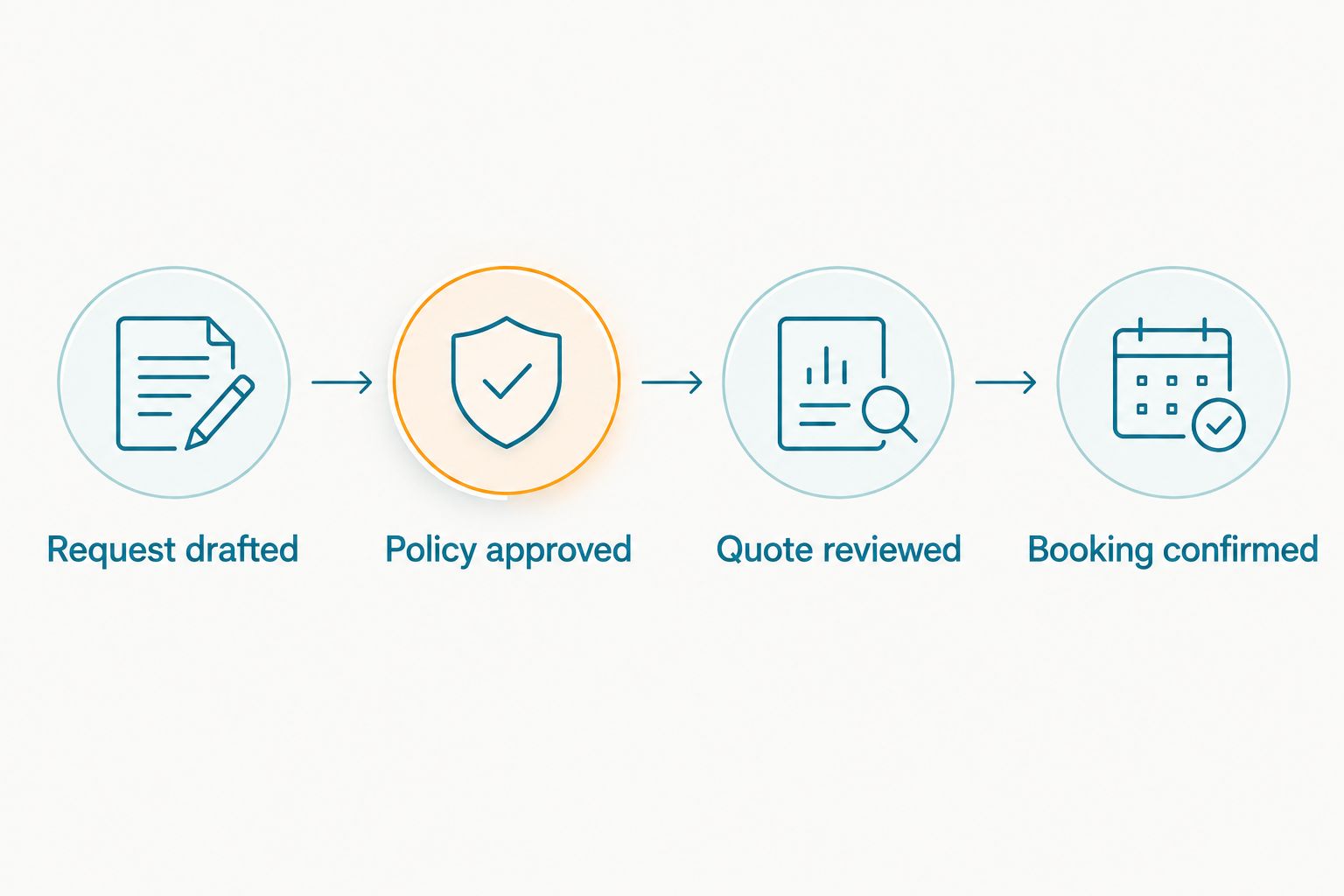
Keep the latest approved brief attached to the quotation record. If the itinerary changes while approval is pending, make the revision visible so the approver does not authorise an outdated proposal.
Handover and review record
A confirmed booking still needs an internal handover. Give the traveller and booking coordinator the information they need without circulating the entire procurement file.
- Prepare the traveller brief. Include confirmed pickup details, operating contacts and the applicable instructions from the agreement. Use the provider’s actual contact details and procedures.
- Allocate responsibilities. Tell employees who handles trip changes, incident reporting, expense records and vehicle return coordination, as applicable. Distinguish company responsibilities from those assigned by the agreement.
- Set a review point. Choose a date linked to the project or assignment. Review passenger needs, destinations and duration before requesting an extension or altered scope.
- Close the record. Reconcile the completed service against the agreed scope and retain supporting documents under your company’s retention policy. Record unresolved matters for the responsible owner.
Expected result: Travellers know how to use the arrangement, and the company knows who manages changes and closure.
When an existing rental requirement changes
Use a shorter amendment workflow when an employee’s assignment, route or duration changes. Do not restart every policy check if your internal rules allow an amendment, but do not treat the original approval as permission for any new use.
- Describe the change: Record what changes, the requested effective date and the business reason.
- Check internal authority: Identify whether the change stays within the existing approval or requires an exception.
- Request revised terms: Send the amendment to the provider and ask what changes in the quotation or agreement.
- Confirm before use: Obtain the required internal approval and provider confirmation before acting on the revised arrangement.
For example, a Metro Manila assignment might expand to include recurring Pampanga visits. Document the additional destinations, schedule and passenger requirements. VPI Cars supports out-of-town Luzon travel; the specific amended itinerary still needs confirmation.
Troubleshooting
The request is approved, but the booking is not confirmed
Check what the approval actually covers. An internal approval authorises your organisation to proceed; it is not supplier acceptance. Ask the booking coordinator to obtain written provider confirmation before telling employees the transport is arranged.
Quotations cover different requirements
Return to the shared brief. Compare duration, driving arrangement, itinerary and stated inclusions on the same basis, then ask each provider to clarify differences. Do not treat a shorter description as equivalent scope.
Employees request changes through separate messages
Route amendments through the Authorised change requester. Keep one current itinerary and identify which version the provider has confirmed. Travellers can flag urgent needs, but the company still needs a clear record of accepted changes.
The policy permits use that the agreement does not address
Pause the disputed use and ask for written clarification. Internal permission cannot amend a rental agreement. Resolve authorised drivers, journey scope or other unclear conditions before relying on them.
Customize your workflow
Once the basic process works, create separate brief templates for assigned vehicles, recurring meetings and staff transport. Keep shared approval fields consistent while changing the operational questions for each use case.
For the next 2026 policy review, examine where requests stall: incomplete itineraries, unclear approval ownership or amendments sent after confirmation. Improve the template around those documented issues rather than adding fields that nobody uses.
Send a clear requirement before asking for a quotation. VPI Cars can assess a more useful enquiry when it includes passenger numbers, dates, destinations and the driving arrangement. Confirm the specific itinerary and contractual terms before committing employees to the plan.
FAQ
How do I set up corporate long-term car rental under a travel policy?
Create an approved brief covering eligible travellers, passenger numbers, destinations, duration and driving arrangement. Obtain a quotation, review the agreement and keep provider confirmation separate from internal approval.
Does my HR system need to connect directly to the rental provider?
No direct software connection is required for the document-based workflow described here. Use your existing internal approval process and confirm the provider’s booking requirements separately.
Is self-drive or car rental with driver better for company travel?
Self-drive suits an employee assigned to handle driving; with-driver suits journeys where driving should be handled as part of the service. Choose according to the work requirement and confirm the relevant responsibilities in the agreement.
Can a corporate rental include provincial trips from Metro Manila?
VPI Cars supports corporate travel in Metro Manila and out-of-town Luzon destinations. Include each destination, travel schedule and passenger requirement in the enquiry so the specific itinerary can be confirmed.
What should procurement include in a long-term rental enquiry?
Include passenger numbers, luggage or equipment, pickup location, destinations, start and end dates, and the driving arrangement. Identify the approval owner and ask the provider to clarify scope, exclusions and agreement requirements.
What happens if the employee’s assignment is extended?
Request an amendment before relying on an extended rental period. Confirm the revised duration and terms with the provider, obtain the required internal approval and retain the updated confirmation.
One last thing
The most useful field in your rental record is Items to confirm. It gives unanswered questions a visible place instead of letting them become assumptions. Assign each item an owner and resolve booking-critical questions before marking the arrangement confirmed.
Related guides
- Rental vehicles for small business fleets
- Vans for corporate shuttle service in Metro Manila
- Car rental for pharmaceutical sales representatives