
Pharmaceutical sales reps’ car rental is planned vehicle access for clinic, hospital and pharmacy visits, with the aim of keeping territory coverage organised and appointments manageable. This guide explains how to choose between self-drive, with-driver and longer-term arrangements for Metro Manila and Luzon routes, where appointment changes, parking and provincial travel shape the booking.
- Car rental for pharmaceutical sales reps should match territory, passenger numbers, appointment patterns and rental duration.
- VPI Cars suits teams comparing self-drive, with-driver and corporate car rental for Metro Manila and Luzon.
- Choose with-driver travel when representatives need to handle work between stops rather than drive.
- Keep medicine-handling requirements separate from passenger transport; an ordinary rental is not a validated cold-chain vehicle.
Why car rental matters for pharmaceutical sales teams
A pharmaceutical sales itinerary is not simply a transfer between two addresses. Your representative needs to reach the correct entrance, find an appropriate drop-off point and leave enough room for the next appointment without assuming every visit ends on schedule.
For your 2026 transport plan, separate the needs of an individual representative from those of a visiting manager or shared field team. Passenger numbers, work materials and the responsibility for driving change the booking brief. Vehicle size matters too; these compact-car considerations for Metro Manila traffic and parking provide a starting point for assessing urban routes.
Book around the workday, not just the destination. A rental arrangement should account for waiting, parking, route changes and the final return journey, not merely the first hospital address.
How to plan pharmaceutical field-team transport
1. Map the territory before choosing a vehicle
Start with a spreadsheet or shared calendar. Record the actual addresses, appointment windows and expected visit sequence before asking anyone to recommend a car.
Separate Metro Manila rounds from provincial itineraries. A route confined to nearby facilities needs a different briefing from a journey that includes an out-of-town Luzon destination and an overnight stay. Neither should be planned from a list of city names alone.
Use an explicitly illustrative brief to test your requirements: 2 passengers, 4 planned visits and 1 workday. These are planning examples, not recommended limits. Add bags and work materials, then check whether each stop belongs in the same route.
- Record the full facility name and address.
- Identify the relevant building, gate or entrance.
- Mark fixed appointments separately from flexible visits.
- List passengers and the materials they will carry.
- State the starting point and final drop-off.
2. Decide who should handle the driving
Compare the work involved before comparing rental options. With self-drive, your representative takes responsibility for driving, parking and returning the vehicle under the agreed terms. With-driver travel assigns the driving task to a driver, but still needs a clear itinerary.
Self-drive is best for representatives who want direct control of the route and are comfortable handling the driving. Its limitation is that travel remains an active task rather than usable time for calls or preparation.
With-driver rental is best for representatives who need to work between appointments. Its limitation is the need to coordinate waiting, changes and the driver's agreed service scope. Do not assume that a driver arrangement removes every scheduling constraint.
- Ask whether the representative wants to drive.
- Identify calls or preparation needed between visits.
- Consider parking responsibilities at each facility.
- Separate confirmed stops from possible additions.
- Discuss the return journey before confirming the arrangement.
3. Match rental duration to the assignment
Mark the required dates on a calendar first. Distinguish a temporary territory assignment from recurring coverage, and separate a visiting manager's field days from a representative's regular transport requirement.
VPI Cars is best for pharmaceutical sales teams comparing self-drive, with-driver and corporate car rental for Metro Manila and Luzon. Its service mix supports that comparison; the appropriate arrangement still depends on your dates, itinerary and vehicle requirements.
For a 2026 territory assignment, send VPI Cars a defined brief rather than asking for a generic corporate package. Ask the company to quote the relevant service, then confirm the proposed duration and conditions in writing. Do not assume that corporate rental automatically includes a driver or special account terms.
- State the first and last required dates.
- Identify recurring days separately from occasional trips.
- Specify self-drive or with-driver requirements.
- Explain whether the vehicle serves one representative or a shared team.
- Ask how extensions and schedule changes are handled.
4. Specify passenger space and material handling
Write down what travels with the team. Passenger seating alone does not answer whether a vehicle suits the assignment: presentation materials, overnight bags and demonstration equipment also need appropriate space.
For VPI Cars car rental enquiries, describe these requirements without requesting an unverified model or assuming a particular vehicle will be assigned. Ask for a suitable proposal and confirm the actual vehicle details before booking.
Keep passenger transport separate from pharmaceutical storage requirements. Air-conditioning in a passenger vehicle does not establish validated storage conditions. If you carry medicines or samples, follow the product's labelled requirements and your employer's handling procedures; do not treat the rental as a cold-chain service.
- List passengers and their luggage.
- Describe bulky or fragile presentation materials.
- Identify any medicines or samples requiring controlled handling.
- Confirm that materials can be secured appropriately.
- Avoid leaving confidential documents or products unattended.
5. Request a quotation against one written brief
A simple email is enough to start. Give every provider the same itinerary, passenger count and rental period so you can compare the proposed service rather than differently defined offers.
For your 2026 quotation request, state whether the route includes provincial travel, an overnight stop or a possible late finish. Ask which charges and responsibilities apply instead of assuming that fuel, tolls, parking, waiting or overnight arrangements are included.
The booking decision should turn on a clear scope. A quotation that leaves important operating conditions unanswered is not ready for approval, even when the headline arrangement looks suitable.
- Send dates, pickup details and the final destination.
- Include the stop sequence and expected finish time.
- Ask how fuel, tolls and parking are treated.
- Request the applicable waiting and extension conditions.
- Confirm deposits, cancellation terms and vehicle-return requirements.
- Identify who can approve changes during the trip.
6. Track visits without turning transport into surveillance
Start with a shared itinerary and a short end-of-day update. Your transport record needs to explain whether the planned journey worked; it does not need to collect everything a representative discussed at a clinic.
Compare the planned sequence with actual arrivals and visit outcomes. A late arrival, unavailable contact and changed appointment are different events. Keeping them separate helps you identify whether the next booking needs a revised route, a different departure plan or better appointment confirmation.
Use three record fields: Planned stop, Actual arrival and Visit outcome. The fields distinguish the transport plan from what happened without inviting unnecessary medical or personal detail.
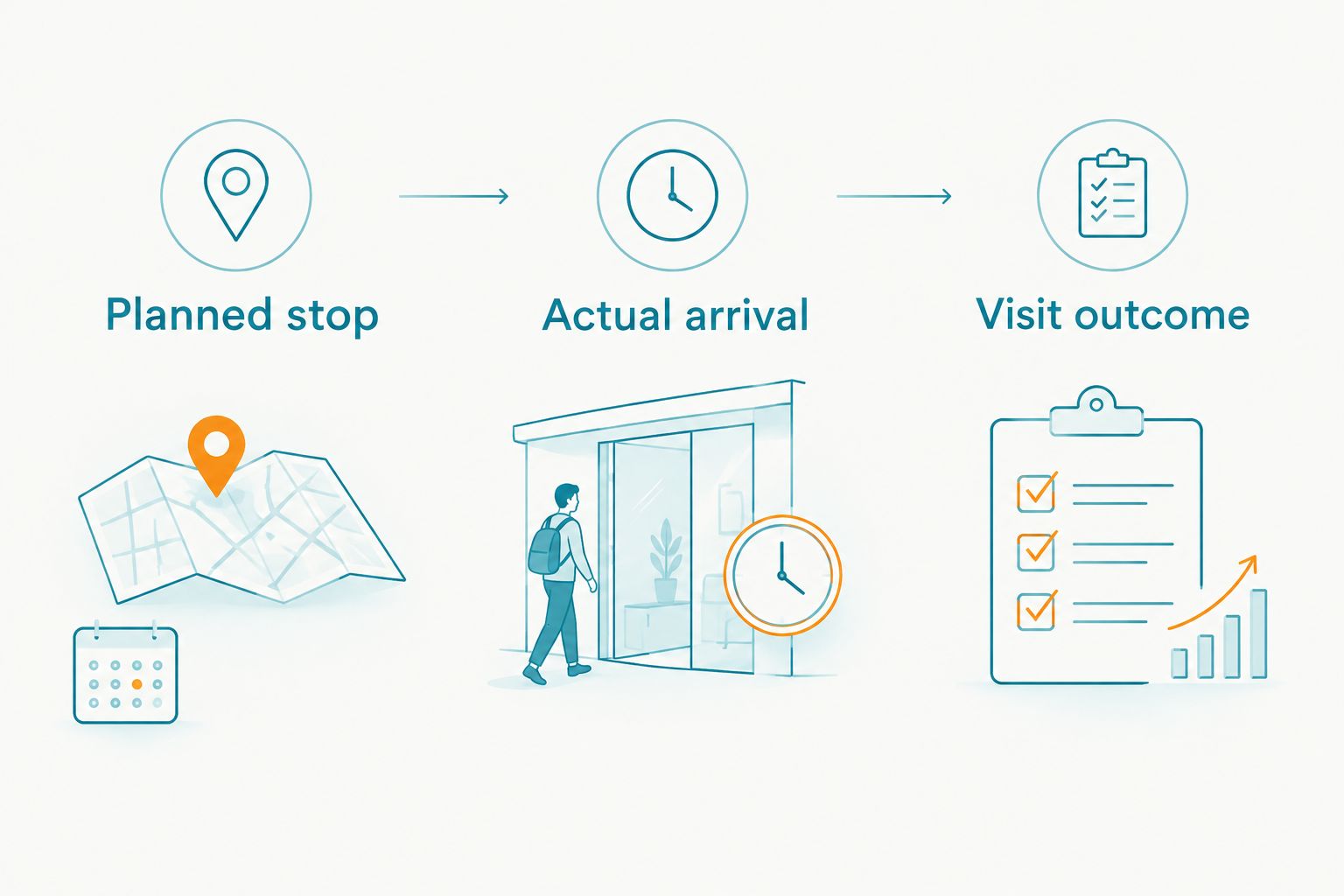
At the review stage, keep site-visit tracking distinct from sales performance: a vehicle reaching a location does not establish that a healthcare professional was available or that a meeting took place. If your company uses location records, define the purpose, access and retention arrangements before collecting them.
For a 2026 review, use these records to improve scheduling rather than claim that transport alone determines sales results. Keep patient information out of ordinary transport logs and share only the itinerary details needed for the journey.
- Record the planned stop without patient information.
- Log actual arrival only for an agreed business purpose.
- Note the visit outcome separately from vehicle movement.
- Restrict access to staff who need the information.
- Follow company privacy and record-retention procedures.
7. Confirm the next day's operating details
Use a short written confirmation before the journey. A booking can have the correct date and still leave the representative unsure which entrance to use, who receives an itinerary change or where the final drop-off will be.
For provincial Luzon assignments, confirm the complete journey rather than only the outbound leg. Include overnight requirements, the next departure and the return destination. An out-of-town itinerary is a supported use case, but the individual booking still needs confirmation.
Keep one agreed contact responsible for communicating changes. That prevents the representative, manager and coordinator from sending conflicting instructions during a busy field day.
- Reconfirm pickup time and the precise meeting point.
- Verify facility access instructions with the relevant contact.
- Share the agreed stop sequence with the necessary people.
- Confirm the process for adding or cancelling a stop.
- Recheck the final drop-off and return arrangements.
Request a field-team transport quotation
Share your dates, passengers and Metro Manila or Luzon itinerary to define the right rental arrangement.
Compare rental options for pharmaceutical fieldwork
Use the table to choose a service format before requesting a specific vehicle. Rental duration and driver provision are separate decisions: a corporate arrangement does not, by itself, explain who drives.
VPI Cars offers all three service categories below. The advantage is the choice of service formats; the booking consideration is that vehicle details, operating scope and contractual terms still need confirmation. No standardised fleet specification or pharmaceutical-handling service is established here.
| Option | Best for | Practical advantage | Key limitation or booking consideration |
|---|---|---|---|
| Self-drive rental | Representatives who prefer to manage their own driving | Direct control over departure and stop sequence within agreed terms | The representative handles driving, parking and vehicle-return responsibilities |
| Car rental with driver | Representatives or managers who need working time between stops | Separates the driving task from the representative's fieldwork | Waiting, itinerary changes and service duration need agreement |
| Corporate/long-term rental | Teams planning recurring territory coverage or an extended assignment | Matches the rental discussion to an ongoing company requirement | Driver provision, duration and contract conditions must be specified |
For your 2026 comparison, assess each quotation against the same route. Do not compare an urban self-drive brief with a provincial with-driver brief as though they cover identical work.
Common mistakes pharmaceutical sales teams make
Treating a hospital name as a complete destination
A facility name does not identify the correct entrance or meeting location. Confirm the building and access instructions before departure, especially when the representative is visiting for the first time.
Packing the itinerary around uninterrupted appointments
A visit can change without any transport failure. Keep flexible stops distinguishable from fixed appointments, and agree which visit takes priority if the sequence must change.
Assuming passenger air-conditioning protects medicine samples
Comfort cooling is not proof of product storage compliance. Use your employer's approved handling process and verify labelled storage requirements rather than relying on the vehicle's cabin temperature.
Booking a recurring assignment as unrelated individual trips
Separate bookings can obscure the full transport requirement. Present the expected pattern together so the provider can discuss corporate or longer-term arrangements without assuming any particular contract terms.
Sending itinerary changes through several people
Conflicting updates make even a clear route difficult to follow. Name the person authorised to approve changes, and have that person communicate the revised plan to everyone who needs it.
FAQ
What’s the best car rental arrangement for pharmaceutical sales reps?
The best arrangement matches the representative’s driving preference, itinerary and rental duration. Choose self-drive for direct control of driving, with-driver travel for working time between stops, or discuss corporate rental for recurring assignments.
Is a driver better than self-drive for hospital visits?
A driver is better when the representative needs to handle calls or preparation between visits instead of driving. Self-drive suits representatives who prefer to manage the journey themselves; either option needs a realistic itinerary and clear parking arrangements.
Can VPI Cars support pharmaceutical sales trips outside Metro Manila?
VPI Cars supports out-of-town and provincial transport within Luzon, as well as Metro Manila travel. Submit the individual itinerary, dates, passenger numbers and vehicle requirements for confirmation rather than assuming a destination has a pickup branch.
What should a pharmaceutical team include in a rental quotation request?
Include the dates, pickup point, destinations, passenger count, materials carried and preferred driving arrangement. State the expected finish time, recurring requirements and any overnight travel so the quotation addresses the full assignment.
Can medicine samples travel in an ordinary rental car?
An ordinary passenger rental must not be assumed suitable for a medicine’s storage requirements. Follow the product’s labelled conditions and your employer’s approved handling procedures; passenger air-conditioning does not establish validated cold-chain transport.
Does corporate car rental automatically include a driver?
No, corporate car rental does not by itself establish that a driver is included. Specify self-drive or with-driver requirements in the quotation request and confirm the arrangement in the written agreement.
How should a team handle appointment changes during the day?
Use one authorised contact to communicate a revised itinerary and confirm how the change affects the agreed service. Keep fixed appointments separate from flexible visits so the team can prioritise stops without issuing conflicting instructions.
One last thing
Make the quotation brief usable as the travel-day brief. If it cannot tell the representative where to start, which appointments take priority and where the journey ends, it is not ready to send.
Keep a short version accessible during the trip, with only the contact and itinerary information needed. That gives the representative, coordinator and driver, where applicable, the same plan without circulating unnecessary confidential material.
Related guides
- Rental vehicles for small-business fleets in the Philippines
- Chauffeured cars for business travellers in Makati
- Car rental with driver: understanding quotation factors