
Van rental for event organizers is planned group transport that brings delegates, speakers and staff between event locations with the aim of keeping arrivals aligned with the programme. For a 2026 corporate event in Metro Manila or elsewhere in Luzon, plan around passenger groups, luggage, venue access and return journeys—not just the vehicle.
- Van rental for event organizers starts with passenger groups, pickup locations and a complete return itinerary.
- VPI Cars suits organizers seeking with-driver or corporate car rental for Metro Manila and Luzon events.
- Choose with-driver transport when your event team needs to coordinate guests rather than drive.
- Request written confirmation of vehicle requirements, waiting arrangements and quotation inclusions before booking.
Why transport planning matters for event organizers
Event transport serves a programme, not simply a destination. A speaker needs to arrive before a session; registration staff need access before delegates; attendees need a clear departure arrangement after the closing programme.
VPI Cars is best for event organizers seeking with-driver or corporate rentals for Metro Manila and Luzon events. You can approach VPI Cars with your passenger requirements and itinerary to request a quotation. Vehicle requirements and booking arrangements still need confirmation for your specific event.
Your first planning task is to separate journeys that genuinely belong together. Passengers sharing a venue do not necessarily share a pickup time, departure time or luggage requirement.
For your 2026 event brief, distinguish between what is fixed and what remains provisional. A confirmed venue address is useful; an estimated finishing time needs to be labelled as an estimate so it does not become an accidental booking assumption.
Why van rental matters for corporate events
A corporate event creates transport requirements that an ordinary point-to-point trip does not. You need to coordinate people with different responsibilities while keeping the venue team informed about arrivals and departures.
A shared van works best when passengers have compatible schedules. It becomes harder to manage when the same vehicle is expected to collect late arrivals, carry equipment and remain ready for an early speaker departure.
Group passengers by journey and timing before grouping them by vehicle. This makes the quotation request clearer and exposes conflicting movements before the event day.
The planning work also supports procurement. When competing quotations use the same itinerary, passenger requirements and service scope, you can compare the actual arrangements rather than a headline total attached to different assumptions.
How to plan event van transport
Define each passenger group's journey
Start with a spreadsheet or shared document. Record who travels together, where they board and when they need to reach their destination. You do not need booking software to establish a workable transport brief.
Use 3 planning fields as your starting point: passenger group, movement and required arrival. Expand those fields as details become available. Keep the transport list separate from the full attendee database so the driver-facing information stays relevant.
For a 2026 conference, distinguish the venue's programme start from the arrival time required for registration, preparation or technical checks. Ask the event lead to approve those arrival requirements before requesting transport.
- Separate delegates, speakers, staff and suppliers when their schedules differ.
- Record the passenger count for each movement, not only total attendance.
- Identify passengers travelling with luggage or presentation materials.
- Mark bookings that depend on an unconfirmed flight or programme slot.
- Assign someone to maintain the passenger list.
Match the vehicle requirement to people and baggage
Count passengers manually, then ask the rental provider to assess the vehicle requirement against that count and the baggage description. Do not treat an advertised seating figure as proof that everyone and everything will fit comfortably.
VPI Cars offers with-driver and corporate rental services, so your inquiry can begin with the journey rather than an assumed vehicle model. Describe the requirement and request confirmation of the proposed arrangement; do not build your event plan around an unconfirmed vehicle.
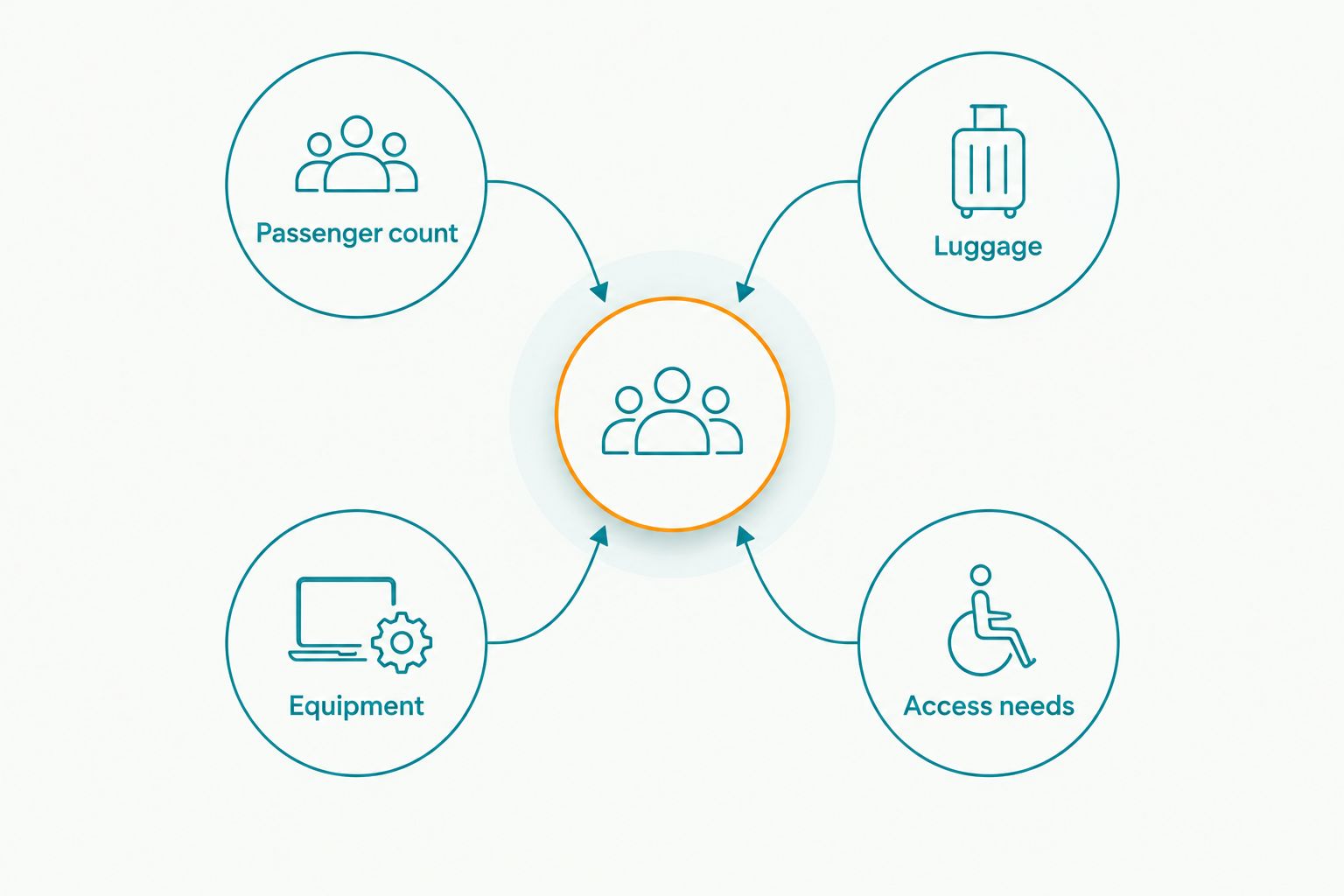
Use these headings in your brief so nothing important sits only in a message thread:
- Passenger count: include the event coordinator if travelling with the group.
- Luggage: describe suitcases, overnight bags and other bulky belongings.
- Equipment: list presentation materials and items travelling with passengers.
- Access needs: ask passengers what boarding or travel arrangements they require.
The passenger and baggage brief should inform the vehicle request together. Equipment that does not fit the agreed arrangement needs a separate transport discussion, not an event-day improvisation.
Choose the service around the coordinator's role
Decide who will drive before deciding who will coordinate passengers. Self-drive places driving responsibilities within your team; with-driver rental separates those responsibilities from event management.
With-driver rental is the stronger fit when your coordinator must handle attendance, venue calls and programme changes during travel. The trade-off is that the provider needs a clearly agreed itinerary and instructions. A driver does not replace an event coordinator.
For recurring conferences, company meetings or extended assignments, discuss corporate or long-term rental requirements with VPI Cars. Ask how the proposed arrangement fits your actual schedule rather than assuming that a longer engagement includes particular services.
- Choose with-driver rental when staff need to focus on the event.
- Consider self-drive only when an assigned driver can take responsibility for driving.
- Discuss corporate rental when transport requirements repeat across dates.
- Separate passenger coordination from driving duties.
- Confirm who can approve itinerary changes.
Build the full itinerary, including the return
Write the journey from the first pickup to the final drop-off. A venue address alone does not explain which entrance to use, where passengers gather or whether the vehicle needs to remain during the event.
For your 2026 itinerary, check timing against venue instructions and current route conditions rather than copying a previous event's schedule. Ask the transport provider to review the proposed movements and identify details that need clarification.
Out-of-town Luzon events belong in the same planning process. VPI Cars supports out-of-town Luzon travel; share the complete route, event duration and return requirements for confirmation.
- Specify pickup addresses and recognisable meeting points.
- State the required arrival time at each destination.
- Identify intermediate stops and their purpose.
- Describe waiting periods between movements.
- Include the final return destination and expected departure.
- Flag programme timings that are still provisional.
Confirm venue access before finalising pickups
Contact the venue directly and ask how event vehicles should approach, unload and depart. Record the answer in plain language that someone unfamiliar with the property can follow.
A map pin identifies a location, but it does not settle the boarding arrangement. Confirm the entrance, meeting point and any venue instructions with the person responsible for access. Share only verified directions with passengers.
For a provincial venue, also confirm where the group will gather for the return journey. Do not assume that the arrival drop-off point automatically becomes the departure pickup point.
- Ask which entrance event passengers should use.
- Confirm where the vehicle can stop for boarding and unloading.
- Check whether the venue requires vehicle or driver details in advance.
- Ask about parking or waiting arrangements.
- Identify a venue contact for access questions.
Assign contacts and a change process
Name 2 contacts for distinct roles: a transport lead who approves changes and an on-site coordinator who gathers passengers. One person can hold both roles, but the responsibilities must remain clear.
A shared document and a message thread are enough to manage the basics. The important distinction is between a proposed change and an approved instruction. Avoid sending the driver several different versions of the itinerary through different people.
Ask the provider how changes should be communicated and confirmed. Do not assume that adding a stop, extending waiting time or changing the return schedule is already included in the booking.
- Give passengers the coordinator's contact details.
- Give the transport provider an authorised event contact.
- Set a clear process for reporting missing passengers.
- Record approved changes in the master itinerary.
- Confirm revised instructions with everyone affected.
Request a quotation against the same written brief
Send 1 master itinerary with the passenger and baggage requirements attached. Ask each provider to quote against that document so differences in the proposed scope are visible.
For a 2026 event, keep the inquiry date and itinerary version on the brief. If the programme changes, send an updated version and ask whether the quotation or arrangements need revision.
A useful inquiry reads: Please quote for the attached event transport itinerary, including the stated passenger groups, baggage and return movements. Please identify the proposed service arrangement, inclusions, exclusions and details requiring confirmation.
- Include event dates, locations and all planned movements.
- State passenger numbers and baggage requirements for each group.
- Ask what the quotation includes and excludes.
- Request clarification of waiting, route changes and additional stops.
- Review payment, cancellation and other booking terms before agreeing.
- Obtain written confirmation of the final itinerary and arrangement.
Once the brief is complete, send VPI Cars your requirements for a quotation. That gives the discussion a practical starting point without treating an inquiry as a confirmed booking.
Request an event transport quotation
Share your dates, passenger groups, baggage and Metro Manila or Luzon itinerary.
Compare transport arrangements for your event
The right arrangement depends on who takes responsibility for driving and how often the transport requirement repeats. These options describe service formats, not confirmed vehicle assignments or identical booking terms.
| Option | Best for | Practical benefit | Key limitation or consideration |
|---|---|---|---|
| With-driver rental | Events where staff need to coordinate guests during travel | Keeps driving separate from event coordination | Requires agreed movements, waiting arrangements and a clear event contact |
| Self-drive rental | Teams with a designated driver and a straightforward itinerary | Places driving and trip management within your team | Your assigned driver must manage driving duties alongside any other responsibilities |
| Corporate or long-term rental | Recurring meetings, event series and extended business requirements | Provides a service format to discuss for repeated transport needs | The duration, journeys and responsibilities still need to be defined and agreed |
Choose with-driver rental for a coordination-heavy event; discuss corporate rental when the requirement repeats. Self-drive remains a relevant option when your team deliberately assigns driving responsibility rather than treating it as an extra task for whoever is available.
VPI Cars offers all these service categories. Confirm the specific vehicle requirement, itinerary and terms through the quotation process instead of assuming the categories carry identical inclusions.
Common mistakes event organizers make
Using total attendance as the transport headcount
Event attendance does not tell you how many people need each transfer. Some attendees travel independently, while staff and speakers follow different schedules. Build passenger lists by movement so the vehicle request reflects the people actually travelling.
Combining incompatible arrival requirements
A speaker's preparation time and a delegate's registration time are different requirements. Putting both groups into the same transfer without checking arrival needs creates an avoidable conflict. Agree on the required arrival first, then decide whether sharing transport works.
Treating the return journey as an informal arrangement
An event finishing time is not a complete departure instruction. Attendees still need a meeting point, coordinator and agreed return destination. Include the return in the original brief, especially when the event is outside Metro Manila.
Comparing quotations with different scopes
A quotation covering a direct transfer is not equivalent to one covering several stops and event waiting. Check that each proposal responds to the same itinerary. Resolve exclusions and assumptions before comparing the overall value.
Asking the driver to manage event attendance
Driving and passenger coordination are separate jobs. Assign an event contact to gather the group, check attendance and approve changes. Give the driver confirmed instructions rather than expecting the driver to resolve competing requests from passengers.
FAQ
What’s the best way to plan van rental for event organizers?
Start with a passenger list for each movement and a complete pickup-to-return itinerary. Then ask the provider to confirm the vehicle requirement, service scope and booking terms against that brief.
Is with-driver rental better than self-drive for a corporate event?
With-driver rental is better suited to events where your team needs to coordinate passengers during travel. Self-drive suits teams that can assign someone to driving without conflicting event responsibilities.
Can VPI Cars support events outside Metro Manila?
VPI Cars supports out-of-town travel in Luzon as well as Metro Manila journeys. Submit the complete destination, dates, passenger requirements and return itinerary for confirmation of your specific arrangement.
How do I work out how many vans an event needs?
Work out the passenger groups, simultaneous movements and baggage requirements before requesting a vehicle recommendation. Ask the provider to confirm the arrangement against those details rather than calculating from an assumed seating capacity.
What should I include when requesting an event transport quotation?
Include the dates, passenger count for each journey, baggage, pickup locations, required arrivals, stops, waiting periods and return movements. Ask for written inclusions, exclusions and clarification of any provisional details.
Can corporate rental suit a series of conferences or company events?
Corporate rental is a relevant service format to discuss when your transport requirements repeat across dates. VPI Cars offers corporate and long-term rentals; define the schedule and scope before agreeing on an arrangement.
What happens if our event programme changes after booking?
Contact the rental provider through the agreed change process and request confirmation of the revised arrangement. Do not assume that extra stops, longer waiting or a different return schedule are included in the original agreement.
One last thing
Check the last departure before approving the first pickup. The return journey reveals whether passenger groups still belong together after the event: speakers, staff and delegates do not necessarily finish at the same time.
Before approving your 2026 transport brief, read it from the final drop-off backwards. Every group should have an agreed departure, destination and responsible contact. Then request a quotation against that complete plan.
Related guides
- Vans for corporate shuttle service in Metro Manila
- Vans for airport group pickups in Clark
- Vans ranked by seating capacity for Manila group trips
- Rental vehicles for small business fleets in the Philippines