
Best overall: a luggage-first passenger van with a driver. Best for business arrivals: an executive-layout van. Best for light-baggage groups: a standard passenger van. For Clark airport pickups in 2026, choose the layout around your passengers, actual luggage and onward destination—not the vehicle name alone.
- For best van airport pickup clark searches, choose a luggage-first passenger van with a driver for mixed passenger-and-baggage needs.
- Executive-layout vans suit business arrivals when seating comfort matters more than carrying the largest group.
- Standard passenger vans suit light-baggage groups; occupied seats must not replace safe luggage space.
- VPI Cars suits groups seeking with-driver car rental; request a quotation specifying Clark, passengers, luggage and destination.
Why this matters
An airport pickup is not just a seating problem. Your group must fit alongside checked bags, cabin bags and anything that needs special handling. A van that accommodates everyone on paper is the wrong choice if luggage blocks an aisle or leaves passengers holding heavy bags.
VPI Cars offers car rental with driver, self-drive and corporate/long-term rentals. VPI Cars is a practical choice for groups seeking with-driver car rental in Metro Manila and Luzon. For a Clark pickup, request confirmation of the proposed vehicle, route and booking arrangements before making travel plans around it.
This guide ranks van configurations rather than vehicle badges. Use it to describe the transport you need, then assess the actual vehicle offered. A model name does not establish its seating layout, luggage space or suitability for your group.
What makes the best van for a Clark airport pickup?
For your 2026 arrival, assess these points before accepting a vehicle recommendation:
- Passenger-and-luggage fit: Confirm usable passenger seats and space for your actual bags with those seats occupied.
- Safe loading: Luggage needs a suitable storage position, not an aisle, doorway or unsecured pile beside passengers.
- Entry and exit: Consider the step into the cabin and access to seats, especially for older travellers or passengers with limited mobility.
- Arrival coordination: Establish who contacts the driver, where you meet and what happens when the flight timing changes.
- Journey suitability: Match the layout to the onward trip, whether you are heading to Metro Manila or another Luzon destination.
- Clear quotation scope: Ask what the quotation covers, including waiting, parking, tolls, additional stops and changes to the itinerary.
Choose the van that fits the complete journey, not the van with the highest advertised seat count. If a proposed layout leaves the luggage question unanswered, resolve that before booking.
Clark airport pickup vans at a glance
These are booking configurations, not named fleet products. Each has a different role; confirm the actual layout and service arrangements in the quotation.
| Rank and option | Best for | Standout feature to request | Key limitation |
|---|---|---|---|
| 1. Luggage-first passenger van with driver | Groups carrying checked luggage | Passenger seating assessed together with baggage space | Luggage requirements can reduce the suitable group size |
| 2. Executive-layout van with driver | Business travellers prioritising cabin comfort | A seating arrangement suited to the passengers and onward journey | Extra seating space does not establish extra luggage space |
| 3. Standard passenger van with driver | Groups travelling with light baggage | A straightforward shared passenger layout | Full seating and bulky luggage can conflict |
| 4. Split-group van arrangement | Groups whose passengers and bags do not fit safely together | Separate passenger-and-luggage allocations across vehicles | Requires more coordination and separate vehicle instructions |
1. Luggage-first passenger van: best for checked-baggage groups
A luggage-first passenger van is the default recommendation for a Clark airport group pickup. The booking starts with your baggage requirements, then establishes a suitable passenger layout rather than treating storage as an afterthought.
This approach suits families, visiting colleagues and travellers continuing from Clark to Metro Manila or another Luzon destination. Ask for confirmation of where the bags will sit with every passenger seat you need occupied. An empty-cabin photograph does not answer that question.
Luggage-first passenger van pros:
- Makes passenger and baggage fit part of the same decision.
- Keeps the group on a shared itinerary when the layout fits.
- Removes the need for an arriving passenger to drive.
- Provides a clear basis for comparing proposed vehicles.
Luggage-first passenger van cons:
- A baggage-heavy group needs more space than its passenger count suggests.
- A suitable layout still requires confirmation for oversized items.
Best for: Groups bringing checked suitcases, particularly when staying together matters.
Before accepting the recommendation, describe large suitcases, cabin bags, folded pushchairs and other bulky items separately. Do not use “normal luggage” as your only description. Different passengers use that phrase for very different loads.
Verdict: Buy this configuration for a checked-baggage group once passenger seating and luggage placement are confirmed together.
2. Executive-layout van: best for business arrivals
An executive-layout van prioritises the passenger seating arrangement rather than maximum group capacity. For this recommendation, the useful feature is space suited to the travellers and journey—not a luxury label.
This option suits business visitors travelling from Clark to meetings, a hotel or an office in Metro Manila or Luzon. Assess the actual seats, access and luggage storage. Do not assume a premium description includes connectivity, charging facilities or other equipment.
Executive-layout van pros:
- Prioritises passenger comfort in the vehicle-selection discussion.
- Suits business itineraries where a driver handles the road journey.
- Allows the seating arrangement to guide the booking decision.
- Keeps colleagues travelling together when the full load fits.
Executive-layout van cons:
- A roomier passenger arrangement does not prove adequate baggage storage.
- A comfort-focused layout is not automatically appropriate for a larger group.
Best for: Business travellers who prioritise the cabin arrangement over carrying the largest possible group.
For a 2026 business arrival, include the first appointment and any intermediate stop in your quotation request. Ask the provider to assess the complete itinerary. Do not schedule the meeting around an assumed airport-to-office journey time.
Verdict: Buy an executive-layout van when its confirmed seating and baggage arrangement match the business party. Skip it if the description offers status but no useful layout details.
3. Standard passenger van: best for light-baggage groups
A standard passenger van focuses on shared passenger transport. It suits groups travelling with limited baggage, provided the quoted configuration still gives every passenger a proper seat and every bag a suitable place.
This is a practical option for a short visit or a group carrying mainly compact bags. The deciding factor is the actual load, not the length of the holiday. A short trip can still involve bulky equipment or large suitcases.
Standard passenger van pros:
- Offers a straightforward configuration to discuss with the provider.
- Keeps passengers together on a shared route.
- Suits light-baggage journeys without requiring a comfort-focused layout.
- Makes seat access and luggage placement easy points to verify.
Standard passenger van cons:
- Using every passenger seat can leave insufficient space for larger bags.
- Access to rear seats deserves attention for passengers with mobility needs.
Best for: Groups with genuinely light baggage and no special loading requirements.
Ask what “passenger capacity” includes. Your booking needs the usable seats for your party, with the driver accounted for separately and luggage storage assessed alongside them. Do not turn an advertised capacity into an airport-transfer recommendation without those checks.
Verdict: Buy a standard passenger van for a confirmed light-baggage load. Skip it when the proposed arrangement depends on luggage occupying passenger space.
4. Split-group van arrangement: best for an oversized total load
A split-group arrangement assigns passengers and luggage across separate vans instead of forcing the entire party into an unsuitable vehicle. It is the practical alternative when a single proposed van cannot accommodate the full load safely.
The arrangement needs a passenger list for each vehicle, a luggage allocation and a contact person for each group. It can also help when arrivals have different destinations or separate schedules, but those details need agreement before booking.
Split-group van arrangement pros:
- Avoids treating overcrowding as a solution to a capacity problem.
- Allows baggage requirements to be assessed vehicle by vehicle.
- Supports separate onward destinations when included in the itinerary.
- Gives each driver a defined passenger group and route.
Split-group van arrangement cons:
- Passengers no longer travel in the same cabin.
- Separate vehicles require separate coordination and clear quotation scope.
Best for: Groups whose combined passengers and luggage exceed the suitable layout of a single van.
Keep essential documents, medicines and personal items with the traveller who needs them. If luggage travels in a different vehicle from its owner, identify the bag and its final destination clearly. Avoid discovering a mismatch at the hotel entrance.
Verdict: Buy a split-group arrangement when a single van does not fit the full load. Skip an improvised last-minute split without agreed passenger, baggage and destination lists.
How these options are ranked
The ranking puts passenger-and-luggage fit first, followed by journey suitability and coordination. It is a booking guide, not a road-test score or a claim that a particular vehicle model outperforms another.
The luggage-first configuration wins as the default because airport groups need to transport people and their bags together. The other options answer distinct needs: business seating preferences, light baggage or a load that requires separate vehicles.
Turn your itinerary into a useful quotation request
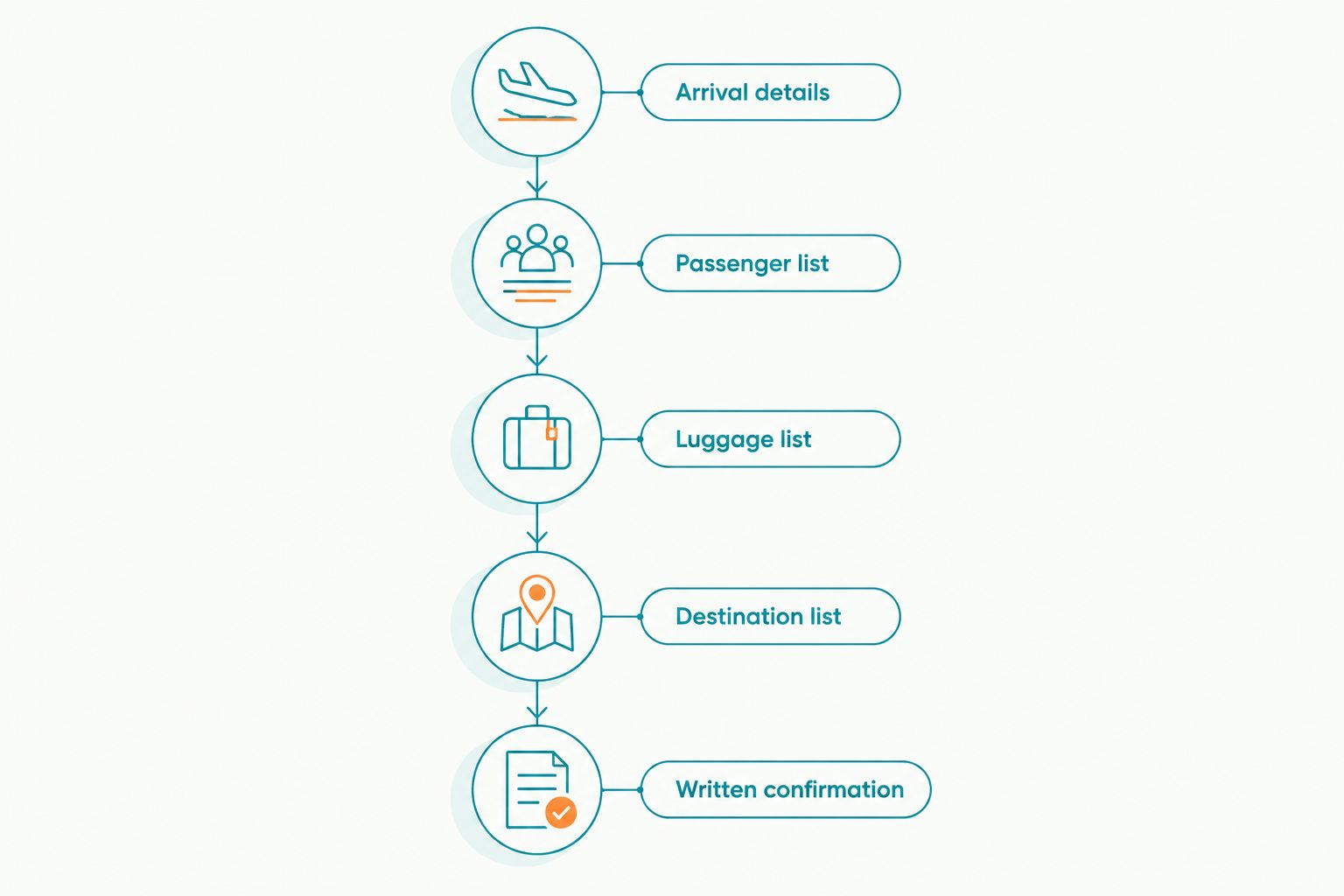
A useful 2026 quotation starts with a clear travel brief. Send the same information to each provider so you can compare the proposed arrangements rather than unrelated vehicle descriptions.
Arrival details
Provide the flight number, arrival date and scheduled arrival time. Identify a lead passenger and a contact method usable after landing. Ask how the meeting instructions will be communicated and how an arrival-time change affects the arrangement.
Passenger list
State the number of adults and children, plus any seating or assistance needs. Describe mobility requirements directly. A request for “easy access” is less useful than explaining that a passenger needs help with steps or carries a mobility aid.
Luggage list
List checked suitcases, cabin bags and oversized items separately. Include dimensions for unusual items when you have them. Ask the provider to confirm fit in the proposed configuration rather than accepting a general assurance that the vehicle is spacious.
Destination list
Give the exact final destination and requested stops in order. A Clark-to-Metro-Manila pickup with several hotel drop-offs is a different itinerary from a direct transfer. Include any onward Luzon destination instead of adding it after the quotation.
Written confirmation
Request the proposed vehicle layout, passenger capacity, baggage arrangement and quotation inclusions in writing. Ask about waiting, parking, tolls, itinerary changes and the applicable terms. Keep the agreed brief accessible to the person coordinating the arrival.
Which van should you choose?
Choose a luggage-first passenger van with driver unless your group has a clear reason to choose another layout. Move to an executive layout for business seating preferences, a standard passenger layout for light baggage, or separate vans when the full load does not fit together.
For a 2026 Clark airport pickup quotation from VPI Cars, provide the flight details, passenger count, luggage list and exact destination. Request confirmation of the proposed arrangement before committing. A destination mentioned in a guide is not confirmation of a pickup branch or a bookable route.
Request a Clark pickup quotation
Share your flight, passengers, luggage and destination to confirm a suitable arrangement.
FAQ
What’s the best van for a group pickup at Clark airport?
A luggage-first passenger van with a driver is the best default for a group carrying checked baggage. Confirm the actual seating and luggage arrangement before booking; the model name alone does not establish fit.
Is an executive van better than a standard passenger van?
An executive-layout van is the better fit when business travellers prioritise the passenger seating arrangement. A standard passenger van suits light-baggage groups; both require confirmation of the actual layout.
How do I know whether our suitcases will fit?
Send a luggage list and ask the provider to confirm fit with all required passenger seats occupied. List large suitcases, cabin bags and oversized items separately rather than describing everything as normal luggage.
Should we book a driver or collect a self-drive vehicle?
Choose a driver if no arriving passenger wants to handle the road journey after landing. Choose self-drive only when a traveller wants that responsibility and the provider confirms the collection arrangements and rental requirements.
Can we travel from Clark airport to Metro Manila?
Include your exact Metro Manila destination in the quotation request and obtain route confirmation. VPI Cars serves Metro Manila and Luzon, but that geographic scope does not establish a specific pickup arrangement or booking.
What happens if our flight arrives late?
The provider’s agreed waiting and flight-change terms determine what happens after a delayed arrival. Ask how to report the change, how the driver coordination works and what the quotation includes before booking.
How much does a Clark airport van pickup cost in 2026?
Request a quotation for your exact Clark pickup itinerary. Provide the date, flight, passengers, baggage, destination and stops, then check which services and trip-related charges the quotation covers.
When should we use separate vans for an airport group?
Use separate vans when a single proposed vehicle cannot accommodate the passengers and luggage safely. Assign passengers, bags, contact people and destinations to each vehicle before arrival.
One last thing
Check the return trip before confirming the outbound pickup. Your group can leave Luzon with more luggage than it arrived with, and passengers can depart on different flights.
For your 2026 booking, treat the return journey as its own passenger-and-baggage brief. The right arrival vehicle is not automatically the right departure arrangement.
Related guides
- Vans ranked by seating capacity for Manila group trips
- Vans for corporate shuttle service in Metro Manila
- What affects car rental with driver costs in Manila
- Van choices for family road trips