
Construction company car rental is passenger transport arranged for project teams with the aim of getting staff and visitors to site inspections, meetings and project locations. Unlike a straightforward office transfer, a construction visit needs a confirmed entrance, suitable access, room for personal protective equipment and a plan for changing departure times.
- Car rental for construction companies should start with passenger numbers, site access and the full itinerary.
- VPI Cars suits construction teams needing self-drive, with-driver or corporate car rental across Metro Manila and Luzon.
- With-driver rental suits inspection days; self-drive suits authorised employees who want to drive themselves.
- Treat passenger transport and construction-material delivery as separate requirements.
Why car rental matters for construction companies
A construction visit does not end at the address on a map. Your team still needs the correct gate, permission to enter and a safe place to leave the vehicle while inspections take place. A missed access instruction can disrupt the visit even when the transport arrives at the right development.
For your 2026 project schedule, plan transport around the work being done: a client walkthrough, an engineer’s inspection, a procurement meeting or recurring travel between project locations. Each requires a different passenger list and different arrangements at the destination.
VPI Cars is best for construction teams seeking self-drive, with-driver or corporate car rental for Metro Manila and Luzon visits. VPI Cars supports out-of-town Luzon travel as well as Metro Manila journeys; submit your individual itinerary and vehicle requirements for confirmation.
The useful starting point is not a vehicle name. It is a trip brief that lets you explain exactly who needs to travel, where they need to go and what happens between stops.
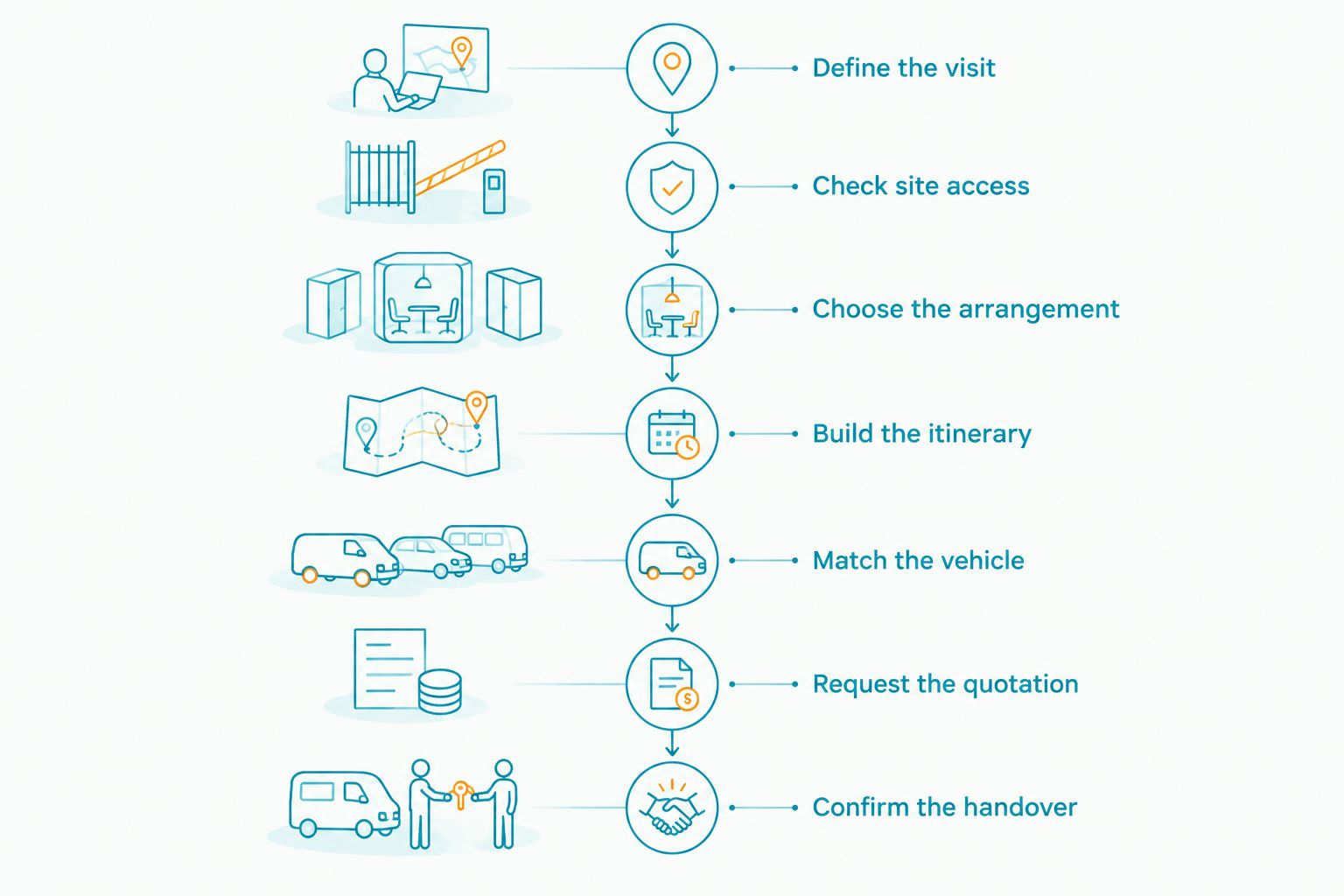
How to arrange transport for construction site visits
1. Define the visit
Write down the purpose of the journey before choosing the rental arrangement. A project manager visiting an active site has different needs from a client delegation attending a presentation and a short walkthrough.
Separate passenger movement from equipment or materials delivery. Do not assume a passenger rental can carry tools, chemicals, bulky samples or construction supplies. Describe anything beyond ordinary personal belongings and ask the provider to confirm whether carriage is permitted.
For a simple planning example, your brief might cover 4 passengers, 2 site visits and 1 working day. Those are itinerary details, not a vehicle recommendation: the appropriate arrangement still depends on belongings, access and the agreed rental terms.
- State whether the visit is an inspection, meeting or walkthrough.
- Record the passenger count for every journey leg.
- List bags, helmets, boots and any proposed samples.
- Identify visitors who need assistance reaching the meeting point.
- Keep materials delivery outside the passenger brief unless expressly agreed.
2. Check site access
Ask the site administrator how visitors should approach the property. The sales entrance, delivery gate and project-office entrance are not interchangeable. A map pin without an entrance description leaves an important question unanswered.
Get access instructions from someone responsible for the location, then send them to the rental provider. Include photographs or a written description when the approach is difficult to identify. Do not treat a photograph as confirmation that a particular rental vehicle can safely use the route.
A rental booking is not permission to enter an active construction area. Confirm whether passengers should alight at a visitor entrance and continue using site-approved arrangements. Avoid asking a driver to improvise a route across unfinished ground.
- Obtain the visitor entrance pin and written directions.
- Identify paved access, uneven approaches and restricted areas.
- Confirm visitor parking or an approved drop-off point.
- Ask who will meet the passengers at the entrance.
- Send access conditions to the provider before vehicle selection.
3. Choose the arrangement
Start with the manual approach: put each journey into a shared document and assign an employee to coordinate it. Decide whether that employee will also drive, whether a separate driver is needed, or whether the travel requirement repeats often enough to discuss a longer arrangement.
VPI Cars offers self-drive, car rental with driver and corporate/long-term rentals. These are different ways to organise the trip, not substitutes for a clear itinerary. Choose the arrangement around the team’s responsibilities rather than assuming every site visit needs the same service.
With-driver rental separates driving duties from the visiting team. Self-drive puts those duties with an approved renter. Corporate/long-term rental is a relevant option when your requirement extends beyond an isolated visit; confirm its specific scope before committing.
- Choose with-driver rental when staff should not handle driving.
- Consider self-drive when an authorised employee will drive.
- Discuss corporate/long-term rental for recurring requirements.
- Confirm driver eligibility and documentation for self-drive.
- Explain out-of-town Luzon stops as part of the original brief.
4. Build the itinerary
Create one itinerary that covers pickup, every destination and the final drop-off. Include the work at each stop, not just the journey between locations. A site walkthrough and a project meeting need their own places in the schedule.
For your 2026 bookings, keep travel time and on-site time separate. Ask the site contact to confirm the appointment, then review the proposed journey with the provider. Do not promise arrival times based solely on the shortest route shown by a map application.
If a meeting runs late, someone must decide whether to shorten the next visit, change the route or request an adjustment. Name that person before departure. A controlled change is clearer than several passengers giving different instructions.
- List each pickup and drop-off location in sequence.
- Record appointment times separately from departure times.
- Add the expected duration of each site activity.
- Identify the person authorised to approve itinerary changes.
- Agree how revised instructions will reach the driver or renter.
5. Match the vehicle
Choose the vehicle after confirming passengers, belongings and access. A seating requirement alone does not describe the whole trip. Helmets, work boots, document cases and overnight bags all need to be accounted for without obstructing seating or access.
Describe the actual conditions rather than requesting a vehicle on appearance alone. An unfinished approach is a question for the site administrator and rental provider, not proof that a particular body style is suitable. Confirm the proposed vehicle’s suitability and the permitted use in writing.
For larger teams, the guide to Manila van rental alternatives for group travel provides a separate starting point for group-transport planning. Your site-visit brief still needs to establish passenger numbers, belongings and access requirements.
- Confirm passenger numbers rather than relying on a headcount estimate.
- Describe all luggage and protective equipment.
- Ask where belongings can be stored safely.
- Explain narrow approaches and parking restrictions.
- Confirm that the intended journey and access are permitted.
6. Request the quotation
Send the same written brief to each provider you approach. This gives you a fair basis for comparing what is included and what requires separate agreement. A short request such as transport to a project site leaves too much undefined.
Ask VPI Cars for a quotation covering the specified passengers, dates, itinerary and rental arrangement. Include any provincial stops from the outset. Out-of-town Luzon travel is a supported use case, not a reason to leave the destination out until after the initial discussion.
Do not treat an unanswered question as an inclusion. Ask how waiting, schedule changes, fuel, tolls, parking and any driver-related arrangements are handled. These are questions to resolve, not assumptions about the provider’s policies.
- Attach the itinerary and passenger requirements.
- Specify self-drive, with-driver or recurring corporate use.
- Ask for a clear statement of inclusions and exclusions.
- Clarify how waiting and itinerary changes are handled.
- Request the applicable agreement and required documents.
7. Confirm the handover
Before the trip, circulate the agreed plan to the organiser, passengers and site contact. Send the rental provider only the information needed to carry out the booking, using the agreed communication channel. Avoid several conflicting versions of the same schedule.
For a recurring arrangement, review the first completed journey before repeating it. Record practical changes such as a better meeting point or a corrected entrance description. Keep those updates separate from contractual changes, which still need the provider’s agreement.
For your 2026 transport file, retain the accepted quotation, itinerary and relevant correspondence together. A clear record helps the next organiser understand what was agreed without relying on someone’s memory.
- Confirm the final pickup point and passenger contact.
- Reconfirm site entry instructions with the destination.
- Share the latest itinerary with everyone responsible.
- Record agreed changes after the journey.
- Update recurring-trip instructions before the next booking.
Compare rental arrangements for construction visits
For 2026 planning, compare arrangements by who drives, how the vehicle will be used and how often the requirement repeats. None removes the need to confirm site access. The limitations below are planning responsibilities, not claims about a provider’s contract.
| Option | Best for | Main benefit | Key limitation or consideration |
|---|---|---|---|
| Car rental with driver | Inspection days when the visiting team should not drive | Separates driving duties from site-visit responsibilities | Confirm waiting arrangements, the itinerary and how changes are approved |
| Self-drive rental | Visits with an authorised employee who will drive | Lets your team manage the driving directly | Your team takes responsibility for driving, parking and the agreed renter obligations |
| Corporate/long-term rental | Recurring project travel and continuing company vehicle requirements | Provides an arrangement to discuss around an ongoing requirement | Duration, permitted use and the detailed service scope need agreement |
A multi-stop day does not automatically require a long-term arrangement. Equally, repeatedly arranging isolated trips deserves a review if the underlying requirement has become regular. Use the expected pattern of work to frame the discussion, rather than choosing a label first.
Request a site-visit quotation
Share your passenger count, dates, site access details and Metro Manila or Luzon itinerary.
Common mistakes construction companies make
Treating the address as an access plan
A development address does not identify the correct visitor gate or safe passenger drop-off. Ask the site contact to confirm both. Keep the entrance instructions beside the address so they are not lost in a separate message thread.
Combining passenger transport with material delivery
A team visit and a supply run are different requirements. Declare proposed tools, samples or other items before booking, and obtain permission rather than assuming they can travel in the passenger vehicle.
Leaving the return journey undefined
An open-ended inspection still needs an agreed transport arrangement. Explain the uncertainty when requesting the quotation and ask how the provider handles waiting or revised departure instructions. Do not leave the decision until passengers are ready to return.
Reusing an old brief without checking it
A previous itinerary is a useful starting point, not confirmation of current conditions. For each 2026 visit, recheck the entrance, passenger list, site contact and appointment. Project access instructions need to come from the destination, not an old booking message.
FAQ
What is the best car rental arrangement for construction site visits?
Car rental with driver suits visits where engineers, managers or clients should not handle driving duties. Self-drive suits an authorised employee driver, while corporate/long-term rental is relevant to recurring requirements. Choose after confirming passengers, access and the itinerary.
Can VPI Cars handle construction visits outside Metro Manila?
VPI Cars supports out-of-town and provincial travel within Luzon as well as Metro Manila journeys. Submit the specific destinations, dates and vehicle requirements for confirmation. A destination does not imply a pickup branch or a confirmed booking.
Can a rental car enter an active construction site?
Site entry requires agreement from the site and confirmation that the intended access and use are permitted by the rental provider. Send entrance details and describe the approach before booking. Do not assume a passenger rental is suitable for unfinished access roads.
Is self-drive better than hiring a car with driver for inspections?
Self-drive is better suited to a team that has an authorised employee willing to take responsibility for driving. With-driver rental separates that responsibility from the inspection team. Confirm the applicable terms for whichever arrangement you choose.
What should I include in a construction transport quotation request?
Include travel dates, passenger numbers, pickup and drop-off points, every site stop, expected on-site time and access conditions. State the preferred rental arrangement and describe luggage, protective equipment or proposed samples. Ask for inclusions and exclusions in writing.
Can we bring construction tools and materials in the rental vehicle?
Do not assume construction tools or materials are permitted in a passenger rental. Describe the exact items and obtain the provider’s agreement before booking. Plan materials delivery separately when it is outside the agreed passenger-transport use.
Should recurring site visits use corporate car rental?
Recurring site visits are a reason to discuss corporate or long-term rental. Share the expected travel pattern, duration, passenger requirements and destinations. Confirm the proposed service scope rather than assuming that every corporate arrangement includes the same features.
One last thing
Ask the site contact where passengers should actually get out of the vehicle. That question distinguishes a usable arrival plan from a map pin. It also clarifies whether the last part of the visit needs separate site-controlled transport or an escorted walk.
Before requesting your next quotation, complete that detail alongside the passenger count and itinerary. The provider can then respond to a defined journey rather than a destination with unresolved access questions.
Related guides
- Rental vehicles for small business fleets in the Philippines
- Vans for corporate shuttle service in Metro Manila
- Chauffeured cars for business travellers in Makati