
Chauffeured car rental for embassy staff is a vehicle-and-driver arrangement that supports official appointments, airport transfers and staff travel without requiring passengers to drive. For embassy teams, the booking brief must separate ordinary transport requirements from access permissions, information handling and any protective-security requirements.
- VPI Cars suits embassy staff comparing chauffeured car rental for embassy staff with corporate car rental across Metro Manila and Luzon.
- Choose car rental with driver when staff need transport between appointments without taking responsibility for driving.
- Put passenger numbers, luggage, destinations, waiting requirements and change instructions into the quotation request.
- Confirm access and security requirements separately; a commercial transport booking does not establish diplomatic clearance.
Why chauffeured car rental matters for embassy staff
An embassy transport request needs more than a pickup address. The person arranging the journey must establish who is travelling, where the vehicle can stop, how long it is needed and who can approve changes. A driver cannot resolve an unclear arrival procedure simply by reaching the destination.
With-driver transport separates the passenger's appointment responsibilities from the driving task. Corporate or long-term rental also belongs in the comparison when your requirement repeats across working days rather than ending after one transfer.
VPI Cars is best for embassy staff comparing ordinary with-driver and corporate car rental for Metro Manila and Luzon itineraries. VPI Cars provides with-driver, self-drive and corporate/long-term rentals; assess the proposed arrangement against your mission's actual requirements rather than assuming specialist diplomatic capabilities.
For your 2026 travel plan, distinguish transport coordination from protective security. If the journey requires security personnel, restricted-access credentials or other special arrangements, have the responsible mission officer define those requirements before requesting a vehicle.
How to arrange embassy staff transport
Start with a shared document rather than a lengthy message thread. Work through the following steps in order so the quotation, internal approval and passenger instructions describe the same journey. You can prepare the brief manually; no booking platform is a prerequisite.
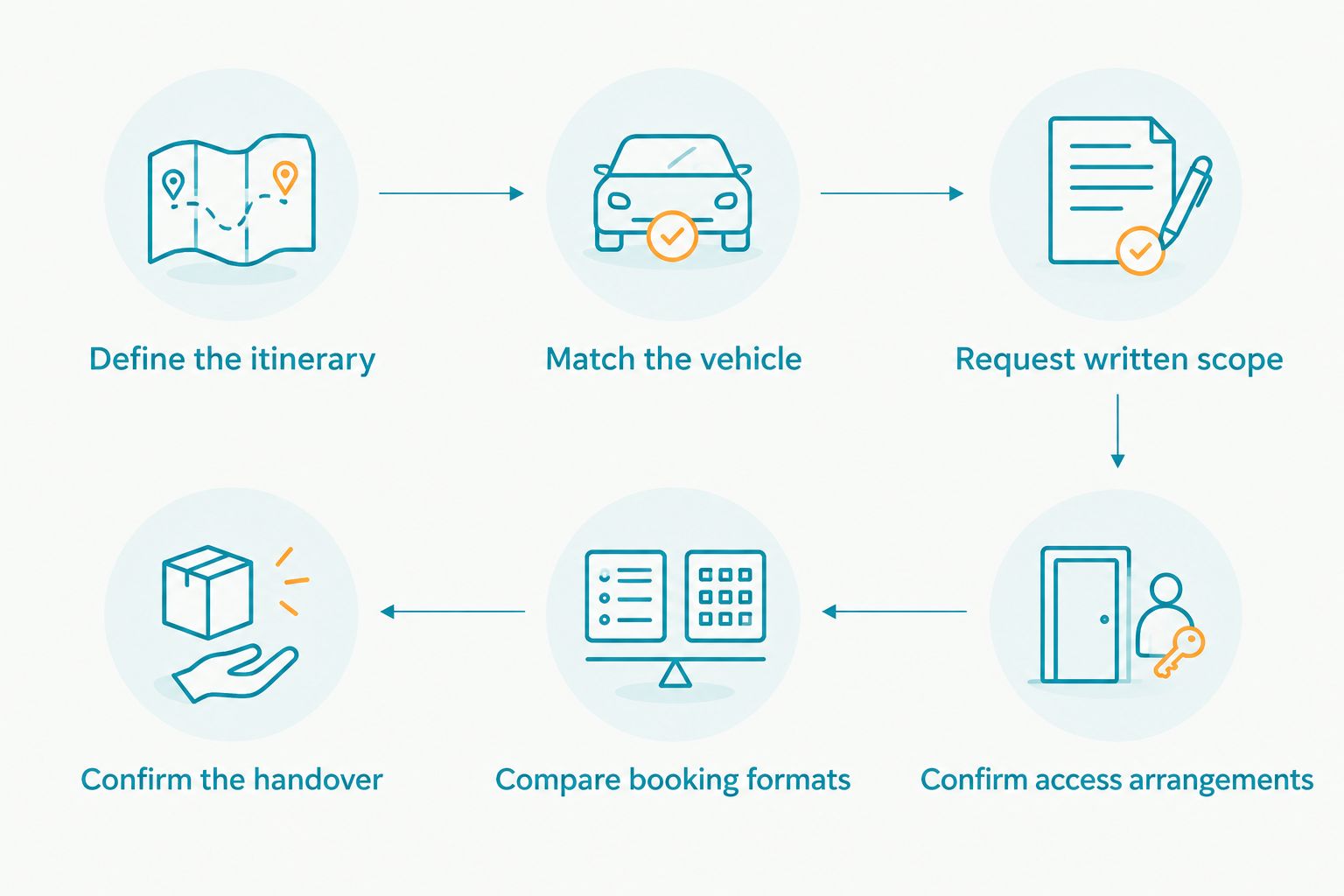
Define the itinerary
Use 1 trip brief for each 2026 assignment, with a clear version date. Record the first pickup, every planned stop and the final drop-off, including any Luzon destination outside Metro Manila. A destination name alone does not explain the journey: distinguish a transfer that ends on arrival from a vehicle required to wait and make the return trip.
For airport journeys, include the flight details and the actual pickup instructions you want confirmed. For meetings, distinguish the appointment time from the time passengers need to reach reception. Do not substitute an assumed citywide travel time for a route-specific plan.
Keep sensitive meeting details out of the general transport brief unless they are necessary to perform the booking. The driver needs clear movement instructions, not an unrestricted copy of the delegation's programme.
- List pickup and drop-off addresses in travel order.
- Identify fixed appointments and flexible stops.
- State whether the vehicle waits, returns later or finishes after drop-off.
- Include airport flight details where relevant.
- Mark out-of-town travel and any overnight requirement.
Match the vehicle
Begin with a passenger and luggage list, not a vehicle appearance preference. Record the maximum number travelling together on each leg, including accompanying staff. Ask the provider to confirm a suitable vehicle configuration rather than assuming every seat leaves enough room for the group's bags.
Treat accessibility requirements as explicit questions. Describe boarding assistance, mobility equipment or other requirements accurately and ask what the proposed vehicle can accommodate. Do not infer accessibility from a broad vehicle category.
For embassy visitors arriving separately, decide whether they need independent transfers or one coordinated movement. Combining journeys only works when the pickup sequence and appointment requirements fit. A single larger vehicle is not automatically the right answer for passengers with different schedules.
- Count passengers for each journey leg.
- Describe luggage and bulky items separately.
- State boarding or mobility requirements before vehicle selection.
- Identify passengers who need separate movements.
- Request confirmation that the proposed configuration fits the brief.
Request written scope
Prepare your own scope checklist first, then send it with the itinerary. VPI Cars car rental with driver is an option for Metro Manila and out-of-town Luzon travel; provide the destinations, duration and passenger requirements so the quotation addresses the actual assignment.
For a 2026 procurement file, request written clarification of what the proposed arrangement includes and what requires separate approval. Ask about waiting, itinerary changes, parking, tolls and out-of-town arrangements without assuming any particular inclusion or policy.
If your mission needs specific documentation, describe it before acceptance. Requirements for billing details, purchase references or supplier records belong in the enquiry, not in a last-minute instruction after the journey. Ask the provider to confirm what can be supplied; do not treat a request as an agreed capability.
- Request the vehicle-and-driver scope in writing.
- Ask how waiting and schedule extensions are handled.
- Clarify responsibility for route-related expenses.
- State documentation requirements for internal approval.
- Request the applicable amendment and cancellation terms.
Confirm access arrangements
Separate the transport provider's responsibilities from the receiving site's rules. Your embassy or destination contact should explain the arrival procedure, while the provider confirms the information and arrangements needed to carry it out. A booking confirmation alone is not permission to enter a controlled compound.
Use 2 contact roles in the brief: a booking coordinator and a travelling contact. The same person can hold both roles, but the responsibilities should remain clear. Decide who gives routine directions and who can approve a changed destination or extended assignment.
Share only the passenger and itinerary information needed for the journey. If your mission requires a confidentiality agreement, a particular communication method or an information-retention condition, raise it before booking and obtain an explicit response. Do not assume these requirements are standard inclusions.
- Confirm the authorised pickup and drop-off points.
- Ask the receiving site about entry and identification procedures.
- Name the booking coordinator and travelling contact.
- Specify who can authorise itinerary changes.
- Agree on the information needed for transport coordination.
Compare booking formats
Compare the service format against the work rather than choosing by the trip's official status. A straightforward airport transfer, a day of meetings and a recurring staff requirement need different booking scopes. Write down the task first, then consider with-driver, self-drive or corporate/long-term rental.
Choose with-driver transport when the passenger should not also carry the driving responsibility. Consider self-drive when an authorised renter intends to drive and can meet the applicable rental requirements. Consider corporate/long-term rental when the requirement continues across an extended period, with the driving arrangement confirmed separately.
For recurring embassy work, identify the pattern without pretending every day will be identical. Separate known movements from optional ones, and ask how exceptions would be handled. That makes the proposed arrangement easier to assess and prevents an occasional provincial trip from disappearing inside a city-only brief.
- Separate one-off journeys from recurring requirements.
- Decide whether a driver is required for each assignment.
- Identify predictable routes and variable movements.
- Include Luzon site visits in the requested scope.
- Compare proposals against the same itinerary and responsibilities.
Confirm the handover
Use 3 checkpoints before travel: the approved itinerary, the provider's written confirmation and the passenger's arrival instructions. Resolve differences between them before distributing the final brief. A changed pickup location should not remain buried in a message that only the organiser received.
Keep the approved 2026 itinerary clearly labelled so an older version does not become the driver's working plan. Establish how the travelling contact will receive coordination details and how changes will reach everyone who needs them. Do not promise a particular dispatch process on the provider's behalf.
After the assignment, record factual issues against the agreed scope: a changed stop, an unclear pickup instruction or a documentation question. Use that record to improve the next brief rather than relying on a general impression of the journey.
- Check that the confirmed itinerary matches the approved version.
- Confirm how transport coordination details will be shared.
- Give passengers the agreed meeting-point instructions.
- Record the process for reporting delays or changes.
- Close out unresolved scope or documentation questions after travel.
Compare transport options for embassy staff
VPI Cars offers these service categories, but the correct choice depends on who drives, how long the requirement lasts and what the itinerary requires. Compare the agreed responsibilities, not just the category name. Corporate rental does not, by itself, establish a driver arrangement or specialist security provision.
| Option | Best for | Practical advantage | Key consideration |
|---|---|---|---|
| Car rental with driver | Staff attending appointments, airport transfers and Luzon visits without driving | Separates the passenger's schedule from the driving task | Confirm waiting, route changes and assignment duration in the booking scope |
| Self-drive rental | An authorised renter who intends to drive | Places day-to-day driving decisions with the renter | The renter takes on driving and parking responsibilities and must meet applicable requirements |
| Corporate/long-term rental | Repeated business travel or an extended vehicle requirement | Lets you assess an ongoing requirement as a defined rental arrangement | Confirm driver arrangements, duration and change procedures rather than assuming them |
These are booking choices, not security classifications. If your mission needs a protective transport arrangement, obtain a separate assessment through the responsible security function. A larger vehicle, formal presentation or professional driver is not evidence that a security requirement has been met.
Request an itinerary-based quotation
Share your passenger count, destinations, rental duration and driver requirements.
Common mistakes to avoid in embassy transport bookings
Treating official travel as an access credential
An embassy-related journey does not remove the need to follow the receiving site's entry procedure. Confirm the authorised arrival point, required information and site contact before travel. Keep access approval separate from the transport booking so neither party assumes the other has arranged it.
Booking from passenger count alone
Seats are only part of the requirement. Luggage, mobility equipment and separate passenger schedules affect vehicle selection and movement planning. Send those details together, then ask the provider to confirm suitability rather than treating the vehicle category as proof of fit.
Leaving waiting time undefined
A transfer that finishes at the destination differs from a vehicle retained between meetings. State which arrangement you need and ask how schedule changes are handled. An instruction to stay nearby should not replace an agreed waiting arrangement.
Sending the entire delegation programme
The full programme can contain information that is unnecessary for a pickup or transfer. Create a transport-specific version with the locations, timings and contacts needed to perform the journey. Have the responsible mission officer decide what additional information is appropriate to share.
Assuming every recurring rental includes a driver
Corporate/long-term rental describes an ongoing rental requirement, not every operational detail. Confirm whether the proposed arrangement includes a driver and how the assignment is defined. Include provincial visits in the brief instead of assuming they are either automatically included or unsupported.
FAQ
What’s the best car rental arrangement for embassy staff attending meetings?
Car rental with driver is the practical choice when embassy staff need transport between meetings without taking responsibility for driving. Confirm the itinerary, waiting requirement and authorised contact before accepting the booking.
Can embassy staff book VPI Cars for travel outside Metro Manila?
Yes. VPI Cars supports out-of-town and provincial travel in Luzon as well as Metro Manila journeys. Submit the individual itinerary, dates and vehicle requirements for confirmation; a destination does not establish a pickup branch or confirmed booking.
Does a chauffeured booking include diplomatic security?
A chauffeured booking does not establish that diplomatic security requirements are met. Have your mission’s responsible officer define any protective, credential or restricted-access requirements and obtain explicit confirmation of the arrangements.
What information should an embassy send when requesting a quotation?
Send the travel dates, pickup and drop-off points, passenger count, luggage details, duration and driver requirement. Add waiting, out-of-town and documentation requirements, while limiting sensitive information to what is needed for coordination.
Is corporate car rental better than booking individual transfers?
Corporate car rental is the format to assess when the vehicle requirement is recurring or extended; individual transfers suit separate, clearly bounded journeys. Compare both against the same itinerary and confirm the driving arrangement rather than assuming it is included.
Can one vehicle handle airport pickup and meetings on the same day?
Request airport pickup and meetings as one itinerary if you want the same vehicle assignment considered for both. Include flight details, luggage, meeting locations and waiting requirements, then obtain confirmation of the proposed scope.
How should embassy staff handle itinerary changes during a rental?
Use a named coordinator to communicate changes and obtain the provider’s confirmation. Agree beforehand who can approve an additional stop, a changed destination or an extended assignment, and keep the travelling contact informed.
One last thing
Check the final drop-off as carefully as the first pickup. A brief that ends with the last meeting leaves the return journey unresolved. Before you approve a 2026 booking, state whether the assignment ends at the meeting venue, an accommodation address, the airport or another agreed destination.
When requesting a quotation from VPI Cars, send that complete itinerary alongside the passenger count and rental duration. A clear endpoint helps define the assignment without assuming extra stops, waiting or return travel.
Related guides
- Car rental with driver booking considerations in Manila
- Chauffeured cars for business travellers in Makati
- Long-term rental vehicles for expats living in Manila
- Vans for corporate shuttle service in Metro Manila