
Best overall: a sedan for a small party travelling light. Best for family luggage: an MPV. Best for compact parking: a hatchback. The best car for a Tagaytay drive depends on your passengers, bags, planned stops and whether you want to drive yourself.
- The best car for tagaytay drive is a sedan for a small party with modest luggage.
- Choose an MPV for family packing needs; confirm the actual seating and luggage layout before booking.
- A hatchback suits compact parking; a crossover suits travellers who prefer a higher seating position.
- VPI Cars offers self-drive and with-driver car rental; request a quotation for your specific Manila–Tagaytay itinerary.
Why the vehicle choice matters
A Tagaytay weekend combines city driving, uphill and downhill sections, destination parking and luggage decisions. Choose for the whole itinerary, not just the open-road portion. A larger vehicle adds little value if your party fits comfortably in something smaller.
For a 2026 weekend trip, start with passenger numbers and luggage, then decide who will drive. VPI Cars offers self-drive and with-driver car rental. Request a quotation with your Manila pickup point, Tagaytay stops and return arrangements rather than assuming a particular vehicle or route is confirmed.
VPI Cars is a fit for Manila travellers seeking self-drive or with-driver car rental for a planned Luzon trip. The useful choice is the service format that matches your driver's confidence and your group's needs.
What makes the best car for a Tagaytay drive?
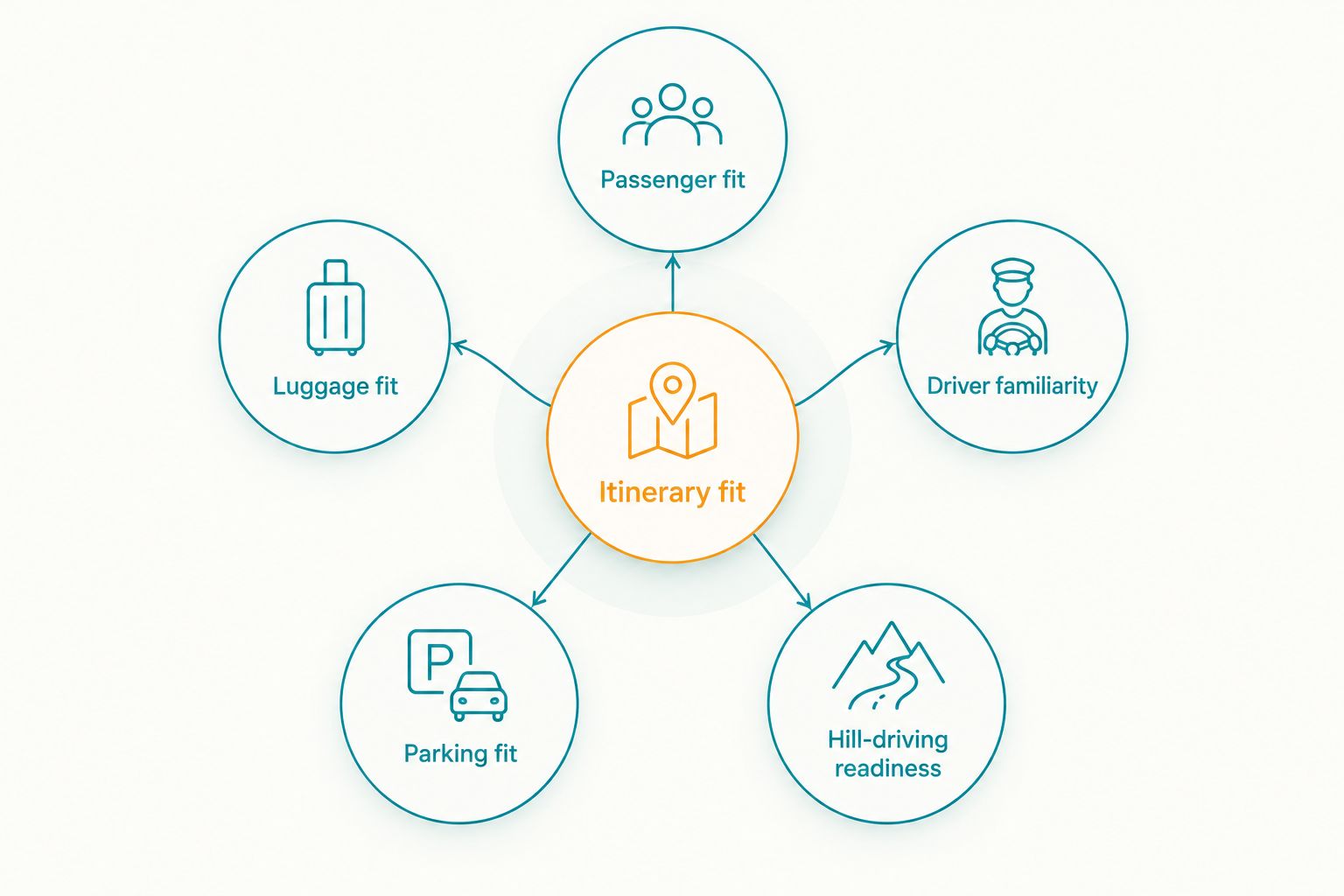
Use these criteria before comparing vehicle classes:
- Passenger fit: Count everyone travelling, including children. Confirm usable seats, seat belts and any child-restraint requirements for the actual vehicle.
- Luggage fit: Check bags with every required seat in use. Folding a seat is not a solution when someone needs it.
- Driver familiarity: Choose a vehicle whose size, transmission and controls you can operate confidently.
- Parking fit: Consider the parking arrangements at your hotel, restaurants and planned stops, not just the road between destinations.
- Hill-driving readiness: Check the vehicle's condition and understand how its transmission handles uphill starts and downhill speed control.
- Itinerary fit: Compare a simple overnight stay with a trip involving several stops, different passengers or an unfamiliar driver.
For example, 2 passengers with overnight bags present a different packing problem from 4 passengers with suitcases. A party of 6 passengers needs the exact seating layout checked before the luggage question can even be answered. These are planning examples, not seating claims for any vehicle class.
Best vehicle classes at a glance
This 2026 shortlist ranks vehicle classes by trip needs, not specific models. Equipment, dimensions and seating arrangements vary within each class, so confirm the quoted vehicle before deciding.
| Rank and option | Best for | Standout benefit | Key limitation |
|---|---|---|---|
| 1. Sedan | Small parties travelling light | Separate boot for luggage | Boot access can restrict bulky items |
| 2. Hatchback | Travellers prioritising compact parking | Rear hatch gives access to the luggage area | Extra cargo space often requires folding seats |
| 3. SUV or crossover | Travellers prioritising a higher seating position | Elevated seating in typical configurations | Vehicle size and luggage room vary considerably |
| 4. MPV | Families balancing passengers and bags | Passenger-focused seating layouts | Occupied rear rows can restrict luggage space |
| 5. Passenger van | Larger groups travelling together | Group-oriented passenger accommodation | Size demands more parking and manoeuvring attention |
1. Sedan: best car for a small Tagaytay travel party
A sedan is the default choice when your passengers and bags fit without compromises. Its separate boot keeps luggage outside the passenger compartment, while the familiar passenger-car layout makes it a sensible starting point for a straightforward weekend.
Do not reject a sedan simply because Tagaytay involves hills. Roadworthiness, the actual vehicle's suitability and correct driving technique matter more than choosing a larger body style by default.
Sedan pros:
- A separate boot keeps bags away from passenger seating.
- The body style suits a simple hotel-and-dining itinerary when everything fits.
- It avoids adding seating rows your small party does not need.
Sedan cons:
- The boot opening can make bulky luggage awkward to load.
- Rear-seat comfort depends on the actual vehicle and passenger needs.
Best for: Couples, friends or a small family travelling with modest luggage.
Before accepting a sedan, list your bags rather than describing them as just a few things. Suitcases, a stroller and food containers create different loading demands. Ask whether everything fits with the required seats occupied.
Verdict: Buy the sedan option if your passengers and luggage fit comfortably. Do not upgrade solely because the destination is uphill.
2. Hatchback: best car for parking-focused Tagaytay stops
A hatchback provides rear-door access to a shared passenger-and-cargo compartment. A compact example suits travellers who want a smaller vehicle for destination parking and do not need substantial luggage space.
The body label alone does not establish the dimensions. Check the actual vehicle, especially if compact parking is your main reason for choosing it.
Hatchback pros:
- The rear hatch gives direct access to bags.
- A compact vehicle reduces the space you need when manoeuvring.
- Folding rear seats can accommodate awkward luggage when those seats are unoccupied.
Hatchback cons:
- Using all passenger seats limits the benefit of folding-seat cargo space.
- Luggage shares the cabin, so bags need secure placement and clear visibility.
Best for: Travellers with light luggage who prioritise a compact vehicle at their stops.
For a 2026 weekend with several restaurant or hotel stops, check parking access before treating a smaller car as the answer. A hatchback does not solve steep entrances, restricted access or a full parking area. It simply changes the vehicle's space requirements.
Verdict: Buy the hatchback option when compact dimensions matter more than luggage flexibility. Skip it if your packing plan depends on removing a passenger seat you need.
3. SUV or crossover: best for a higher seating position
An SUV or crossover is worth considering when you prefer an elevated seating position. That preference is separate from needing extra seats, more luggage space or special drivetrain equipment.
Do not interpret the category name as proof of all-wheel drive, better braking or enough room for every bag. Those are vehicle-specific questions.
SUV or crossover pros:
- Typical configurations offer a higher seating position than a conventional sedan.
- Rear-hatch access helps you reach the cargo area.
- Different layouts let you compare passenger and luggage needs against the actual vehicle.
SUV or crossover cons:
- Exterior size does not establish usable luggage space.
- A larger example requires more attention in tight parking areas.
Best for: Travellers who specifically prefer elevated seating and have checked the vehicle's dimensions.
Test the choice against your passengers too. A higher seat can suit one person's preferences while making entry less convenient for another. Ask about boarding needs rather than assuming a taller vehicle is more comfortable for everyone.
Verdict: Buy the SUV or crossover option for a confirmed seating preference. Skip the upgrade if it adds size without solving a passenger or luggage problem.
4. MPV: best for family luggage and passenger planning
An MPV puts passenger accommodation at the centre of the vehicle layout. It belongs on your shortlist when a family trip involves several occupants, overnight bags and items that need their own loading space.
Its usefulness depends on the seating configuration. A rear row that looks convenient in an empty vehicle can leave a much smaller luggage area once everyone is seated.
MPV pros:
- Passenger-focused layouts support family seating decisions.
- Some configurations offer seating flexibility when particular seats are not needed.
- The rear loading area lets you assess bags and passenger space together.
MPV cons:
- Occupied rear rows can reduce luggage room.
- Access to rear seats needs checking for passengers with boarding difficulties.
Best for: Families whose passenger-and-bag requirements exceed a smaller car's practical layout.
For a 2026 family weekend, send the passenger count alongside a realistic bag list. Include strollers, mobility aids and bulky items in the inquiry. None should become an unexpected loading problem at pickup.
Verdict: Buy the MPV option after confirming the occupied-seat luggage layout. Hold if the quotation identifies only a broad class without resolving your packing needs.
5. Passenger van: best for keeping a larger group together
A passenger van is the class to investigate when a larger party wants to travel in the same vehicle. It changes the planning task: seating, luggage, boarding and parking all need explicit attention.
For a casual outing or a colleagues' weekend, travelling together can simplify shared departures. It does not remove the need to confirm suitable seats and luggage storage.
Passenger van pros:
- Group-oriented seating supports a shared itinerary.
- Passengers can travel together rather than coordinate separate departures.
- The layout gives you a clear basis for checking individual seating needs.
Passenger van cons:
- Vehicle size makes parking and manoeuvring more demanding.
- Passenger capacity alone does not establish luggage capacity.
Best for: Larger families or groups that prioritise travelling together.
A self-drive van is not the right choice merely because someone in the party can drive a smaller car. Consider a with-driver quotation if the assigned driver is unfamiliar with the vehicle's size or does not want driving responsibility throughout the outing.
Verdict: Buy the van option when the group fits with its bags and the driving arrangement is suitable. Skip it for a small party without a specific space requirement.
Self-drive or with-driver: choose before requesting a quote
Choose self-drive when you want control of the itinerary and your assigned driver is comfortable with the vehicle. The trade-off is responsibility for driving, parking and staying attentive throughout the journey.
Choose with-driver when you want to remove driving duties from your travelling party. You still need to agree on the itinerary, waiting arrangements and quotation scope; hiring a driver does not replace trip planning.
| Arrangement | Best for | Main benefit | Main trade-off |
|---|---|---|---|
| Self-drive | A confident driver seeking itinerary control | Your party handles its own movements | A traveller remains responsible for driving and parking |
| With-driver | A party that wants driving handled separately | Travellers do not take on driving duties | Stops, timing and service scope need agreement |
VPI Cars offers both rental formats. Specify the preferred arrangement before requesting a quotation so the inquiry answers your actual transport need.
What to include in your Tagaytay quotation request
For your 2026 inquiry, provide the following details together:
- Pickup and return: Give the Metro Manila locations, dates and intended times.
- Passengers: State the full count and any boarding or seating requirements.
- Luggage: Describe suitcases, overnight bags and bulky items.
- Itinerary: List the Tagaytay destinations and whether the trip includes an overnight stay.
- Driving arrangement: Request self-drive or with-driver service explicitly.
- Quotation scope: Ask what is included and how changes to the agreed itinerary are handled.
VPI Cars can receive a more useful inquiry when these details are specific. Confirm the vehicle, terms and route arrangements before treating the trip as booked.
Request a Tagaytay rental quotation
Share your passengers, luggage, itinerary and preferred driving arrangement.
How these vehicle classes are ranked
The ranking follows passenger fit, luggage fit, driver familiarity, parking needs and itinerary requirements. The sedan comes first as the default for a small party; the other classes each solve a different problem. This is a planning guide, not a model-level road test or a statement of fleet availability.
Which car should you choose for Tagaytay?
Start with a sedan, then change classes only to solve a specific need. Choose a hatchback for compact dimensions, an SUV or crossover for elevated seating, an MPV for family packing requirements, or a passenger van for a larger group.
Separate the vehicle decision from the driving decision. The best-fitting car still needs a confident driver, and a with-driver arrangement still needs a suitable passenger-and-luggage layout.
FAQ
What’s the best car for a Tagaytay drive from Manila?
A sedan is the best starting point for a small party with modest luggage. Choose another class when passenger numbers, bags, boarding needs or driver preferences create a specific requirement.
Do I need an SUV to drive to Tagaytay?
You do not need an SUV solely because your destination is Tagaytay. Choose a roadworthy vehicle suited to your route and load, and make sure the driver understands its controls and hill-driving operation.
Is an MPV better than a sedan for a family weekend?
An MPV is the better choice when its actual layout accommodates your family and bags more comfortably. Check luggage room with every required passenger seat in use before deciding.
Should I book self-drive or a car rental with driver?
Choose self-drive if your assigned driver is comfortable with the vehicle and wants itinerary control. Choose with-driver service if your party wants driving handled separately, then agree on the stops, timing and quotation scope.
What vehicle should I request for six passengers?
Request a vehicle whose confirmed seating accommodates six passengers and whose luggage area fits their bags. An MPV or passenger van belongs on the shortlist, but a class name alone does not confirm the required layout.
How much does a Tagaytay weekend car rental cost?
Request a quotation for your dates, vehicle requirements, pickup point, itinerary and driving arrangement. Compare what each quotation includes rather than treating an unspecified headline rate as the trip total.
What should I check before driving downhill from Tagaytay?
Understand the vehicle’s transmission controls and follow its operating instructions for downhill driving. Keep speed controlled, leave space ahead and stop safely if the vehicle develops a braking or handling problem.
One last thing
Check luggage space with the seats occupied, not folded away. A vehicle can look spacious in a photo and still fail your actual packing plan. Resolve that question before choosing a larger class or accepting a quotation.
Related guides
- Cars for first-time self-drive renters in Manila
- Car rental with driver costs in Manila
- Van seating capacity for Manila group trips