
Best overall: a compact automatic sedan. Best for tight parking: a small automatic hatchback. Best for a higher seating position: a compact automatic crossover. Best for family luggage: an automatic MPV. For first-time self-drive renters in Manila in 2026, choose the smallest vehicle that comfortably fits your passengers and bags.
- The best car for first time self drive renters Manila is a compact automatic sedan for ordinary city trips.
- A small automatic hatchback suits tight parking; check luggage space before choosing.
- Choose a compact crossover for a higher seating position, not as permission to drive through floodwater.
- VPI Cars offers self-drive rentals; request a quotation for a vehicle suited to your route and passengers.
Why this matters
Your first rental should reduce unfamiliar tasks, not add them. You already need to follow directions, identify pickup points and find parking; learning an unfamiliar transmission or judging an unnecessarily large vehicle adds work.
VPI Cars offers self-drive rentals alongside with-driver and corporate rentals. VPI Cars self-drive rental is best for customers who want to drive themselves; choose a familiar transmission and a manageable vehicle size.
This 2026 guide ranks vehicle types rather than named models. Use it to decide what to request, then confirm the exact vehicle, transmission and rental terms before booking. A category name alone does not tell you how the supplied car handles or what equipment it includes.
What makes the best car for a first-time renter?
Use these criteria before comparing vehicle categories:
- Familiar transmission: Choose an automatic if that is what you normally drive. Your rental is not the place to learn manual clutch control.
- Manageable dimensions: Pick a vehicle whose corners you can judge during turns, parking and reversing.
- Clear visibility: Check your view from the adjusted driving position, including mirrors and rearward visibility.
- Usable luggage space: Fit your actual bags without blocking windows or leaving loose items around passengers.
- Understandable controls: Locate the lights, wipers, hazard lights, parking brake and gear selector before leaving.
- Route suitability: Match the car to your passengers, parking arrangements and planned roads—not simply its appearance.
A reversing camera or parking sensor is useful, but confirm that the actual rental has it. Neither replaces looking around the vehicle and checking for pedestrians before moving.
Best first-time rental cars at a glance
| Rank and vehicle type | Best for | Standout benefit | Key limitation |
|---|---|---|---|
| Compact automatic sedan | Everyday Manila trips | Separate luggage compartment and a conventional passenger-car layout | Rear boot position takes practice when reversing |
| Small automatic hatchback | Tight parking with light luggage | Short body and rear hatch access | Passenger and luggage needs compete for space |
| Compact automatic crossover | Drivers who prefer a higher seating position | Raised driving position | Taller seating does not guarantee clear sightlines |
| Automatic MPV | Families travelling with more passengers and bags | Flexible passenger-and-cargo layout | More seats do not guarantee enough luggage room |
These are category recommendations, not a list of vehicles offered for a particular booking. Confirm the specific model and configuration in your quotation.
1. Compact automatic sedan: best for everyday Manila trips
A compact automatic sedan is the default recommendation for ordinary city travel. It gives you a separate luggage compartment without moving straight into a larger family vehicle.
Choose this category when your passengers and bags fit comfortably and you want a familiar passenger-car layout. During collection, check the rear corners: a sedan's boot extends beyond the rear window, so window position is not the vehicle's endpoint.
Compact automatic sedan pros:
- Separate boot keeps luggage outside the passenger seating area.
- Suits straightforward city itineraries without needing a larger vehicle.
- Automatic transmission removes manual gear changes from your driving tasks.
Compact automatic sedan cons:
- The rear boot edge requires attention when reversing.
- A boot opening can make bulky luggage awkward to load.
- Equipment varies; do not assume a camera or sensors are included.
Best for: First-time renters making everyday Manila trips with luggage that fits the boot.
Before accepting the vehicle, load your bags and adjust your driving position. Check whether you can see the mirrors properly without stretching or leaning forward.
Verdict: Buy—choose a compact automatic sedan when you have no specific need for another vehicle type.
2. Small automatic hatchback: best for tight parking
A small automatic hatchback makes sense when manageable body length matters more than carrying bulky luggage. Its rear hatch gives access to the cargo area, but the usable space depends on the particular car.
Choose a genuinely small hatchback rather than assuming every hatchback is compact. Check the vehicle's dimensions and whether the rear seats must stay upright for your passengers.
Small automatic hatchback pros:
- Short body helps when positioning the car in constrained spaces.
- Rear hatch provides direct access to the luggage area.
- Suits city trips when passenger and luggage requirements are modest.
Small automatic hatchback cons:
- Cargo space can become restrictive with the rear seats occupied.
- Larger bags can obstruct rear visibility if loaded carelessly.
- A small exterior does not guarantee a comfortable driving position.
Best for: Renters expecting tight parking and travelling with light luggage.
Do not solve a luggage problem by stacking bags above the rear seatbacks. Keep sightlines clear, secure the load and select a larger category if the bags do not fit safely.
Verdict: Buy—choose a small automatic hatchback when parking space is your main constraint and luggage is limited.
3. Compact automatic crossover: best for a higher seating position
A compact automatic crossover suits drivers who prefer sitting higher than they do in a conventional passenger car. That preference is useful only if the actual vehicle gives you a comfortable view and controls you understand.
Sit in the supplied vehicle before deciding. A raised seat does not remove blind spots, and a taller body can still be difficult to judge near walls, posts or motorcycles.
Compact automatic crossover pros:
- Raised seating position suits drivers who prefer that perspective.
- Rear hatch makes the luggage area accessible.
- Offers an alternative when a low seating position feels uncomfortable.
Compact automatic crossover cons:
- Exterior width and turning behaviour still need checking.
- Higher seating does not guarantee visibility close to the vehicle.
- SUV-style appearance does not establish off-road or flood capability.
Best for: Drivers who prefer a higher seating position and remain comfortable with the vehicle's dimensions.
If your itinerary extends beyond Manila, read the guide to best SUVs for Philippine road trips. For your 2026 rental, assess the planned route separately from the seating preference.
Verdict: Hold—choose a compact automatic crossover only when the seating position provides a clear benefit for you.
4. Automatic MPV: best for family passengers and luggage
An automatic MPV is the practical category to consider when a smaller car cannot accommodate your family and belongings. The important question is how much luggage space remains with every required seat occupied.
Do not choose from the advertised seating capacity alone. Confirm the seating arrangement, working seat belts and space for your actual bags; discuss any child-restraint requirements before booking.
Automatic MPV pros:
- Flexible layouts support different passenger-and-cargo needs.
- Rear access helps with loading family belongings.
- Accommodates trips that genuinely require more space than a compact car.
Automatic MPV cons:
- Occupied rear seats reduce the space available for bags.
- Greater vehicle size requires more attention in confined parking areas.
- Seat count alone does not establish a suitable family arrangement.
Best for: Families whose passengers and luggage do not fit comfortably in a compact vehicle.
Check the entrance and parking arrangements at your accommodation before requesting a larger vehicle. A car that fits everyone still needs to fit the places you intend to stop.
Verdict: Buy—choose an automatic MPV when passenger and luggage requirements justify the additional size.
How these vehicle types are ranked
The ranking prioritises familiar operation, manageable dimensions, visibility, luggage fit and route suitability. It does not score vehicles on unverified performance figures or assume that every model within a category behaves alike.
The compact automatic sedan takes the default position because it addresses ordinary passenger-and-luggage needs without requiring a larger category. The other recommendations solve distinct problems: tight parking, seating preference or family space.
For a 2026 booking, the exact supplied vehicle matters more than the category badge. Change the recommendation when your passengers, luggage or driving comfort require it.
Check the rental before you drive away
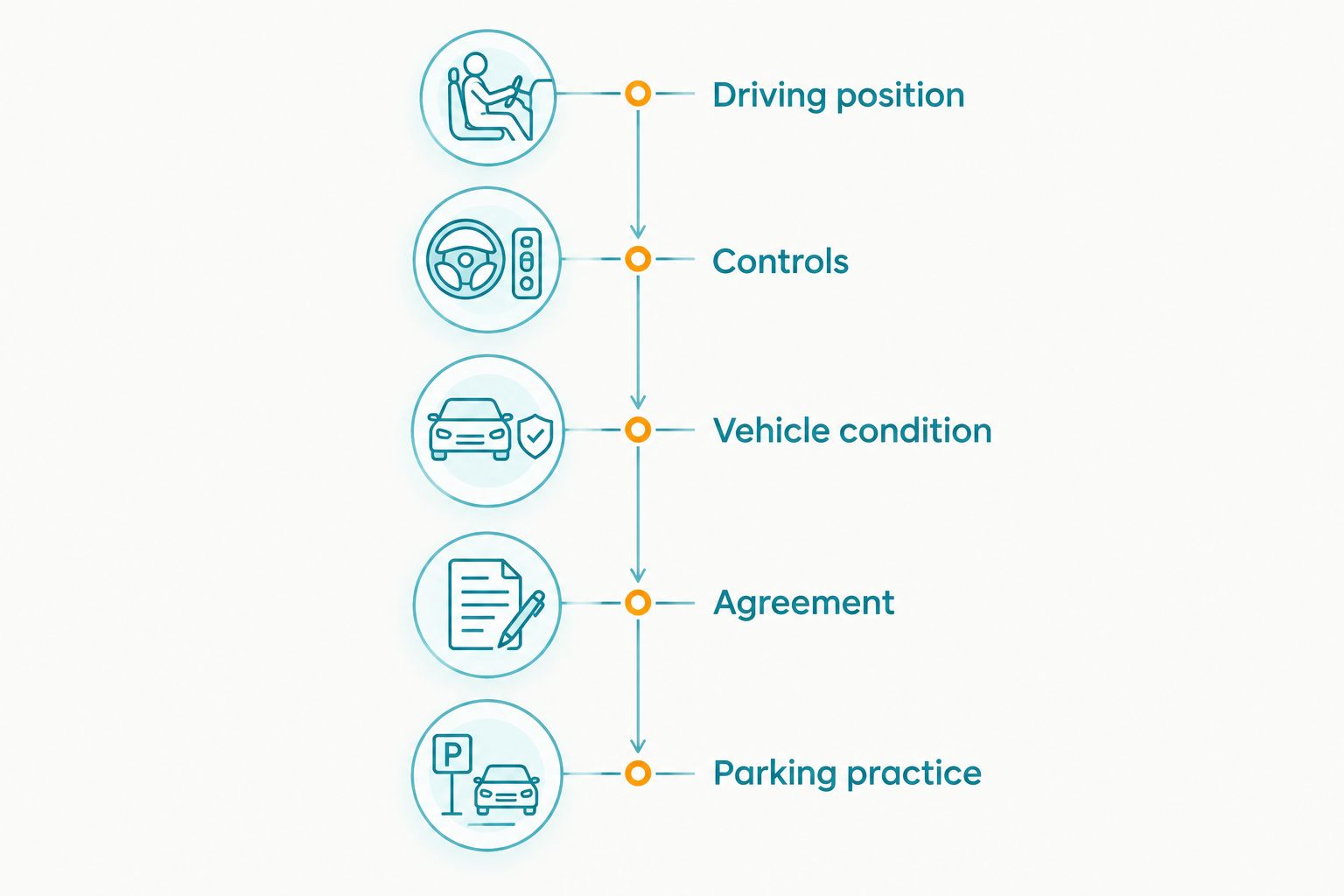
Set aside 10 minutes for a familiarisation check, separate from any paperwork or vehicle inspection. This is a planning recommendation, not a promised collection time. Ask for an explanation whenever a control or contract term is unclear.
Driving position
Adjust the seat, steering wheel where adjustable, and mirrors before moving. Make sure you can press the pedals fully without stretching and turn to check your surroundings comfortably.
Controls
Locate the lights, wipers, hazard lights, parking brake and gear positions. Check how to release the parking brake and how the car indicates that reverse gear is engaged.
Vehicle condition
Record visible marks using the provider's agreed inspection process. Include the wheels, glass and interior, and raise any concern before accepting the vehicle rather than relying on memory at return.
Agreement
Read the return arrangements, fuel requirements, permitted use and responsibility for damage. Ask how to contact the provider if a warning light appears or the vehicle becomes unsafe to drive.
Parking practice
Where permission and space allow, complete 2 low-speed parking manoeuvres before entering busy traffic: reverse into a marked space, then pull out and turn. Use the exercise to judge the corners, not to test the vehicle's limits.
Which car should you choose?
Choose a compact automatic sedan unless a specific requirement points elsewhere. Move to a small hatchback for tight parking, a compact crossover for your preferred seating position, or an MPV when your family needs the space.
Send VPI Cars your travel dates, pickup and return locations, passenger count, luggage details and planned route when requesting a self-drive quotation. Ask for the proposed model and transmission, then check the written inclusions and responsibilities.
For a 1-day rental, assess the whole itinerary—not just the first destination. Include parking at each stop and the return journey. If you do not feel comfortable driving the route, request a with-driver quotation instead.
Request a suitable rental quotation
Share your dates, route, passengers and luggage to discuss the right rental option.
FAQ
What’s the best car for a first-time self-drive renter in Manila?
A compact automatic sedan is the default choice for everyday Manila trips when your passengers and bags fit comfortably. Choose another category only when parking, seating preference or family space gives you a specific reason.
Is an automatic better than a manual for my first rental?
Choose the transmission you already drive confidently. An automatic removes manual gear changes, but you still need to understand the supplied vehicle’s selector and parking brake.
Is a hatchback better than a sedan for Manila parking?
A small hatchback is the stronger choice when short body length is your priority. Check the actual dimensions and luggage fit because not every hatchback is smaller than every sedan.
Should I rent an SUV because Manila roads can flood?
Do not choose an SUV as permission to drive through floodwater. A higher seating position does not establish safe water depth; avoid flooded routes and follow road closures.
What should I check before accepting a rental car?
Check your driving position, controls, vehicle condition, agreement and parking comfort before leaving. Record visible damage through the agreed process and ask about anything you do not understand.
What information should I send when requesting a quotation?
Send VPI Cars your dates, pickup and return locations, passenger count, luggage details and planned route. Request the proposed vehicle and transmission, then review the written rental terms.
Should I book self-drive if I am uncomfortable driving in Manila?
Choose a with-driver rental if you do not feel comfortable handling the planned route yourself. Self-drive is appropriate when you are confident driving and willing to manage directions and parking.
One last thing
Check the parking destination before choosing the car. Ask your accommodation or meeting venue about access restrictions and parking arrangements, then compare those requirements with the proposed vehicle.
For your 2026 booking, send luggage details as well as passenger numbers. A vehicle with enough seats can still be the wrong choice when the remaining cargo area cannot hold your bags safely.
Related guides
- Best vans for family road trips around the Philippines
- Best vans ranked by seating capacity for Manila group trips
- How much does a car rental with driver cost in Manila?