
BPO employee car rental is a transport arrangement for business process outsourcing staff, with the aim of getting employees between agreed pickup points and work around their shifts. For night-shift teams in Metro Manila, the key decisions are who drives, how pickup times match reporting times, and what happens when overtime changes the return journey.
- VPI Cars is best for BPO teams seeking with-driver or corporate car rental for recurring Metro Manila travel.
- Plan car rental for BPO employees around actual reporting times, passenger numbers and separate outbound and return journeys.
- Choose car rental with driver when employees should not carry the driving responsibility after an overnight shift.
- Confirm recurring transport requirements in writing; a corporate rental does not automatically include a managed employee shuttle.
Why car rental matters for BPO employees
A night-shift transport plan must work in both directions. Getting employees to the office does not settle how they will get home after a shift extension, a changed roster or a different release time.
Build the arrangement around attendance requirements, not just office distance. Two employees living near each other do not necessarily belong on the same pickup route if their reporting times differ. Likewise, employees who arrive together might need separate return arrangements.
For your 2026 transport plan, distinguish between an employee booking a personal rental and an employer arranging recurring staff transport. The booking contact, authorised passengers, payment responsibility and approval process need to match the actual arrangement.
VPI Cars offers self-drive, with-driver and corporate/long-term car rental. Those are useful starting points for an enquiry, but your quotation still needs to specify the route, shift pattern and responsibilities rather than assume a complete shuttle operation is included.
How to plan night-shift transport for your team
1. Map the roster before choosing a vehicle
Start with a spreadsheet rather than a vehicle shortlist. Give each journey its own row: date, pickup point, office destination, required arrival time, passenger count and return requirement. Keep outbound and return trips separate so that a change to one does not silently change the other.
Use actual transport requirements, not the total number of people assigned to an account. Hybrid attendance, rest days and different release times change who needs a ride on a particular date. Ask employees to confirm their requirements through an agreed company channel instead of collecting requests across several private conversations.
For a 2026 roster, record the calendar date as well as the time. A shift that starts before midnight and ends the next morning needs an unambiguous return date.
Finish the roster with these checks:
- Record reporting time separately from shift start time.
- Enter the return journey under its actual calendar date.
- Separate regular passengers from occasional riders.
- Identify who approves changes after the roster closes.
- Share only passenger details needed to arrange the journey.
2. Group passengers by route and reporting time
Plot the proposed pickup points on a map before asking anyone to quote. A route that looks convenient as a list of neighbourhoods can involve backtracking once office access roads and pickup locations are considered. Keep the final passenger's reporting requirement visible while reviewing earlier stops.
Use a clear planning example: compare 2 pickup points with individual household pickups for the same group. This is a route-design exercise, not a promise that either arrangement will take a particular amount of time. Ask employees whether they can reach each proposed meeting point safely and reliably.
Choose meeting points that passengers can identify without lengthy directions. Check access at the actual pickup hour; a familiar daytime entrance is not enough information for an overnight booking.
Before settling the route:
- Confirm the exact side of the road for each pickup.
- Check whether the location permits stopping and boarding.
- Agree how passengers will identify the vehicle.
- Set a clear process for reporting a missed pickup.
- Review the return route separately from the outbound route.
3. Choose who carries the driving responsibility
Compare the arrangements manually before choosing a provider. With-driver rental separates passenger travel from driving responsibility. Self-drive gives the authorised renter control of the journey but also places driving, parking and vehicle-handling responsibilities on that renter.
Do not make post-shift driving the default simply because someone holds a licence. Ask whether the designated driver expects to be sufficiently rested and whether that person actually agrees to take on the role. Feeling sleepy is a reason not to drive, not a scheduling problem to solve by assigning another passenger casually.
VPI Cars offers both self-drive and car rental with driver, alongside corporate/long-term rentals. Describe your roster and ask which arrangement fits; do not assume that a vehicle rental includes route management or employee dispatch.
For a larger shared journey, the guide to vans for corporate shuttle service in Metro Manila provides a separate vehicle-planning starting point.
- Choose with-driver rental when passengers should not drive.
- Choose self-drive only with a suitable authorised driver.
- Discuss corporate/long-term rental for recurring requirements.
- Confirm passenger capacity against the quoted vehicle.
- Include bags and equipment when describing space requirements.
4. Write an operating brief for both journeys
Create a short transport brief that a colleague can follow without calling you for clarification. It should connect the roster to the booking: where the vehicle goes, when passengers must arrive, who communicates changes and who can approve an amended journey.
Keep the 2026 brief dated and give revised copies a clear version name. If operations changes a release time, replace the old instruction rather than leaving conflicting messages in a group chat. Ask the rental provider to acknowledge material changes before treating them as accepted.
Set a planning allowance between arrival and reporting. For example, you can assess a proposed 30-minute arrival allowance against building entry, security checks and the team's needs; this is an illustrative planning choice, not a traffic forecast or guaranteed buffer.
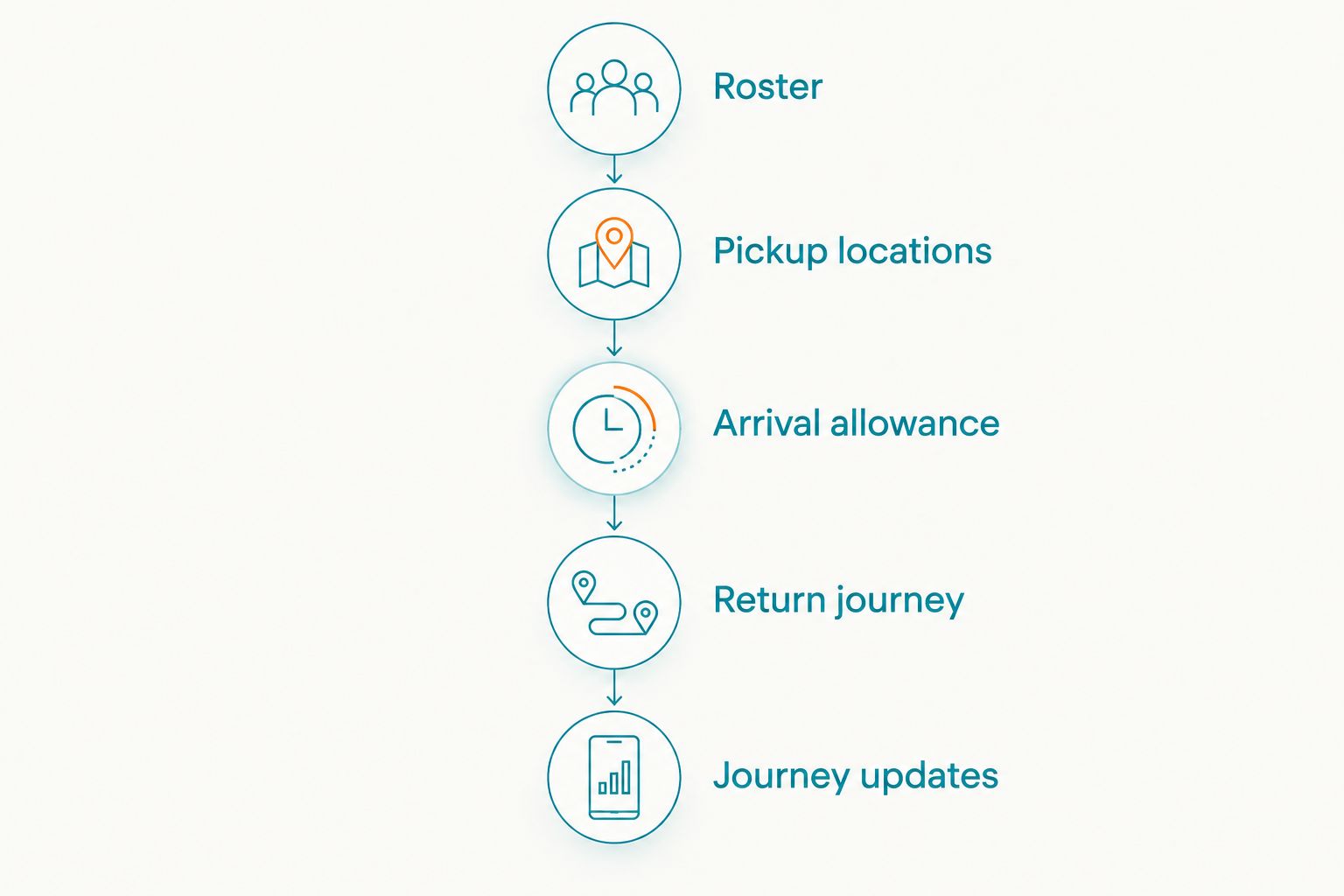
The brief should cover:
- Pickup locations and the intended order of stops.
- Required office arrival and return departure times.
- The person authorised to amend the itinerary.
- Instructions for absences, overtime and missed pickups.
- Building access or designated vehicle waiting areas.
- The agreed communication channel for journey updates.
5. Request a quotation against a complete brief
You can prepare the request yourself using the roster, route and operating brief. Send the same requirements when comparing arrangements; otherwise, different quotations might describe different journeys rather than different value for the same job.
Give VPI Cars the passenger count, dates, reporting times, pickup points, destinations and expected rental duration. State whether you need a driver and whether the request concerns individual travel, a shared team journey or a recurring corporate requirement. Ask for the included services and booking conditions in writing.
For example, a request covering 5 workdays should identify the actual dates and both journey windows. Do not describe it only as a weekly requirement if shift patterns or attendance change within that week.
Your quotation request should ask the provider to clarify:
- What the quoted rental arrangement includes and excludes.
- How driver duty hours and waiting are treated, where applicable.
- How overtime, additional stops and schedule changes are handled.
- Who handles fuel, tolls and parking under the proposed arrangement.
- What documents and approvals are required to book.
- Which cancellation, deposit and vehicle-return conditions apply.
6. Review the arrangement against actual attendance
Before committing to an ongoing schedule, check the written booking against the roster one final time. Make sure the confirmed passenger requirement, vehicle arrangement and journey windows match what your team expects. A quotation approval is not a substitute for checking the operational details.
During the arrangement, maintain a simple journey log. Record planned and actual pickup and arrival times, missed journeys and the reasons for changes. Separate transport issues from roster errors so that you fix the right problem rather than changing vehicles without evidence.
For a recurring arrangement in 2026, review the log whenever the account's attendance pattern changes. A new shift window, office location or reporting requirement calls for a fresh route check, not just a copied booking.
Keep the review focused:
- Compare actual arrivals with required reporting times.
- Record empty seats without circulating unnecessary personal details.
- Identify repeat changes to return departure times.
- Check whether the pickup order still makes sense.
- Confirm revised instructions with passengers and the provider.
Compare rental arrangements for a night-shift team
Choose the arrangement that matches responsibility and duration, not just the vehicle description. With-driver and corporate/long-term rental are not mutually exclusive categories: one describes who drives, while the other describes the business arrangement or rental duration. Ask for the combination your team needs.
| Option | Best for | Main advantage | Key limitation or booking consideration |
|---|---|---|---|
| Car rental with driver | Teams that want employees to travel as passengers | Separates the commute from employee driving responsibility | Confirm driver hours, waiting arrangements and both journey windows |
| Self-drive rental | An individual or small group with a suitable authorised driver | Gives the renter direct control of the journey | The renter must handle driving, parking and the agreed vehicle responsibilities |
| Corporate/long-term rental | Businesses assessing recurring transport or company vehicle requirements | Lets the enquiry address an ongoing business requirement | Define driver provision, scheduling responsibilities and change procedures explicitly |
| Individually arranged ride-hailing | Employees making separate, changing journeys | Allows employees to request journeys individually | Separate bookings do not create one agreed team transport schedule |
For a shared night-shift journey, settle the driving arrangement first, then assess duration and route. A longer rental term does not resolve unclear pickup instructions, and a larger vehicle does not resolve incompatible reporting times.
Discuss your night-shift transport requirements
Share passenger numbers, shift times, pickup points and rental duration for a quotation.
Common mistakes BPO teams make
Booking around headcount instead of actual riders
An account's staffing total is not a passenger manifest. Build the requirement from confirmed travel dates and shifts, then update the provider when that requirement changes. Avoid circulating employee home addresses when an agreed meeting point is sufficient.
Treating the shift end as the departure time
Employees still need to leave their workstations and reach the pickup location. Agree a departure time that reflects the team's reporting process, and define what happens when someone is held back. Do not leave the driver or other passengers to negotiate an informal waiting rule.
Assuming every corporate rental is a shuttle service
Corporate rental describes a business booking, not a guaranteed package of dispatch, attendance tracking or route supervision. Ask which responsibilities sit with your company and which sit with the provider. Put the answer in the booking record.
Leaving overtime changes to the passengers
An employee should not have to approve a revised company transport arrangement without authority. Name a decision-maker and an escalation contact before the first journey. Confirm changes with the provider rather than assuming a message in the employee chat updates the booking.
Ignoring a sleepy designated driver
Self-drive is not an appropriate workaround when the designated driver is sleepy. Reconsider the arrangement before departure and do not pressure an employee to drive after an overnight shift. Transport planning must account for driving responsibility, not merely possession of a licence.
FAQ
What’s the best car rental arrangement for BPO night-shift employees?
Car rental with driver is the clearest fit when BPO employees should travel as passengers rather than drive after work. For recurring requirements, discuss a corporate/long-term arrangement and specify both journey windows, passenger numbers and schedule-change procedures.
Can VPI Cars help with car rental for BPO employees?
VPI Cars offers self-drive, with-driver and corporate/long-term car rental for businesses and individuals. Send the passenger count, itinerary, shift times and rental duration so the proposed arrangement can be assessed against your requirements.
Is self-drive rental a good choice after a night shift?
Self-drive is appropriate only when the authorised driver is fit to drive and accepts the associated responsibilities. Do not drive while sleepy; consider a with-driver arrangement when post-shift driving is a concern.
Does corporate car rental automatically include an employee shuttle?
No, you should not assume corporate car rental includes a managed employee shuttle. Confirm driver provision, routes, dispatch responsibilities, waiting arrangements and schedule changes in the written proposal.
What information should HR send for a night-shift transport quotation?
Send the travel dates, passenger numbers, pickup points, destination, required arrival time, return departure time and expected rental duration. Identify the booking contact and who can approve overtime-related changes.
Can a team request transport from Metro Manila to a Luzon location?
VPI Cars supports Metro Manila and out-of-town Luzon travel. Submit the specific itinerary, dates and vehicle requirements for confirmation rather than assuming a destination mention guarantees a booking.
What should we do when employees finish at different times?
Plan separate return groups or ask the provider to assess an amended departure arrangement. Confirm the implications in writing instead of assuming the outbound group will always travel home together.
One last thing
Treat the return journey as a separate booking requirement, even when the same employees and vehicle are involved. This exposes the details most easily missed: the next calendar date, staggered release times, waiting instructions and the person authorised to approve changes.
Before approving your 2026 arrangement, ask a colleague who did not prepare it to read the brief. If that person cannot identify where and when each group travels, revise the instructions before requesting confirmation. Clear instructions make the quotation easier to assess and the journey easier to coordinate.
Related guides
- Rental vehicles for small business fleets in the Philippines
- First-time self-drive rental choices in Manila
- Vans ranked by seating capacity for Manila group trips