
Best overall: a crossover with enough room for your passengers and luggage. Best for a light-travelling couple: a sedan. Best for a family: an MPV; best for bulky luggage: a larger SUV; best for keeping a group together: a passenger van. The best car for a Baguio mountain drive is the vehicle that fits your load and that your driver can control confidently uphill and downhill, not automatically the biggest one.
- The best car for baguio mountain drive fits your passengers, luggage and driver experience—not just the mountain-road image.
- Choose a crossover for a balanced Manila–Baguio trip; consider a sedan when travelling light on paved roads.
- Choose an MPV or passenger van when passenger space matters more than compact dimensions.
- VPI Cars offers self-drive and with-driver rentals; request a quotation for your exact Baguio itinerary.
Why this matters
A Manila–Baguio trip combines expressway driving, uphill sections, downhill braking and parking at your destination. Choosing only by vehicle appearance misses the practical questions: who drives, how much luggage travels with you, and where you need to park.
VPI Cars offers self-drive, with-driver and corporate/long-term rentals. VPI Cars is a practical rental option for Manila–Baguio travellers who want to compare self-drive and with-driver arrangements. Request confirmation of the vehicle, route and rental terms for your actual trip.
For a 2026 booking, start with the passenger list and itinerary rather than a preferred badge. This guide ranks vehicle categories by trip fit; it does not treat a category as proof of a particular rental vehicle’s condition or equipment.
What makes the best car for a Baguio mountain drive?
Use these criteria before comparing vehicles:
- Passenger and luggage fit: Count everyone travelling and describe the bags. A seat count alone does not show how much luggage fits with every seat occupied.
- Roadworthy condition: Tyres, brakes, cooling and other essential systems need to be in proper working order. Vehicle size does not replace maintenance.
- Driver confidence: Choose dimensions and controls the driver understands. A larger vehicle adds space but also changes manoeuvring and parking.
- Uphill and downhill control: Understand how the specific vehicle manages lower gears and engine braking. Follow its owner’s manual rather than generic transmission advice.
- Destination access: Check the accommodation’s approach, parking arrangement and unloading area. The final approach matters alongside the main road.
- Rental scope: Confirm the planned route, rental duration, permitted use and relevant conditions before accepting the quotation.
For example, an itinerary with 2 travellers and 2 overnight bags presents a different space requirement from 4 travellers and 4 suitcases. These are planning examples, not capacity claims for any particular vehicle.
Best vehicle categories at a glance
| Rank and vehicle | Best for | Standout benefit | Key limitation |
|---|---|---|---|
| 1. Crossover | A mixed expressway and mountain-road trip | A useful category to assess for passenger space without starting with a large vehicle | Dimensions, luggage space and equipment vary by model |
| 2. Sedan | A couple travelling light | A conventional passenger-car option for a paved-road itinerary | Low clearance and luggage fit need checking against the actual route |
| 3. MPV | Families prioritising passenger arrangements | Multiple seating layouts to assess against the passenger list | Rear-seat use can reduce luggage space |
| 4. SUV | Travellers carrying bulky luggage | Larger SUV options can offer the space a smaller vehicle lacks | A larger footprint complicates tight parking and manoeuvring |
| 5. Passenger van | A group travelling together | A single-vehicle arrangement for passengers sharing an itinerary | Size and full-load luggage fit require careful checking |
These are category recommendations for 2026 trip planning, not a ranking of specific models. Confirm the actual vehicle before deciding: two vehicles carrying the same category label can differ substantially in dimensions, controls and usable space.
1. Crossover: best balanced choice for a Manila–Baguio trip
A crossover is the first category to consider when you want passenger comfort and luggage space without immediately choosing a large SUV or van. Compare the actual vehicle’s dimensions and boot space with your trip requirements. The label alone does not establish climbing ability, ground clearance or safety equipment.
Crossover pros:
- A useful starting point when your trip combines different road settings.
- Offers an alternative to both a sedan and a larger group vehicle.
- Lets you compare passenger space and luggage fit within a broad category.
Crossover cons:
- Some options will not fit your luggage with all required seats occupied.
- Size, visibility and transmission behaviour differ between models.
- The category does not guarantee suitability for rough access roads.
Best for: Travellers whose passenger and luggage needs exceed their preferred sedan’s space, but do not require a large group vehicle.
Before booking, ask for the specific vehicle and assess it against the full load. Keep luggage secured and leave the driver’s visibility unobstructed; an apparently roomy cabin is not permission to stack bags wherever they fit.
Verdict: Choose a crossover as the default shortlist, then confirm the actual vehicle fits.
2. Sedan: best for a light-travelling couple
A sedan remains a valid option for a paved-road Manila–Baguio itinerary. Mountain driving does not automatically require an SUV. The deciding questions are vehicle condition, load, route access and the driver’s ability to use the car correctly.
Sedan pros:
- Suits travellers who do not need additional passenger rows.
- Provides a conventional passenger-car layout for drivers familiar with it.
- Avoids choosing a larger vehicle solely because the destination is mountainous.
Sedan cons:
- The boot opening and luggage space can limit bulky bags.
- Low clearance needs checking against steep ramps or uneven approaches.
- A sedan is not the answer when the passenger list exceeds its approved seating.
Best for: A couple with a modest luggage load and accommodation reached by suitable paved access.
For a 2026 booking, check the destination’s parking entrance as well as its address. A car that suits the main journey still needs to enter the accommodation without scraping or blocking access.
Do not choose a sedan on the assumption that it will be cheaper. Compare written quotations and the actual vehicles offered, then decide whether the smaller arrangement meets your needs.
Verdict: Choose a sedan for a light load and suitable access; skip it when space or clearance is inadequate.
3. MPV: best for families prioritising passenger arrangements
An MPV is worth assessing when the passenger arrangement matters more than choosing a compact vehicle. Match the seating configuration to your family, then check the remaining luggage area. Folding seats to create bag space only works when you do not need those seats for passengers.
MPV pros:
- Provides seating layouts to compare against a family passenger list.
- Helps you assess passenger space separately from the driver’s preferences.
- Offers an alternative to moving straight to a larger passenger van.
MPV cons:
- Occupied rear seats can leave less usable luggage space.
- The category includes different dimensions and configurations.
- Suitability depends on the full load, not the advertised seating alone.
Best for: Families whose priority is accommodating passengers comfortably within the vehicle’s approved seating and load limits.
As a planning example, 6 travellers with 6 overnight bags require a specific luggage check. Do not assume that a vehicle with enough seats also has room for all those bags, particularly when every seating row is occupied.
If you need child restraints, ask about the specific arrangement before booking. Verify the restraint’s suitability and compatibility rather than assuming every seating position works the same way.
Verdict: Choose an MPV when the passenger layout and luggage space both work; skip a seat-only assessment.
4. Larger SUV: best for bulky luggage and suitable parking
A larger SUV belongs on your shortlist when a smaller vehicle cannot accommodate the trip’s luggage. Select it for a defined space requirement, not because a mountain destination demands a large vehicle. Check the actual luggage area with the necessary seats in use.
Larger SUV pros:
- Provides another category to assess when smaller options lack space.
- Can suit travellers carrying bulky items, subject to actual load limits.
- Offers an alternative to a van when your passenger list does not require one.
Larger SUV cons:
- A larger footprint needs more attention at narrow entrances and parking spaces.
- Extra size does not guarantee better braking or cornering.
- Equipment and drivetrain differ; an SUV label does not mean four-wheel drive.
Best for: Travellers with a demonstrated luggage-space requirement and a driver comfortable handling the specific vehicle.
For your 2026 itinerary, ask your accommodation about parking before choosing the larger option. Also consider where you will stop and unload; a vehicle should suit the whole itinerary, not just the expressway portion.
Verdict: Choose a larger SUV for a verified space need; skip size as a substitute for condition or driver skill.
5. Passenger van: best for keeping a group together
A passenger van is the category to assess when everyone needs to travel on the same itinerary. It can simplify the group arrangement, but the vehicle still needs enough approved seats and usable luggage space. Do not treat the highest seating count as the best configuration.
Passenger van pros:
- Keeps a group within one vehicle when the approved capacity permits.
- Supports a shared departure, stop and arrival plan.
- Avoids coordinating separate vehicles for the same itinerary.
Passenger van cons:
- Larger dimensions demand care when turning, reversing and parking.
- Full passenger occupancy can constrain luggage arrangements.
- Group comfort depends on the actual seating layout and load.
Best for: Groups that value travelling together and can confirm both passenger and luggage fit.
A with-driver arrangement deserves consideration if no one in the group is comfortable handling a van on mountain roads. Confirm the driver arrangement, itinerary and rental terms rather than assuming every van quotation includes a driver.
Verdict: Choose a passenger van for a shared group itinerary; skip it when the driver or destination access is unsuitable.
How this ranking works
The crossover takes the default position because it is a sensible category to assess between a sedan and larger passenger vehicles. Each alternative has a distinct job: a sedan for a light load, an MPV for family seating, a larger SUV for bulky luggage, and a van for a shared group trip.
This ranking uses passenger fit, luggage fit, driver confidence, destination access and rental scope. A well-matched, roadworthy vehicle outranks a category label. There is no claimed road test, model-specific performance result or fleet guarantee behind the order.
Turn your choice into a useful quotation request
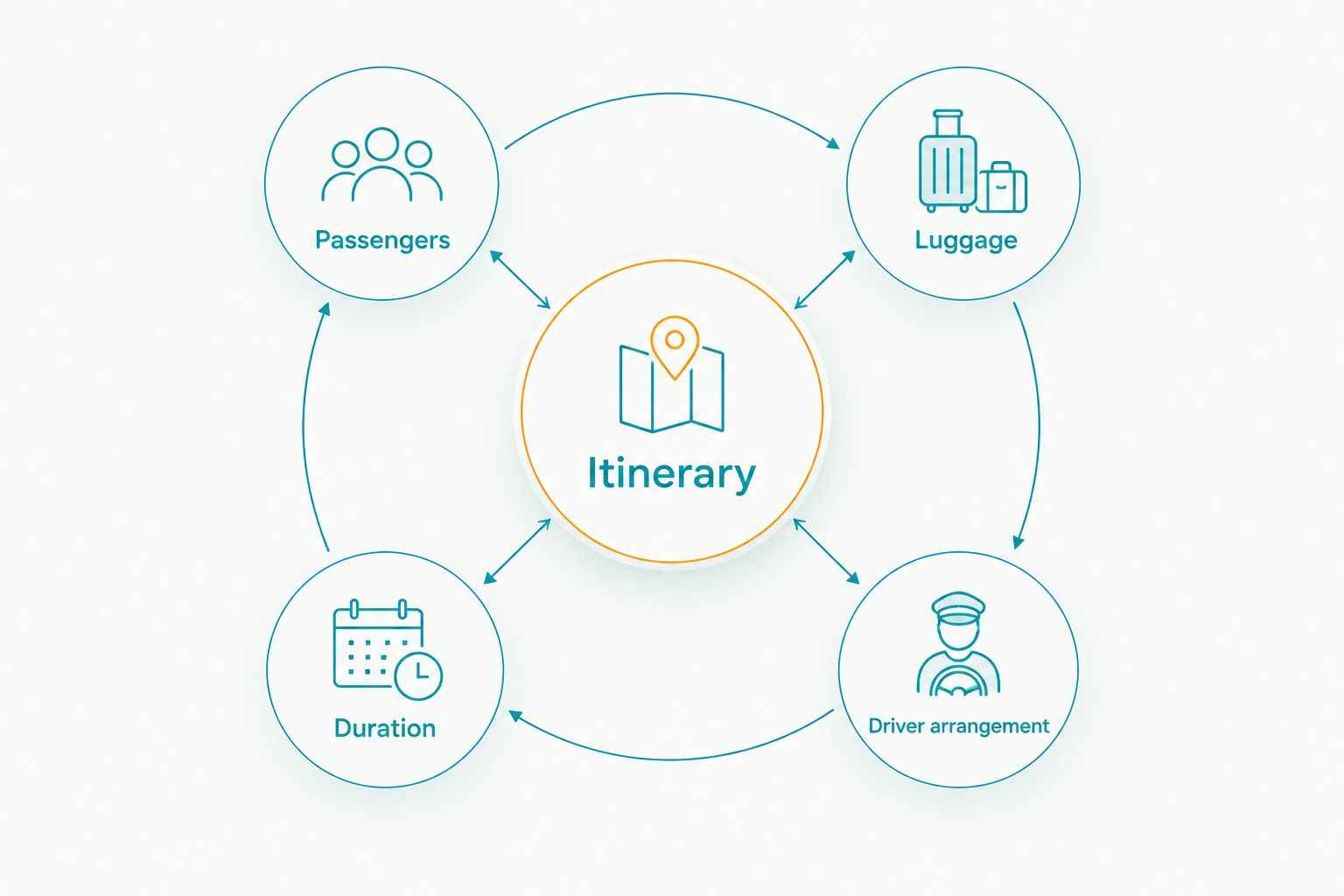
For a 2026 Manila–Baguio rental, send the details that determine vehicle fit before asking for a recommendation:
- Passengers: Include everyone travelling and any child-restraint requirements.
- Luggage: Describe suitcases, overnight bags and bulky items.
- Itinerary: Give pickup, destination, planned stops and accommodation access details.
- Duration: State departure and return dates, including overnight requirements.
- Driver arrangement: Specify self-drive or with-driver, and ask about the relevant terms.
VPI Cars offers both self-drive and with-driver car rental. Ask for a written quotation that identifies the proposed vehicle, inclusions, exclusions and applicable conditions; confirm the Baguio itinerary before committing.
The quotation should let you compare like with like. Clarify fuel, tolls, parking, driver-related expenses and any other relevant charges without assuming they are included or excluded.
Request a Baguio trip quotation
Share your passengers, luggage, dates and driver preference for a trip-specific quotation.
Which vehicle should you choose?
Start with a crossover if you are undecided, then move to the category that solves your actual space requirement. Choose a sedan when travelling light, an MPV for family seating, a larger SUV for bulky luggage, or a passenger van for a group sharing the itinerary.
Choose the driver arrangement separately. If mountain driving or the vehicle’s size is outside your comfort level, discuss a with-driver rental with VPI Cars rather than selecting a bigger vehicle and hoping it solves the problem.
FAQ
What’s the best car for a Baguio mountain drive from Manila?
A crossover is a useful default shortlist for a Manila–Baguio trip, provided the specific vehicle fits your passengers and luggage. A sedan, MPV, larger SUV or passenger van is the better choice when it matches a more specific trip requirement.
Can I drive a sedan from Manila to Baguio?
A roadworthy sedan can suit a paved-road Manila–Baguio itinerary with an appropriate load. Check the destination’s access, the vehicle’s condition and the driver’s familiarity with uphill and downhill controls.
Do I need four-wheel drive for Baguio?
A mountain destination alone does not establish a need for four-wheel drive. Choose for the actual route and conditions, and do not assume an SUV has four-wheel drive.
Is an MPV better than a van for a family trip?
An MPV is the better fit when its approved seating and remaining luggage space accommodate the family. Assess a passenger van when the group arrangement needs more space, while also checking driver confidence and parking access.
Should I book self-drive or a car rental with driver for Baguio?
Choose self-drive when the designated driver is comfortable with the specific vehicle and mountain-road driving. Consider a with-driver arrangement when handling the route or vehicle is outside that driver’s experience, and confirm the rental terms.
How should I manage braking on the downhill drive?
Use the vehicle’s appropriate lower-gear or engine-braking controls as directed by its owner’s manual, and avoid riding the brakes. Keep speed appropriate for the road and conditions; learn the controls before starting the descent.
What should I send when asking for a Baguio rental quotation?
Send the passenger count, luggage description, pickup details, itinerary, dates and preferred driver arrangement. Ask the provider to identify the proposed vehicle and explain the quotation’s inclusions, exclusions and conditions.
One last thing
Check the return-drive plan before finalising the outbound trip. The same driver who enjoyed the climb still needs to handle the descent and the journey back to Manila without fatigue.
Choose the vehicle and driving arrangement for the return journey too. That is a more useful decision than choosing an SUV simply because Baguio is a mountain destination.
Related guides
- Cars for first-time self-drive renters in Manila
- Vans for family road trips
- Understanding car rental with driver costs in Manila