
Instead of arranging a new pickup after every meeting, plan your Manila meeting day as one itinerary and request a driver booking covering the full route. For a multi-stop meeting day driver booking in Manila, confirm every stop, waiting period and final drop-off before treating the transport as arranged.
- VPI Cars offers car rental with driver for shared business itineraries in Metro Manila and out-of-town Luzon.
- For a multi-stop meeting day driver booking in Manila, request confirmation of the complete itinerary, not just the first pickup.
- Keep meeting times, pickup points and itinerary changes in one shared document.
- Confirm waiting arrangements, rental duration and changes in writing before the meeting day.
Why this matters
A calendar invitation tells passengers when a meeting starts. It does not necessarily tell a driver which entrance to use, whether passengers need transport between appointments, or where the day ends.
VPI Cars car rental with driver is best for teams that want a driver for a shared meeting itinerary. You can review the available rental services before preparing your request. The practical benefit is a single transport brief; the booking still needs to cover the actual route and duration.
This 2026 planning guide uses a shared itinerary and written booking confirmation. It does not require a calendar integration or assume that changing an appointment automatically updates your transport arrangements.
Before you start
- Gather the meeting details: dates, full addresses, meeting start and expected finish times, passenger numbers, luggage and final drop-off. Identify which appointments have fixed times.
- Assign a transport coordinator: choose someone authorised to approve the itinerary and communicate changes. Give travellers access to the current schedule through a shared document or calendar they already use.
- Confirm the waiting arrangement: do not assume that one booking means the vehicle remains outside each building throughout the day. Ask how waiting, parking, duration and itinerary changes will be handled before accepting the booking.
Keep private meeting notes out of the transport brief. The driver needs access instructions and timing, not the contents of a client presentation.
1. The master itinerary
Build the transport brief
- Create a document headed Meeting-day transport brief. Use Travel date to record the complete date, including 2026 where applicable, and identify all times as Philippine time.
- Add Lead passenger, Transport coordinator and Contact number. State who communicates with the provider if the lead passenger is in a meeting.
- Create one row for every movement, including the first pickup and final drop-off. Record the exact building, address, entrance and destination contact where needed.
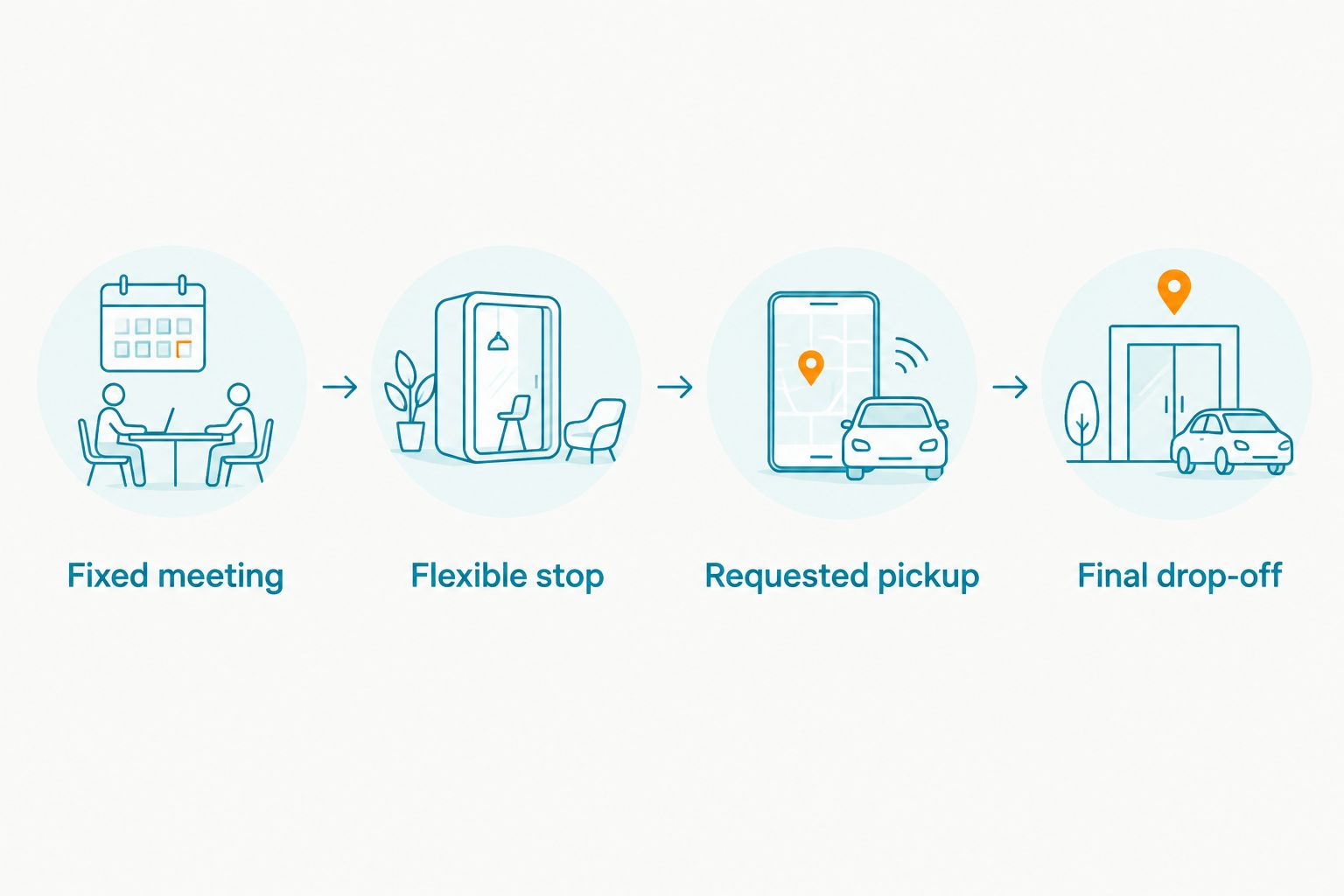
- Separate Meeting start, Expected finish and Requested pickup. These are different instructions; a meeting finish time is not automatically a vehicle departure time.
- Record passenger and luggage changes by leg. Tell the provider if someone joins halfway through the day or leaves before the final stop.
These bold labels are suggested headings for your own document, not fields in a booking platform.
Expected result: someone who has not attended your planning discussion can identify every required journey without guessing.
Check the brief with a sample day
For illustration, consider 3 passengers attending 3 meetings with 1 bag carried throughout the day. These are planning examples, not vehicle specifications or booking limits.
| Movement | Details to record | Check before sending |
|---|---|---|
| Office to Makati meeting | Office pickup point and meeting-building entrance | All passengers start at the same location |
| Makati to BGC meeting | Expected departure and exact destination | The next appointment allows for travel and building entry |
| BGC to Ortigas meeting | Passenger count and meeting finish | Any passenger joining or leaving is recorded |
| Ortigas to final drop-off | Complete final address | The itinerary includes the journey after the last meeting |
Do not substitute district names for addresses. “Makati office” is not enough when a building has separate pedestrian entrances, parking access and vehicle loading points.
2. The route and timing plan
Separate fixed appointments from flexible stops
- Mark immovable appointments Fixed meeting. Mark stops that can move Flexible stop, but only after the meeting organiser agrees.
- Review the geographical sequence. Group nearby appointments where schedules permit rather than repeatedly crossing between districts.
- Check current route estimates for the intended departure periods. Treat those estimates as planning inputs, not promised arrival times.
- Add time for building entry, registration, walking to the meeting room and leaving the premises. Keep that allowance separate from the road journey.
- Flag the appointment that determines the whole day. If an earlier meeting overruns, decide which flexible activity changes first.
Expected result: the itinerary shows how passengers reach each appointment, not merely a list of meeting start times.
For a 2026 meeting schedule, recheck addresses and access instructions with each host rather than reusing an old office entry. A correct street address still leaves uncertainty if visitors must enter through a different gate.
Choose the booking structure
Use the itinerary to decide whether your team needs transport across the day or only for isolated journeys. Neither structure removes the need for accurate pickup instructions.
| Booking structure | Best for | Practical advantage | Consideration |
|---|---|---|---|
| One with-driver itinerary | Passengers travelling together between linked meetings | Keeps the route in one transport brief | Waiting, duration and route changes need explicit agreement |
| Separate journey bookings | Travellers with independent schedules or different destinations | Each movement can have its own brief | Every pickup needs separate coordination and confirmation |
Choose one shared itinerary when the passengers and route stay together. If travellers split between simultaneous meetings, describe both movements before requesting a quotation; one vehicle cannot take different groups to different places at the same time.
3. The quotation and booking confirmation
Turn the itinerary into a booking request
- Send the complete transport brief to VPI Cars, identifying the request as Car rental with driver. Include the travel date, passenger count, luggage, full route and expected finish.
- Ask the quotation to address the whole itinerary. Request clarification of inclusions, exclusions, waiting arrangements, parking, tolls and any process for extending the agreed duration.
- Identify special requirements before accepting. Examples include building access procedures, presentation materials carried in the vehicle, or a passenger joining at a later stop.
- Check the written response against your latest brief. Resolve any difference in dates, stops, passenger requirements or final destination.
- Obtain explicit booking confirmation and the agreed coordination instructions. Sending a request or receiving a quotation is not the same as confirming the trip.
Expected result: the confirmed transport scope matches the itinerary your passengers will actually follow.
You can contact VPI Cars with the finished brief to request a quotation. Include any out-of-town Luzon leg at the outset so the full journey is considered, rather than adding it as an informal instruction during the day.
Use a clear request format
Copy these headings into an email or document and replace each with your trip details:
- Travel date: full day, month and year; use the actual 2026 date for a 2026 trip.
- Passengers and luggage: maximum passengers travelling together and items carried.
- First pickup: requested time, exact location and entrance.
- Meeting sequence: addresses, meeting times and expected departure from each stop.
- Final drop-off: destination and expected end of transport.
- Coordination: lead passenger, authorised coordinator and contact details.
- Questions to confirm: waiting arrangements, inclusions, exclusions and the change process.
Request explanations for unclear terms before accepting. A useful quotation makes the scope understandable; a short description such as “Manila business trip” leaves too much unresolved.
4. The shared schedule and change process
Keep the confirmed plan current
- Save the accepted itinerary as Confirmed transport plan. Keep draft versions clearly separate so travellers do not forward an outdated route.
- Put the relevant pickup point and coordinator contact in each calendar entry. Link to the shared brief using your organisation's normal access settings.
- Agree who sends changes. Ask passengers to route requests through the coordinator rather than giving conflicting instructions independently.
- Send revised details to the provider when a stop, time, passenger requirement or destination changes. Ask whether the revision affects the agreed scope and obtain acknowledgement.
- Share the accepted revision with passengers. Keep the previous arrangement in place until the change is confirmed or an alternative is agreed.
Expected result: passengers, coordinator and provider work from the same accepted schedule.
For example, label a revision Updated 18 August 2026, 14:00 Philippine time only when that is the actual update timestamp. A clear version label helps distinguish the current plan from a forwarded screenshot.
A calendar update is not a booking update. Your internal schedule and the provider's confirmed instructions must agree.
When the same meeting day repeats
A recurring meeting circuit needs a repeatable brief, not an assumption that last week's instructions still apply. This approach suits teams visiting the same offices or sites on a regular schedule.
- Create a baseline route containing the usual stops and passenger requirements.
- Record each actual travel date. Identify holidays, cancelled meetings and exceptions before requesting the recurring arrangement.
- Confirm which details stay fixed and how individual dates will be amended.
- Recheck passengers, access instructions and final drop-off for each occurrence.
VPI Cars offers corporate/long-term rentals as well as car rental with driver. Ask which arrangement fits the pattern of travel; do not assume a recurring calendar invitation creates a recurring booking.
The benefit is less repeated preparation. The trade-off is that a copied schedule can carry old information into the next trip unless someone checks the exceptions.
Troubleshooting
The meeting runs beyond its expected finish
Tell the designated coordinator as soon as the overrun is clear. Ask the provider to confirm the revised pickup and any effect on the agreed duration before assuming the driver can continue unchanged.
The driver and passenger are at different entrances
Compare the building name, exact entrance and loading point. Ask the passenger or host for a precise meeting point, then have the coordinator communicate the corrected instruction.
A passenger adds an unplanned stop
Send the proposed address and timing to the coordinator first. Confirm the revised scope with the provider before treating the additional journey as part of the booking.
The team needs to split up
Identify which passengers need each destination and when. Request an appropriate revised arrangement rather than trying to keep incompatible journeys inside a single-vehicle plan.
Someone forwards an old itinerary
Point everyone back to the current confirmed document and identify the superseded version. Notify the provider directly if the outdated copy also reached the transport contact.
Customize your workflow
Expand the brief when the trip requires more than office-to-office travel. Add site-entry instructions for a project visit, passenger changes for a client lunch, or complete destinations for a provincial Luzon leg.
For internal approval, attach the accepted quotation to the itinerary using your company's normal process. Keep confidential procurement documents separate from the practical instructions passengers and the driver need.
Request the arrangement that matches the route, not just the first pickup. That gives the provider the information needed to assess the full meeting day.
FAQ
Can I arrange one driver booking for several Manila meetings?
You can request a car rental with driver covering several Manila meetings in one itinerary. Send every stop, the expected waiting periods and final drop-off, then confirm the full scope before travel.
What should I send for a multi-stop meeting day driver booking in Manila?
Send the travel date, passenger and luggage requirements, complete addresses, meeting times, requested pickups and final destination. Include a coordinator’s contact details and ask how waiting and changes will be handled.
Does updating my calendar change my driver booking?
No, an internal calendar update does not confirm a transport change. Send the revision to the provider and obtain acknowledgement before relying on the new arrangement.
Will the driver wait at every meeting venue?
The waiting arrangement must be confirmed for your booking. Ask whether the vehicle remains at the venue, where collection takes place and how changes to the agreed duration are handled.
Can a Manila meeting itinerary include an out-of-town Luzon stop?
VPI Cars supports out-of-town Luzon travel as well as Metro Manila trips. Include the complete provincial itinerary, dates and vehicle requirements in your request so the individual trip can be confirmed.
What happens if our meeting finishes late?
Notify your transport coordinator and ask the provider to confirm the revised pickup. Check any effect on the agreed booking scope before assuming the original arrangement continues unchanged.
Is one booking better than separate bookings for business meetings?
One shared itinerary suits passengers travelling together between linked appointments. Separate arrangements suit travellers whose routes or meeting times diverge; compare the actual movements rather than assuming one structure always fits.
One last thing
Write the final drop-off before refining the middle of the day. It forces you to distinguish “the last meeting has ended” from “the transport requirement has ended”—and prevents the return journey from becoming an afterthought.
Related guides
- Connecting a recurring meeting schedule to monthly chauffeur bookings
- From purchase order to pickup: corporate car rental workflow
- Car rental for tech companies in Metro Manila: site visits