
Corporate car rental is not automatically cheaper than individual bookings: it is cheaper only when the total quotation for your actual travel schedule is lower than equivalent separate bookings. Include unused rental time, driver arrangements and any separately quoted trip expenses before deciding; a lower advertised rate does not establish a saving.
- Is corporate car rental cheaper than individual bookings? Compare equivalent itineraries and total quoted charges, not booking labels.
- Corporate rental fits recurring business travel; individual bookings fit occasional trips without an ongoing vehicle requirement.
- VPI Cars offers corporate car rental, self-drive and with-driver services for Metro Manila and out-of-town Luzon travel.
- Ask for written inclusions, exclusions and change terms before choosing either arrangement.
Why this matters
A company account and a lower transport bill are different things. For your 2026 travel budget, the useful comparison is the total expense of completing the same journeys under each arrangement—not whether a quotation carries a corporate label.
Start with your itinerary, then compare suitable car rental services. VPI Cars offers self-drive, with-driver and corporate/long-term rentals, so your enquiry should identify both the service you need and how regularly you need it.
Is corporate car rental cheaper than individual bookings?
Corporate car rental is cheaper only when its total cost for equivalent travel is lower. Compare the same dates, passenger requirements, destinations and driver arrangements before treating either quotation as better value.
A recurring arrangement deserves consideration when your business repeatedly needs transport. Separate bookings deserve consideration when trips are isolated or your schedule does not justify retaining a vehicle between journeys.
| Booking approach | Best for | Main advantage | Main drawback or check |
|---|---|---|---|
| Corporate or long-term rental | Recurring meetings, staff transport and continuing vehicle requirements | Lets you assess an ongoing transport requirement under a defined rental arrangement | Compare the full commitment with the journeys you will actually complete |
| Individual bookings | Occasional visits, isolated transfers and irregular business trips | Lets you request transport around each confirmed itinerary | Each new booking needs its own arrangements; compare the combined total |
Neither approach wins merely because your company makes the booking. A business can request a rental for an isolated trip, and a continuing requirement still needs a quotation that matches its actual use.
The deciding question is simple: what will your company pay to complete the same required travel under each option? Keep convenience and administrative work visible, but do not present them as cash savings unless your own records support that calculation.
Corporate rental: best for recurring transport needs
Corporate rental is worth assessing when you can describe a repeatable requirement: recurring meetings, regular site visits, staff journeys or an ongoing company vehicle need. A clear schedule gives the provider something specific to quote against.
The advantage is planning around a continuing requirement rather than treating every journey as unrelated. The drawback is that the arrangement must still make sense during quiet periods, cancelled meetings and gaps between trips.
For a 2026 comparison, separate confirmed travel from tentative plans. A quotation built around journeys your team hopes to make is not the same as one supported by an approved calendar.
If meetings drive most of your demand, use this guide to connecting a recurring meeting schedule to monthly chauffeur bookings to organise the enquiry. Keep pickup locations, meeting times and return requirements together so the proposed arrangement reflects the full working day.
Individual bookings: best for occasional business trips
Individual bookings suit travel that happens occasionally and has a clear start and finish. An isolated airport transfer or a standalone client visit does not, by itself, establish a continuing vehicle requirement.
The advantage is matching each request to a confirmed journey. The drawback is repeating the booking process and checking the arrangements each time your team travels.
Do not assume this approach is cheaper simply because you book fewer rental days. Add together all required bookings over the comparison period, including return journeys and any separately quoted expenses.
Likewise, do not assume a corporate arrangement is necessary because several employees travel. Their journeys might overlap, happen in different places or require separate vehicles; the itinerary determines the requirement.
Why the total cost varies
The comparison changes when the underlying travel changes. Keep these factors consistent when requesting quotations:
- Rental duration: State the full period you need transport, including gaps between assignments. Ask how the proposed arrangement treats those gaps.
- Travel frequency: Separate recurring journeys from occasional requests. A busy week alone does not describe an ongoing requirement.
- Driver arrangement: Compare self-drive with self-drive, or with-driver with with-driver. Different responsibilities mean the services are not equivalent.
- Passenger and luggage requirements: Describe who is travelling and what they are carrying. Do not compare quotations based on different transport requirements.
- Route and working schedule: Include pickup points, stops, return journeys and expected finishing times. Out-of-town Luzon travel belongs in the itinerary from the start.
- Inclusions and change terms: Ask what the quoted total covers and what happens if dates, routes or duration change. Do not assume different quotations use identical terms.
These factors explain why a colleague's previous booking is not a reliable substitute for your own quotation. Even the same destination can involve a different schedule, passenger requirement or driver arrangement.
How do you compare corporate and individual bookings fairly?
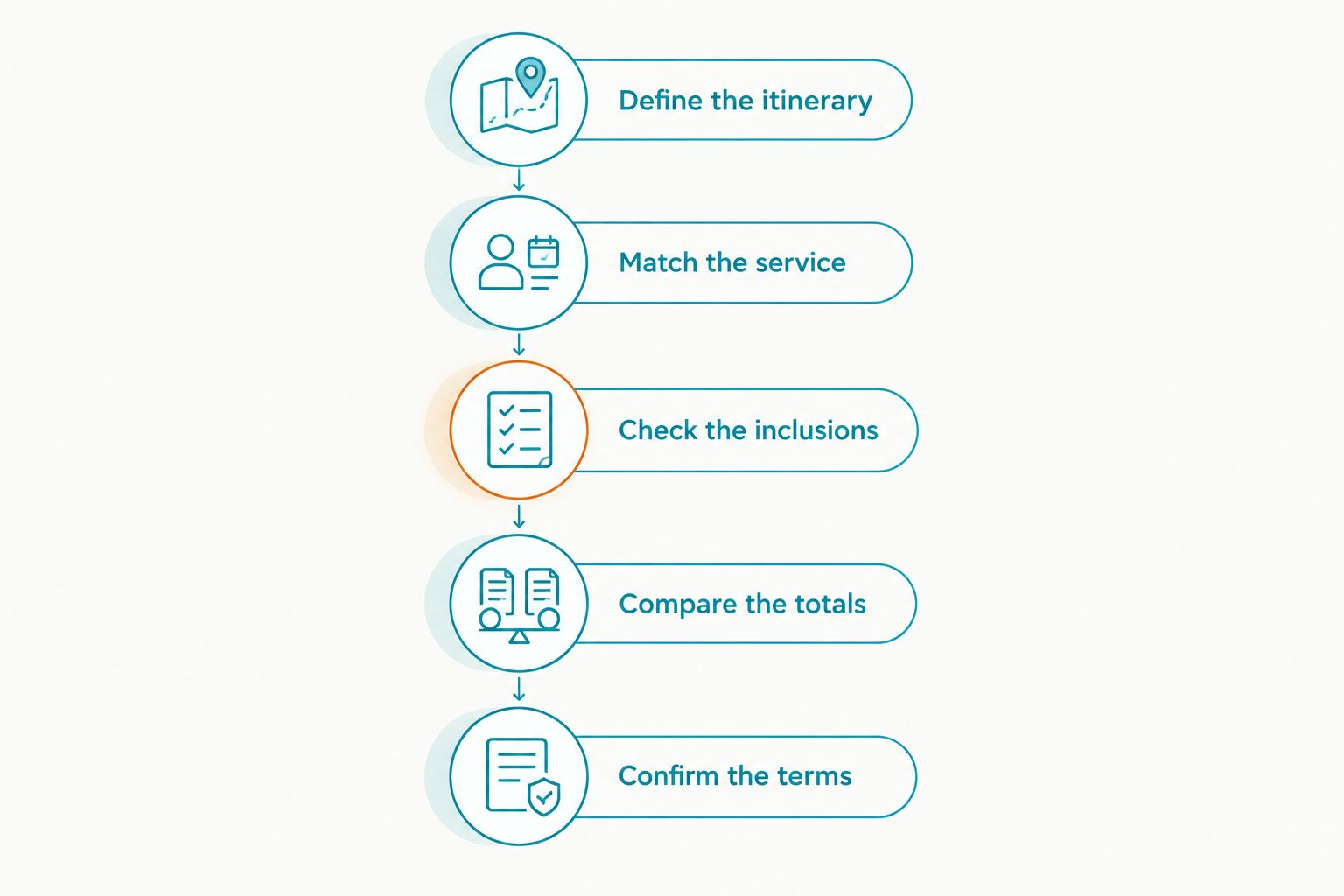
Use the same written brief for both enquiries. For your 2026 assessment, work from confirmed travel requirements and ask the provider to identify assumptions rather than leaving them unstated.
Define the itinerary
List pickup and drop-off locations, dates, stops and return requirements. Distinguish journeys that must happen at a fixed time from those your team can reschedule.
Include provincial travel explicitly. A Metro Manila meeting schedule and a Luzon site-visit schedule are different requirements, even when the same employees make both trips.
Match the service
State passenger numbers, luggage needs and whether you require a driver. If you are considering both self-drive and with-driver rental, request separate comparisons rather than treating them as interchangeable.
An employee driving the vehicle and a passenger travelling with a hired driver have different responsibilities. Decide which arrangement fits the work before comparing totals.
Check the inclusions
Ask whether fuel, tolls, parking and any driver-related expenses are included or handled separately. These are questions for the quotation, not assumptions about what a provider includes.
Request written clarification of the rental period, permitted itinerary and applicable changes. An unclear exclusion makes an apparently simple comparison unreliable.
Compare the totals
Place the corporate quotation beside the combined quotations for the equivalent individual bookings. Compare the full required period, not a busy day selected from it.
Keep refundable deposits separate from rental expense where the agreement identifies them as refundable. They still affect cash requirements, but they are not the same as a charge you expect to incur.
Confirm the terms
Check what happens when a meeting is cancelled, a return journey runs later or a project finishes sooner. Use the actual written terms rather than assuming flexibility from the booking category.
Before approving the arrangement, identify who in your company can request changes. Clear responsibility helps prevent conflicting instructions from different travellers.
What should you send when requesting a quotation?
Send a travel brief rather than asking only for a corporate rate. The provider needs enough detail to assess the service, duration and itinerary you actually require.
For a 2026 quotation request, include:
- Your company contact and the person coordinating transport.
- Confirmed travel dates and the overall rental period under consideration.
- Pickup points, destinations, intermediate stops and return requirements.
- Passenger numbers and luggage or work-equipment needs.
- Whether you require self-drive or with-driver service.
- Which journeys repeat and which are occasional.
- Questions about inclusions, exclusions and changes.
VPI Cars is a fit for businesses comparing self-drive, with-driver and long-term car rental for Metro Manila and Luzon. Its service range supports that enquiry; the quotation and agreed terms determine whether the proposed arrangement suits your budget and schedule.
Ask for confirmation of your particular itinerary, dates and vehicle requirements. A supported destination does not establish a pickup branch or confirm a booking.
Request a quotation for your itinerary
Share your dates, passenger numbers, routes and driver requirements for a relevant quotation.
Does a corporate account guarantee a lower rental cost?
A corporate account does not establish a saving by itself. The written quotation must be lower than equivalent individual bookings before you can describe it as cheaper.
Keep any stated eligibility conditions, duration requirements and exclusions attached to the comparison. A headline offer without its applicable terms is not an approval-ready transport budget.
Is monthly rental better than booking each business trip?
Monthly rental fits a continuing vehicle requirement; individual bookings fit isolated journeys. Compare the complete monthly commitment with all the separate trips your company genuinely needs during the same period.
For your 2026 decision, look for gaps as well as busy days. Transport that serves the calendar well is more useful than an arrangement chosen solely because its billing period sounds economical.
Should you compare self-drive and with-driver quotations directly?
Self-drive and with-driver quotations cover different responsibilities, so compare each service separately first. A lower total for self-drive does not mean it delivers the same arrangement as transport with a driver.
Choose the suitable service based on the traveller's role and itinerary, then compare equivalent bookings. Do not assign a monetary value to employee time unless your company has an agreed basis for doing so.
FAQ
Is corporate car rental always cheaper than individual bookings?
No. Corporate car rental is cheaper only when its total quoted cost is lower than equivalent individual bookings for the same travel requirement. Compare dates, routes, driver arrangements and exclusions.
What’s the best booking approach for occasional business travel?
Individual bookings fit occasional business travel without a continuing vehicle requirement. Compare the combined total for all confirmed journeys before ruling out another arrangement.
Can I request corporate car rental with a driver?
VPI Cars offers with-driver and corporate/long-term car rental services. Describe the recurring schedule, destinations and passenger requirements when requesting a quotation for your business.
Can corporate rental cover provincial trips outside Metro Manila?
Out-of-town Luzon travel is a supported use case. Include each destination, stop and return journey in your enquiry, and confirm the individual itinerary and vehicle requirements before booking.
What expenses should I check beyond the quoted rental charge?
Ask how fuel, tolls, parking and driver-related expenses are treated. Also check the written terms for changes to the route, rental period or schedule rather than assuming these are included.
Does having more employees travelling make corporate rental cheaper?
More travellers do not establish a saving on their own. Check whether journeys overlap, whether passengers can travel together and whether the proposed vehicle arrangement meets the actual schedule.
How do I ask for a useful corporate car rental quotation?
Send your dates, itinerary, passenger numbers, luggage requirements and preferred driver arrangement. Identify recurring journeys and request written inclusions, exclusions and change terms so you can compare equivalent options.
One last thing
Request both quotations from the same itinerary before choosing the booking structure. Asking for a corporate rate first and defining the travel later reverses the decision: your company needs a suitable transport arrangement, not simply a corporate label.
Keep the final comparison alongside the approved travel schedule. If that schedule changes, reassess the figures instead of assuming the original choice remains cheaper.
Related guides
- Is monthly car rental cheaper than daily rental in Manila?
- How to connect your HR travel policy to a long-term rental account
- Car rental for construction site visits