
Instead of arranging a driver separately for every meeting, build a recurring chauffeur booking schedule that turns your calendar into a monthly trip list for quotation and confirmation. This guide shows you how to organise Metro Manila business trips, handle schedule changes and include out-of-town Luzon journeys without confusing a calendar entry with a confirmed booking.
- VPI Cars suits businesses arranging recurring car rental with driver in Metro Manila and out-of-town Luzon.
- Build your recurring chauffeur booking schedule around passenger numbers, pickup times, destinations and return arrangements.
- Request a quotation for the monthly trip list; a recurring calendar entry is not a confirmed booking.
- Keep meeting changes separate from transport confirmations so outdated instructions do not reach passengers.
Why this matters
A recurring meeting is not a complete transport instruction. Your calendar can show the destination and meeting time while leaving out the pickup address, passenger count, building entrance and return journey.
VPI Cars is best for businesses seeking car rental with driver for recurring Metro Manila and out-of-town Luzon trips. Start with VPI Cars when you are ready to discuss the actual itinerary rather than an approximate monthly requirement.
For your 2026 business travel plan, keep the meeting calendar, quotation request and confirmed transport instructions connected through a shared trip reference. That gives your coordinator a way to check whether a meeting change also requires a booking change. It does not require a software integration.
Before you start
- Get calendar access and name an owner. Your coordinator needs permission to view the relevant meetings and collect changes from organisers. Choose who can request transport and who approves the final itinerary.
- Prepare a shared trip register. Use a spreadsheet or document your team already works with. Gather dates, pickup addresses, destinations, passenger numbers, luggage requirements, contact details and expected rental duration before requesting a quotation.
- Separate recurrence from confirmation. A repeated calendar event does not reserve a vehicle or driver. Changes to one meeting can also be mistaken for changes to the entire series, so identify exactly which trip dates each update affects.
The column names below are suggested labels for your own register, not buttons or fields in a VPI Cars booking system. This workflow uses your calendar, a shared record and direct booking communication; it does not assume automatic calendar syncing or a customer portal.
Meeting calendar and trip register
Turn meetings into individual transport requirements
- Review the relevant month in your 2026 calendar. Include confirmed meetings, expected recurring appointments and known exceptions, but label tentative events clearly.
- Create a Trip reference column. Give each requested movement a distinct reference that you can repeat in the quotation request and subsequent updates.
- Add suggested columns for Travel date, Meeting time, Pickup time, Pickup address, Destination, Passengers, Luggage, Return arrangement and Booking status.
- Enter 1 row per transport leg when the outward and return journeys need separate instructions. For example, an office-to-client journey and a later client-to-office journey are 2 transport legs, even when they support the same meeting.
- Check recurring events individually. Remove cancelled occurrences and flag changes in location, attendees or meeting format before copying the trip list into a quotation request.
Use plain-language destinations with an address, not just a client name. A meeting labelled with a company name gives the coordinator too little information when that company uses several offices.
Keep the meeting time and pickup time in separate columns. Work backwards from the required arrival time using current route information and your team's arrival buffer; do not treat a fixed Metro Manila travel time as dependable for every date.
Expected result: every meeting requiring transport has identifiable journey instructions, and every tentative journey remains visibly separate from confirmed requirements.
Keep the register readable
Use a small set of statuses that your team understands, such as Draft, Requested, Confirmed and Change requested. These are your internal tracking labels, not provider-issued booking statuses.
Keep the latest confirmed instructions beside the proposed change until the update is acknowledged. Replacing confirmed details too early makes it difficult to tell which instructions still apply.
Monthly booking brief
Define the service before requesting a quotation
- Group the trip rows by date and passenger requirements. Identify journeys that overlap, because overlapping meetings need separate transport arrangements rather than an assumption that one vehicle can cover both.
- Specify whether each requirement is a transfer, transport between several meetings or an ongoing vehicle requirement. State the expected start and finish times instead of writing only a meeting duration.
- Describe the passengers and luggage together. Ask for a suitable vehicle recommendation rather than selecting a vehicle from passenger numbers alone.
- Include every destination outside Metro Manila in the same brief. For a Luzon site visit, state the exact address, intermediate stops and whether the itinerary includes an overnight stay.
- Request a written quotation covering the stated itinerary. Ask what is included and how waiting, additional stops, parking, tolls, overtime and itinerary changes would be handled where relevant.
Do not assume that recurring trips require a full-month arrangement. Likewise, do not assume separate transfers are the right fit for an employee travelling between appointments throughout the working day. Ask which arrangement matches the schedule.
| Planning option | Best for | Practical benefit | Booking consideration |
|---|---|---|---|
| Scheduled transfers | Separate journeys with defined destinations | Each movement has a clear pickup and drop-off brief | Return journeys and changes need explicit instructions |
| Time-based with-driver request | Several appointments within a defined period | The request describes the whole working itinerary | Confirm waiting arrangements, duration and additional stops |
| Corporate/long-term rental request | An ongoing company vehicle requirement | The discussion starts with recurring business needs | Define usage, driver requirements and rental duration before comparing quotations |
These are ways to describe your requirement, not promises of particular packages or terms. VPI Cars offers car rental with driver and corporate/long-term rentals; the quotation should establish the arrangement for your specific trips.
Expected result: your quotation request explains the work transport must cover, including Metro Manila meetings and any out-of-town Luzon travel.
Confirmation and passenger instructions
Turn the agreed itinerary into usable instructions
- Compare the quotation and booking correspondence with your trip register. Check dates, pickup points, destinations, passenger requirements and expected duration against the same trip references.
- Resolve gaps before marking a row Confirmed internally. Acknowledgement of an enquiry is not the same as confirmation of the requested arrangement.
- Record the booking reference and operational contact instructions provided through the booking process. Keep these alongside the trip, without assuming a named driver or vehicle has already been assigned.
- Send passengers a concise journey brief: date, pickup time, precise meeting point, destination and the appropriate contact instructions you have received.
- Ask passengers to raise itinerary changes through the coordinator. Keep the organiser informed, but avoid several people sending conflicting transport instructions.
For example, an office reception area and a building's vehicle pickup entrance are not interchangeable descriptions. Confirm the actual meeting point, especially when visitors do not know the building.
If passengers have separate departure points, list them explicitly. Do not combine several pickups into one vague instruction such as collect the team; the route and timing need to reflect the actual stops.
Expected result: the coordinator and passengers can identify the confirmed journey without searching through meeting invitations or separate message threads.
The process should stay simple enough to use during a busy week. Follow the same sequence for each monthly booking cycle, rather than creating a different method for every department.
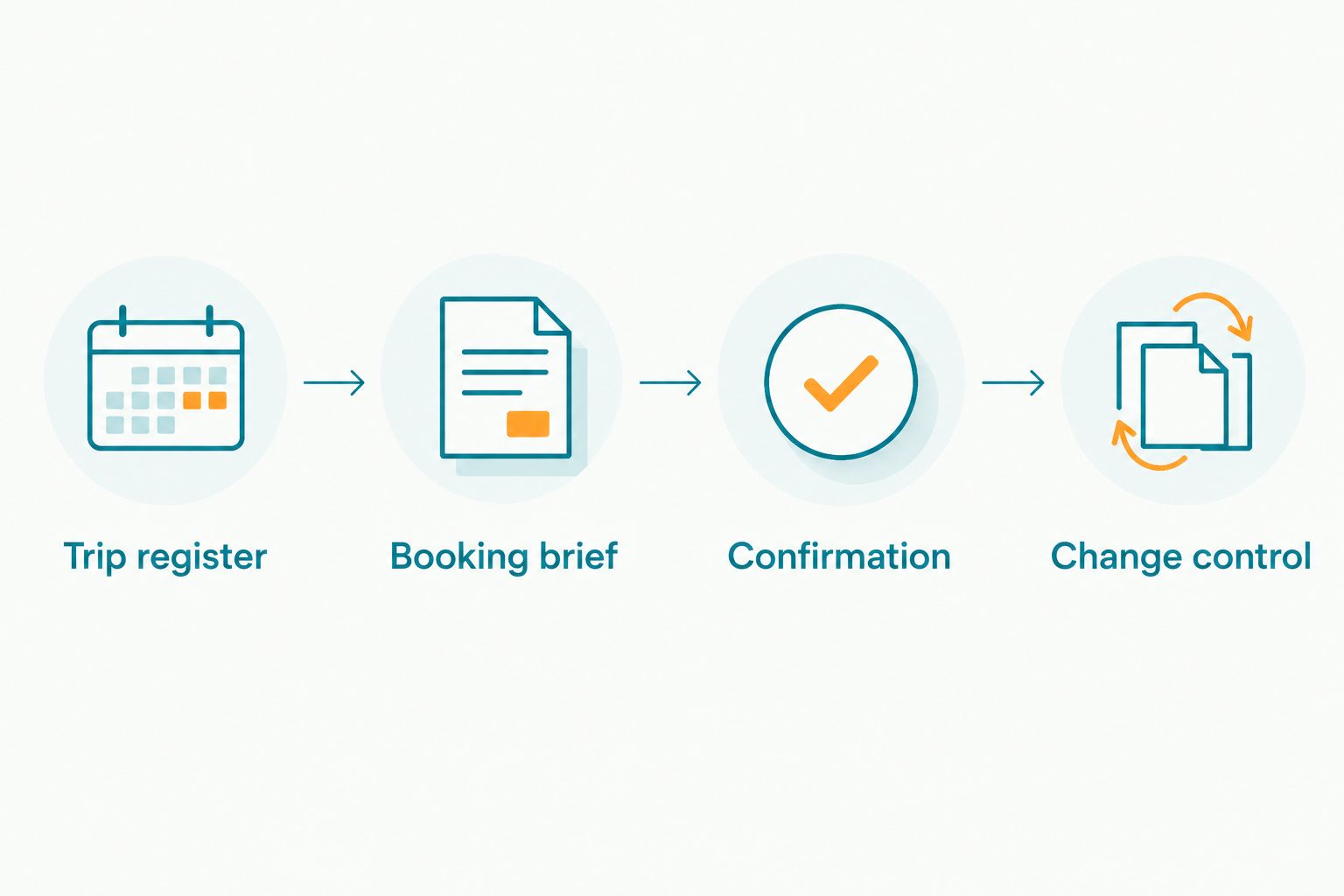
Change control and monthly review
Update individual trips without losing the confirmed version
- When a meeting changes, identify the affected Trip reference first. Record whether the change concerns one journey, a return leg or all future occurrences.
- Add the proposed revision to a Change requested note with the date of the request. State the old instruction and the requested replacement clearly.
- Send the change through the agreed booking contact channel. Ask whether the revised itinerary changes the quoted scope or requires a different arrangement.
- Update the confirmed instructions only after receiving confirmation of the change. Then notify the affected passengers and remove superseded journey briefs from active use.
- At month-end, review completed, cancelled and changed journeys before preparing the next month's request. Carry forward the meeting pattern, not outdated assumptions about addresses or attendees.
For a recurring series running through 2026, set a monthly review even when the meetings appear unchanged. Staff assignments, meeting locations and return requirements still need checking.
Choose an internal review deadline that suits your approval process, and agree booking lead times directly with the provider. Do not present your internal deadline as a supplier policy.
Expected result: a changed meeting produces a traceable transport update, while unaffected bookings retain their original instructions.
Variant: handle moving meetings and multi-stop days
A recurring chauffeur booking schedule also works when the weekday stays fixed but the route changes. Keep the recurring calendar event as a planning reminder, then submit the actual destinations for each date.
For a day involving several client meetings, distinguish between transport needed only between addresses and transport needed across a defined working period. An hourly chauffeur service request describes time-based use, while a point-to-point request describes a particular journey; spell out which requirement you are asking the provider to quote.
Do not infer that waiting between meetings, extra stops or a late finish is included. List the expected sequence and ask for the relevant terms before confirming.
For provincial work, keep the same register but expand the itinerary. The car rental for construction site visits guide is relevant when a recurring business schedule includes field locations rather than office-only appointments.
Your brief should distinguish the site address from the meeting contact's office address. Include access instructions supplied by the host and describe any equipment or luggage passengers will carry.
VPI Cars supports out-of-town Luzon travel as well as Metro Manila trips. Confirm the individual itinerary, dates and vehicle requirements; a destination in a planning document is not itself a confirmed booking.
Troubleshooting
The meeting moved, but the transport instructions did not
Compare the calendar event with the trip register using the trip reference. Send a specific change request and keep the booking marked Change requested until the revised arrangement is confirmed. Do not assume calendar edits reach the provider.
The outward trip is confirmed, but the return is unclear
Check whether the return was requested as a separate leg or as part of a broader itinerary. Supply the return pickup point, expected time and passenger requirements. Avoid treating the end of the meeting as an automatic return booking.
Two departments requested the same journey
Match the travel date, passengers and pickup details before sending another request. Keep one active trip reference and ask the provider to clarify the booking record before withdrawing anything; an internal duplicate does not establish whether two bookings exist.
A meeting runs beyond the planned finish
Contact the agreed booking contact as soon as the change becomes clear. Ask how the extended requirement will be handled and advise passengers of the confirmed arrangement. Do not promise that a driver can remain indefinitely.
The next month's schedule contains outdated details
Review exceptions before copying the register. Check passenger names, office entrances, destinations and return instructions, then obtain approval for the new request. Reusing a template saves typing, not verification.
Customize your workflow
Once the monthly process works, add only the fields that solve a real coordination problem. A department reference helps identify the requester; a passenger contact helps resolve pickup questions; an approval field helps distinguish authorised trips from draft plans.
Keep sensitive meeting notes out of the transport brief. Share the journey information needed to arrange the trip, rather than forwarding an entire calendar invitation with unrelated attachments.
For 2026 procurement discussions, present the recurring pattern alongside its exceptions: regular office meetings, variable client visits and planned Luzon travel. That is more useful than asking for a monthly arrangement without explaining how the vehicle would be used.
Send VPI Cars the passenger count, itinerary, rental duration and recurring dates when requesting a quotation. Add the confirmed exceptions so the discussion reflects the journeys your team actually needs.
Discuss your recurring business trips
Share your dates, passenger numbers, itinerary and rental duration for a quotation.
FAQ
How do I create a recurring chauffeur booking schedule?
Create a shared trip register from your recurring meetings, then request a quotation and confirmation for the actual journeys. Record pickup details, destinations, passengers, duration and return arrangements separately from the meeting invitation.
Does a recurring calendar invitation confirm a driver booking?
No, a recurring calendar invitation is a planning record, not booking confirmation. Confirm the transport arrangement directly and record the agreed instructions against each trip reference.
Can I arrange recurring business trips outside Metro Manila?
Yes, VPI Cars supports Metro Manila and out-of-town Luzon travel. Submit the exact destinations, dates, stops and vehicle requirements for confirmation of your individual itinerary.
Should I request transfers or a longer with-driver arrangement?
Request transfers for clearly defined journeys and describe a longer with-driver requirement when transport is needed across several appointments. Ask the provider to confirm the suitable arrangement and terms for the full itinerary.
What details are needed for a monthly chauffeur quotation?
Provide recurring dates, passenger numbers, pickup addresses, destinations, expected duration and return requirements. Include luggage, additional stops and any provincial or overnight itinerary details that affect the request.
What should I do when a recurring meeting changes?
Send a change request identifying the affected trip and the revised instructions. Update passengers after the transport change is confirmed rather than assuming the calendar edit updates the booking.
Can I automate the calendar-to-booking process?
This workflow does not require automation: it uses a calendar, a shared register and direct booking communication. Treat any proposed software connection as a separate requirement to verify before relying on it.
One last thing
Record the return arrangement before sending the outward-trip request. That single check makes you decide whether passengers need a separate return journey, transport between meetings or an arrangement covering the working period.
For each remaining month of 2026, carry forward only the meeting pattern. Recheck the journey details and obtain confirmation for the transport you intend to use.
Related guides
- Connect your HR travel policy to a long-term rental account
- Plan a hotel arrival and chauffeured pickup
- Organise van rental for conferences and events