
Best overall: a compact sedan for solo home visits. Best for equipment-heavy visits: an MPV; best for tight parking: a compact hatchback. This 2026 guide compares vehicle types for healthcare professionals travelling between homes in Manila, with separate recommendations for provincial Luzon routes and larger teams.
- The best vehicles for home-visit healthcare professionals in Manila depend on equipment, passenger numbers and parking access.
- Choose a compact sedan for solo visits, an MPV for larger kits, and a van for coordinated team travel.
- VPI Cars offers self-drive, with-driver and corporate/long-term rentals for Metro Manila and out-of-town Luzon travel.
- Confirm the actual vehicle, equipment fit and written quotation before committing to a recurring rental.
Why your home-visit vehicle choice matters
Your vehicle needs to carry the people and equipment required for each appointment without making every arrival a parking or unloading problem. Start with the working day, not the largest vehicle you can book.
VPI Cars is a practical car rental option for healthcare professionals who need self-drive, with-driver or recurring transport in Metro Manila and Luzon. Review the available car rental services after defining your passenger count, equipment and itinerary; the service arrangement matters as much as the body style.
This guide concerns transport for healthcare professionals and their equipment. For patients who require monitoring, medical assistance during travel or specialist transport, arrange the appropriate medical transport service rather than treating an ordinary rental as a substitute.
What makes the best home-visit vehicle?
Use these criteria to compare the actual vehicles proposed for your 2026 schedule. A category name alone does not establish that your kit will fit.
- Equipment fit: Check the largest case, its loading orientation and how it will be secured. Assess storage with every required passenger seat in use.
- Parking access: Consider building entrances, parking bays, turning space and the distance from the vehicle to the patient's door.
- Repeated loading: Look at boot height, door opening and how easily you can retrieve the item needed at the next appointment.
- Passenger needs: Count the clinician, assistants and driver separately. Do not plan to carry loose equipment on occupied seats.
- Route suitability: Include all destinations, provincial legs, parking arrangements and return travel in the booking brief.
- Driving responsibility: Decide whether a clinician will drive or whether a with-driver arrangement better separates travel duties from the clinical schedule.
Best vehicle types at a glance
The order below prioritises distinct home-visit needs, not vehicle prestige. These are category recommendations, not a statement about specific rental models or fleet assignments.
| Vehicle type | Best for | Standout feature to assess | Key limitation |
|---|---|---|---|
| Compact sedan | Solo urban visits | Separate boot for a modest kit | Boot opening can restrict bulky cases |
| Compact hatchback | Parking-constrained routes | Rear hatch access in a compact body | Equipment can remain visible without suitable coverage |
| MPV | Equipment-heavy visits | Seating and cargo layout | Passenger and equipment space compete |
| Crossover or SUV | Mixed Manila–Luzon routes | Loading access and route suitability | Higher loading position can complicate lifting |
| Passenger van | Coordinated clinical teams | Shared travel for people and equipment | Larger footprint complicates parking and access |
1. Compact sedan: best for solo urban home visits
A compact sedan is the default shortlist for a clinician travelling alone with a manageable set of cases. Its separate boot provides a defined equipment area, while the passenger compartment remains available for personal belongings and an accompanying colleague when needed.
Start by checking the boot opening rather than accepting a description such as spacious. A case can fit inside the boot yet still be awkward to pass through its opening.
Compact sedan pros:
- A separate boot keeps equipment apart from occupied seats.
- A compact body is a practical starting point for assessing residential parking.
- The layout suits a straightforward routine without repeated seat changes.
Compact sedan cons:
- Tall or rigid cases can be difficult to load through the boot opening.
- A larger kit can require a different body style even when passenger numbers are low.
For a planning example involving 1 clinician, list every case carried on a normal day and the occasional extras needed for a specialised appointment. Choose against the fuller requirement rather than the lightest possible load.
Best for: A solo clinician carrying a modest kit between urban appointments.
Verdict — Buy: Choose the compact sedan category when your complete equipment load fits securely without using passenger seating.
2. Compact hatchback: best for parking-constrained routes
A compact hatchback deserves a separate place on the shortlist when access and frequent unloading dominate the day. The rear hatch gives you a different loading arrangement from a sedan, but the usable space depends on the exact vehicle.
Assess the parking location with the hatch open. A vehicle that fits in a bay still needs enough clearance to retrieve equipment without blocking a walkway or entering moving traffic.
Compact hatchback pros:
- Rear hatch access lets you assess the equipment area directly.
- A compact footprint suits a shortlist built around constrained parking.
- Smaller cases can be arranged for retrieval at successive stops.
Compact hatchback cons:
- Cargo shares the cabin environment rather than sitting in a separate boot.
- Folding rear seats reduces passenger space and changes how equipment must be secured.
- Equipment can remain visible unless the vehicle has suitable cargo coverage.
Do not judge fit using an empty vehicle with its seats folded if your actual booking includes an assistant. Ask to assess the layout you will use throughout the route.
Best for: Solo professionals whose main constraint is parking and access at residential stops.
Verdict — Buy: Choose a compact hatchback when its actual loading arrangement solves your access needs without compromising secure storage.
3. MPV: best for equipment-heavy home visits
An MPV is the next category to assess when your kit has outgrown a compact car. Its value comes from the seating and cargo arrangement, not simply the number of seats advertised.
For a planning example involving 2 clinicians, identify which seats must remain occupied and then assess the space left for equipment. A layout that works with seats folded is irrelevant if those seats are needed throughout the day.
MPV pros:
- The body style gives you another option for assessing bulky equipment fit.
- Passenger and cargo layouts can be evaluated against different visit requirements.
- It provides a useful shortlist for a clinician travelling with an assistant and larger cases.
MPV cons:
- Using more passenger seats reduces the space left for equipment.
- Some layouts require awkward reaching to retrieve items behind occupied seats.
- A larger body needs a separate parking-access check.
Before choosing an MPV for a recurring 2026 booking, map where each case will sit and which door you will use to unload it. Avoid a layout that requires moving several bags just to reach the next appointment's kit.
Best for: Clinicians carrying bulky equipment or travelling with an assistant.
Verdict — Buy: Choose an MPV when the occupied-seat layout accommodates your full kit and makes repeated unloading practical.
4. Crossover or SUV: best for mixed Manila–Luzon routes
A crossover or SUV belongs on the shortlist when home visits combine Metro Manila appointments with out-of-town Luzon travel. Compare the actual vehicle against your route and equipment rather than treating the category as automatically more capable.
VPI Cars supports out-of-town Luzon travel. Supply the full pickup location, destinations, dates and vehicle requirements so the quotation addresses the complete itinerary.
Crossover or SUV pros:
- It offers an alternative seating and cargo layout to assess for longer routes.
- A rear hatch can suit cases that are awkward through a sedan boot opening.
- The category gives you another option when an MPV does not meet your preferences or loading needs.
Crossover or SUV cons:
- A higher cargo floor can make heavy cases harder to lift repeatedly.
- Exterior size does not establish usable equipment space.
- The category label does not establish suitability for damaged roads or floodwater.
For your 2026 shortlist, ask about the proposed vehicle's loading height and access before focusing on appearance. Do not select a taller vehicle solely because a route extends beyond Metro Manila.
Best for: Mixed urban and provincial itineraries where the specific vehicle passes the route and loading checks.
Verdict — Hold: Choose a crossover or SUV only when its actual layout offers a clear advantage over a sedan or MPV.
5. Passenger van: best for coordinated clinical teams
A passenger van is worth assessing when several professionals need to arrive together with their equipment. It is a team-transport decision, not an automatic upgrade for an individual clinician.
For a planning example involving 3 clinicians, count all equipment alongside the people. Then check whether the destination has somewhere suitable for the vehicle to stop, unload and wait, if waiting forms part of the proposed arrangement.
Passenger van pros:
- The team can travel together on one shared itinerary.
- One vehicle simplifies agreeing a common departure and arrival plan.
- The layout can be assessed for combined passenger and equipment requirements.
Passenger van cons:
- The larger footprint needs more careful access and parking checks.
- Passenger seats do not establish how much equipment space remains.
- A shared vehicle is less suitable when clinicians need to split into different routes.
Confirm how cases will be secured without obstructing doors or aisles. Do not assume a vehicle with enough seats also has enough safe storage for every person's kit.
Best for: A clinical team following the same sequence of home visits.
Verdict — Buy: Choose a passenger van when shared travel and verified equipment space justify the larger vehicle.
Match the rental arrangement to the working day
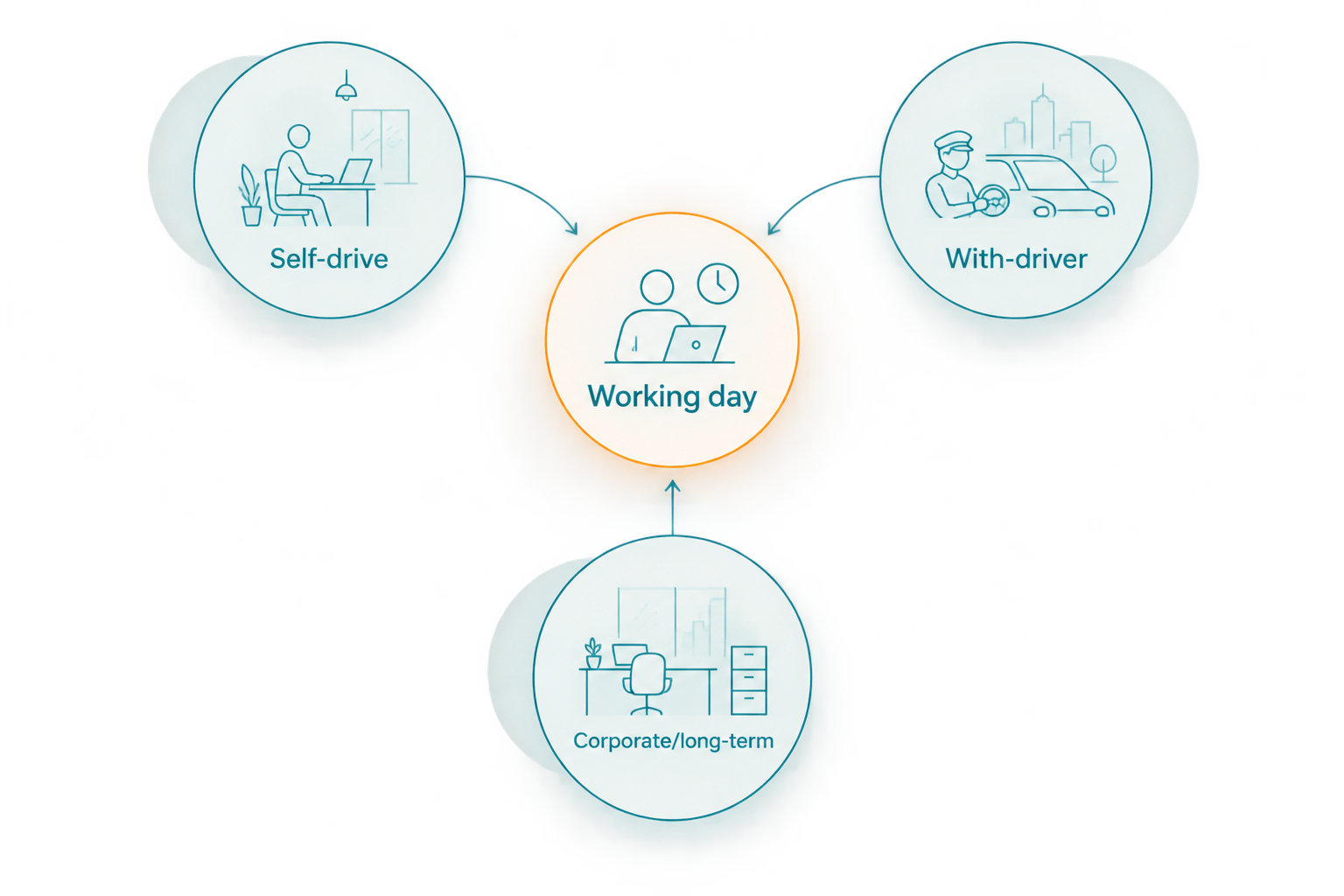
Vehicle choice and driving responsibility are separate decisions. VPI Cars offers self-drive, with-driver and corporate/long-term car rental services; define the working pattern before requesting the appropriate arrangement.
| Arrangement | Best for | Practical benefit | Booking consideration |
|---|---|---|---|
| Self-drive | Clinicians who want to drive | Direct control over driving and stops | You remain responsible for driving and parking |
| With-driver | Multi-stop days without clinician driving | Separates driving duties from clinical work | Confirm stops, waiting and the booked schedule |
| Corporate/long-term | Recurring organisational requirements | Lets you discuss an ongoing transport requirement | Define changing routes, users and rental duration |
- Self-drive: Choose it when driving fits your workload; reconsider it when parking and driving interfere with your appointment responsibilities.
- With-driver: Choose it to delegate driving; confirm how schedule changes and waiting will be handled rather than assuming unlimited flexibility.
- Corporate/long-term: Choose it for an ongoing requirement; confirm the written terms instead of assuming recurring use includes particular account features.
A driver does not remove the need for a realistic itinerary. Confirm destination access, allow for the work required at each stop, and avoid building a schedule around uninterrupted travel.
Prepare a quotation brief before choosing
For a 2026 booking, send the same brief for every vehicle option you compare. That keeps differences in service scope from being mistaken for differences in value.
Include:
- Pickup address, date, start time and expected finish.
- All destinations, visit order and return location.
- Passenger count, including assistants and the driver where relevant.
- Equipment dimensions, handling needs and storage requirements.
- Parking or entrance restrictions already known at each stop.
- Whether the requirement is occasional, recurring or long-term.
- Whether you need self-drive or a driver.
Keep the transport brief operational. Use addresses, access instructions and contact arrangements rather than sharing patient diagnoses or unnecessary clinical information.
Ask the provider to identify the proposed vehicle and confirm what the quotation includes and excludes. For recurring work, explain how often routes change and ask how changes are agreed.
You can contact VPI Cars with this brief to request a quotation tailored to your home-visit schedule.
How these recommendations were ranked
This 2026 ranking uses equipment fit, parking access, repeated loading, passenger needs, route suitability and driving responsibility. Each category has a distinct use case; the order is not a measured performance comparison between individual models.
The compact sedan is the default because it answers a clearly defined solo-visit requirement. Move to another category when your equipment, team or access needs justify it—not because a larger vehicle sounds more professional.
Which vehicle should you choose?
Start with a compact sedan for solo visits, then move to an MPV if the full equipment load does not fit. Choose a hatchback for a better compact loading arrangement, assess a crossover for a specific mixed-route need, and reserve a van for a team travelling together.
For recurring healthcare transport, settle the vehicle layout and driving arrangement before discussing duration. A long-term booking does not correct an unsuitable loading setup.
FAQ
What’s the best vehicle for a healthcare professional making home visits in Manila?
A compact sedan is the default shortlist for a solo clinician with a modest equipment kit. Choose an MPV when larger cases or an accompanying assistant make the sedan layout unsuitable.
Is an MPV better than an SUV for carrying home-visit equipment?
Choose between an MPV and an SUV by checking the actual loading layout, not the category name. Compare usable space with occupied seats, cargo-floor height and access to frequently used cases.
Should I book self-drive or a car with a driver for home visits?
Choose self-drive if you want to handle driving and parking; choose with-driver transport if you want to delegate those duties. Confirm the itinerary, waiting arrangements and schedule-change terms before booking.
Can VPI Cars handle home-visit travel outside Metro Manila?
VPI Cars supports out-of-town and provincial travel within Luzon as well as Metro Manila transport. Submit the complete itinerary, dates and vehicle requirements for a booking-specific quotation.
Can I use an ordinary rental to transport a patient who needs care during travel?
Use appropriate medical transport when a patient needs monitoring, treatment or specialist assistance during the journey. This guide recommends vehicles for healthcare professionals and their equipment, not medically supported patient transfers.
What should I send when requesting a recurring home-visit rental quotation?
Send your pickup point, destinations, schedule, passenger count, equipment requirements and preferred driving arrangement. Explain the rental duration and how often routes change so the quotation addresses the actual requirement.
One last thing
Check the last case you unload, not just whether everything fits. If reaching that case requires removing the rest of the kit at every stop, the vehicle layout needs another look before you commit.
Related guides
- Compact cars for Metro Manila traffic and parking
- Planning a multi-stop day with one driver booking
- Connecting a recurring schedule to monthly chauffeur bookings