
A van rental is cheaper than multiple car rentals only when its total quoted trip cost is lower for the same passengers, luggage, route and schedule. Separate cars can be the better fit when travellers need different destinations or departure times; compare fuel, tolls, parking and driver arrangements before deciding.
- Van rental vs multiple car rentals has no fixed winner: compare total quotations for the same itinerary.
- A van suits passengers travelling together; separate cars suit groups with different destinations or schedules.
- Confirm passenger seating and luggage space together before choosing a vehicle.
- VPI Cars supports group travel planning through self-drive, with-driver and corporate car rental services.
Is a van rental cheaper than multiple cars for group trips?
A van wins on cost only when the complete quotation beats the combined cost of the cars your group actually needs. Comparing a van’s rental charge with the charge for a single car does not answer the question.
For your 2026 trip, ask for both arrangements using the same itinerary. Start with the available car rental services, then specify whether you want self-drive or with-driver quotations so the comparison stays consistent.
| Decision point | One van | Multiple cars |
|---|---|---|
| Best for | A group sharing a route and schedule | Travellers with separate routes or departure times |
| Main advantage | Keeps passengers and the travel plan together | Lets smaller groups move independently |
| Main drawback | Everyone shares the same vehicle schedule | Requires coordination across vehicles |
| Cost comparison | Complete quotation for the proposed van arrangement | Combined quotations for every required car |
| Luggage check | Confirm the whole group’s bags fit with passengers seated | Allocate bags and passengers to each car |
| Driver planning | Confirm the driver arrangement for the van | Confirm the driver arrangement for each car |
| Out-of-town use | Assess against the full Luzon itinerary | Assess each car against its assigned Luzon itinerary |
Do not select either arrangement from the vehicle category alone. A workable group booking starts with who is travelling, what they are carrying and whether they must stay together.
Why this matters
A lower rental charge does not necessarily mean a lower transport bill. A quotation that includes operating expenses is not directly comparable with one that leaves those expenses to you.
The wrong arrangement can also create a scheduling problem. If some passengers must leave a meeting early while others stay, keeping everyone in one vehicle removes that independence—even when the vehicle fits the whole group.
For a useful 2026 comparison, settle the trip requirements before requesting quotations. Otherwise, you risk choosing between different services rather than different ways to deliver the same journey.
One van: Best for a shared itinerary
Choose a van arrangement when the group needs to travel together and the confirmed vehicle suits both passengers and luggage. This fits a shared airport transfer, a family outing or a team visiting the same Luzon destination.
The practical advantage is coordination. You have a shared pickup plan, destination sequence and return arrangement rather than separate vehicle movements to manage.
The trade-off is a shared schedule. An extra pickup, an early departure or a change of destination affects everyone using that vehicle.
Before choosing a van, confirm:
- Whether every passenger has a suitable seat with the planned luggage loaded.
- Whether the pickup and drop-off points work for the whole group.
- Whether passengers need the vehicle during the stay or only for transfers.
- Whether the return journey follows the same schedule for everyone.
Do not treat an advertised seating description as confirmation of luggage space. Send the passenger count and baggage details together, especially for airport journeys and overnight trips.
Multiple cars: Best for independent schedules
Choose multiple cars when independent movement is a requirement, not merely a preference. Separate cars suit a group splitting between meeting locations, different return times or separate accommodation.
The benefit is flexibility. Each assigned group can follow its own itinerary without requiring everyone else to change plans.
The drawback is additional coordination. You need a passenger allocation, luggage allocation and driver arrangement for every car, along with clear instructions about who goes where.
Multiple cars also need a combined cost check. Do not compare the van quotation with only the cheapest car quotation while leaving the other vehicles outside the calculation.
For self-drive, confirm the rental requirements for the people expected to drive. For with-driver travel, describe each car’s schedule separately; identical pickup times do not mean the vehicles will have identical duties throughout the day.
How do you compare the total cost fairly?
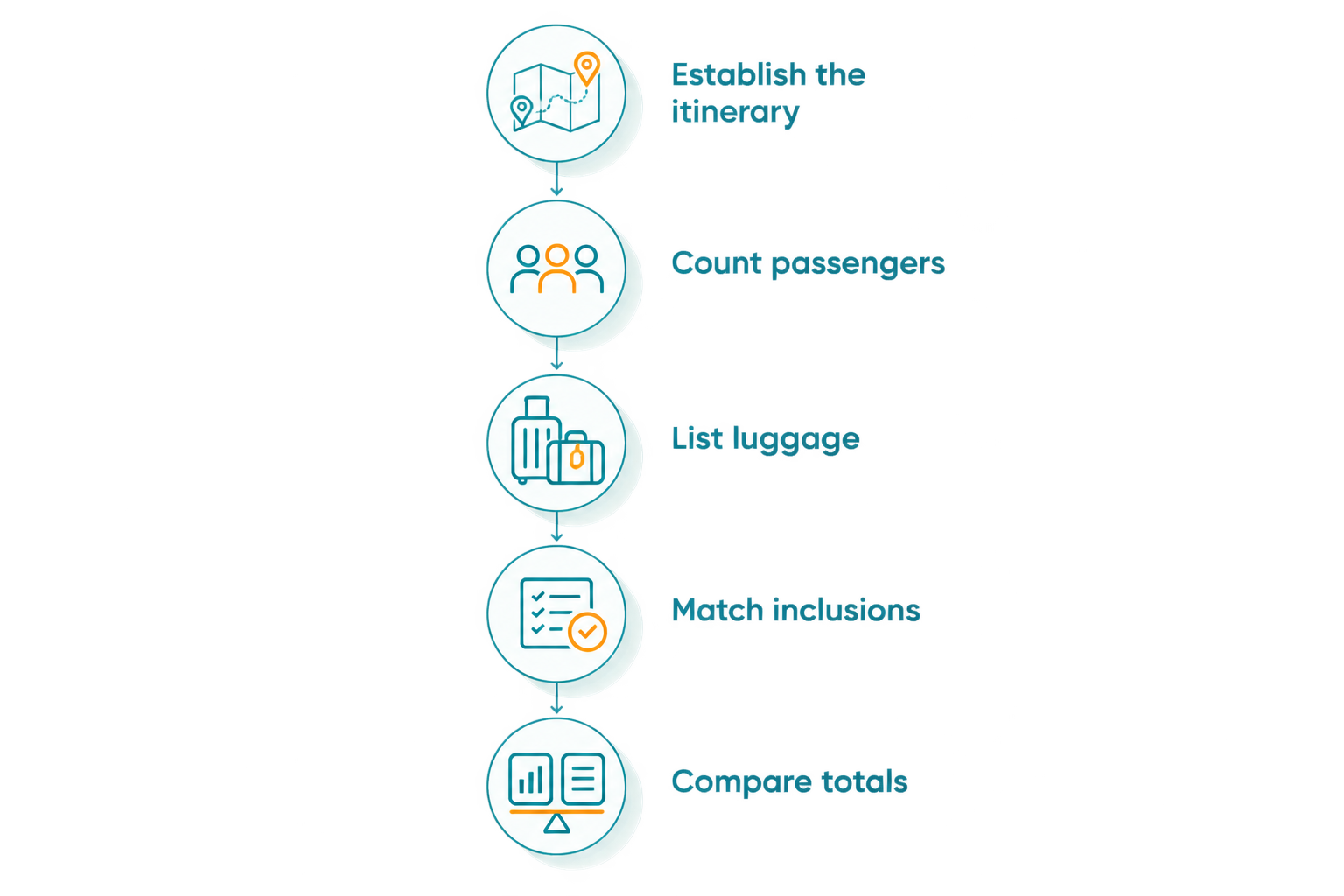
Use these steps for a 2026 booking comparison. Keep the trip requirements fixed until you have checked both proposals, then discuss changes deliberately rather than letting assumptions change between quotations.
Establish the itinerary
Write down the pickup address, destinations in order, required arrival times and final drop-off. Include the return journey instead of describing only the outbound trip.
Separate fixed commitments from preferences. A scheduled meeting start is a different planning constraint from a flexible lunch stop.
Count passengers
Provide the actual travelling group, including anyone joining or leaving partway through. Explain whether everyone must travel together throughout the trip.
Avoid requesting a vehicle solely by its category name. Let the passenger requirements guide the proposed arrangement, then check the details in the quotation.
List luggage
Describe suitcases, equipment, presentation materials and other bulky items. An airport pickup with luggage is a different loading requirement from a meeting transfer with small personal bags.
Ask for confirmation that the proposed arrangement accommodates passengers and belongings together. Do not plan to solve a space problem at pickup.
Match inclusions
Ask what each quotation includes and excludes. Check driver service, fuel, tolls, parking, taxes and the quoted service period where relevant.
Treat these as questions, not assumed fees. A listed item might already be included, excluded or irrelevant to the proposed service.
Compare totals
Add together all required cars and any confirmed expenses outside their quotations. Compare that result with the van arrangement on the same basis.
Choose the lower total only after both proposals meet the trip requirements. An unsuitable arrangement does not become suitable because its initial quotation is lower.
Why the cheaper option varies
The result changes with the booking requirements, not simply the number of vehicles. These factors belong in every 2026 quotation request:
- Passenger and luggage requirements: The proposed vehicles must accommodate both, not just the passenger headcount.
- Route and pickup points: Shared pickups and separate routes describe different transport tasks.
- Service duration: Specify when transport starts, when it ends and whether the vehicle is needed between journeys.
- Driver arrangement: Compare self-drive with self-drive or with-driver with with-driver before assessing mixed arrangements.
- Included expenses: Check the treatment of fuel, tolls, parking and taxes rather than assuming identical inclusions.
- Schedule flexibility: Separate departure times can make independent cars more useful even when travelling together initially looks simpler.
Ask the provider to explain any material difference between the proposals. That explanation should connect to your itinerary or service requirements, not just a broad claim that one vehicle type offers better value.
Should you compare self-drive with a van with driver?
You can compare them as different ways to organise the trip, but they are not equivalent services. A with-driver arrangement includes someone to drive; self-drive requires an eligible renter or authorised driver to take that role under the rental agreement.
For a fair decision, identify who would drive each self-drive car. Confirm that those people are comfortable with the route and available for the full driving responsibility rather than assuming someone in the group will volunteer.
Also consider what the passengers need to do. A colleague who must prepare for a meeting cannot drive at the same time; a with-driver arrangement separates those responsibilities.
Vehicle category alone cannot settle a rental comparison. The same principle applies when examining SUV rental costs: the destination and service scope belong alongside the vehicle type, and figures for New York do not establish a Manila or Luzon quotation.
Compare the transport task, not just the vehicle label. You can prefer self-drive for personal control or with-driver travel to remove driving duties without claiming either is automatically cheaper.
What changes for corporate and out-of-town trips?
For corporate travel, start with the working schedule. A team attending the same site visit has different needs from colleagues splitting between client meetings and returning at different times.
If the journey repeats, describe the recurring pattern rather than presenting it as an isolated day. Include which days require shared transport and which require independent vehicle movements.
VPI Cars is best suited to renters seeking self-drive, with-driver or corporate car rental for Metro Manila and Luzon travel. Out-of-town Luzon journeys are a supported use case; the individual itinerary, dates and vehicle requirements still need confirmation.
A provider’s Metro Manila base does not make a provincial itinerary unsuitable. State the actual starting point, destinations, overnight plans and return requirements so the quotation reflects the complete journey.
For a 2026 business trip, also identify who can approve itinerary changes. A clear decision-maker helps prevent passengers from giving conflicting instructions about stops or departure times.
What should you send when requesting quotations?
Send the same written brief for both options. Ask for a suitable van arrangement and a suitable multiple-car arrangement, with the differences in inclusions explained.
You can use this format:
- Travel date and pickup: Give the date, address and required departure time.
- Passengers and luggage: State the travelling group and describe bags or equipment.
- Destinations: List stops in travel order, including the final drop-off.
- Timing: Identify fixed appointments, flexible stops and the expected return.
- Service preference: Request self-drive, with-driver or a clearly described comparison.
- Separate movements: Identify passengers who need different routes or departure times.
- Quotation details: Ask for the total, inclusions, exclusions and relevant booking terms.
VPI Cars offers car rental with driver, self-drive and corporate/long-term rentals. You can contact VPI Cars with this brief to request a quotation for your specific Metro Manila or Luzon itinerary.
Before accepting, check that the written proposal matches your latest requirements. If the passenger count, luggage or route changes, ask whether the proposed arrangement and quotation still apply.
FAQ
Is a van rental always cheaper than renting several cars?
No. A van rental is cheaper only when its complete quoted trip cost is lower than the combined cost of the required cars for the same journey. Compare equivalent inclusions and schedules.
What is best for a group going to the same destination?
A van is a practical fit when everyone shares the route and schedule and the confirmed vehicle accommodates passengers and luggage. Separate cars remain relevant if some passengers need independent departures.
Should I compare the cost per person or the total booking?
Compare the total booking first, then divide the complete cost among the paying passengers if you need a cost-per-person figure. Use the same passenger group and included expenses for both arrangements.
Does a van’s passenger capacity include space for suitcases?
A passenger seating description does not confirm that your group’s suitcases will fit. Provide luggage details and ask the rental provider to confirm the proposed passenger-and-baggage arrangement.
Can I book group transport outside Metro Manila?
VPI Cars supports out-of-town Luzon travel as well as Metro Manila journeys. Send the full itinerary, dates, passenger count and luggage requirements for confirmation and a quotation.
Is self-drive cheaper than hiring a vehicle with a driver?
There is no fixed winner without quotations for the specific trip. Compare total expenses and inclusions, then account for who will take responsibility for driving each self-drive vehicle.
What if our group needs different return times?
Different return times make separate cars worth comparing because each assigned group can follow its own schedule. Ask how the proposed arrangements handle the separate departures before choosing.
One last thing
Check the return journey before choosing the vehicle. A group that travels together in the morning does not necessarily finish together in the evening.
Write down who returns, from where and at what time. That simple check exposes whether you need shared transport throughout or independent cars for part of the day—before you commit to the wrong arrangement.
Related guides
- Van rental for conference and event organizers
- Is corporate car rental cheaper than individual bookings?
- Is car rental with driver available outside Metro Manila?